Capsicum baccatum is the species behind aji amarillo, the lemon drop and the bishop’s crown. It’s one of the five domesticated species in the genus Capsicum, it comes from South America, and if you want to pick one out, look at the flowers. A baccatum blossom has spots at the base of its petals.

What is Capsicum baccatum?
Capsicum is the genus covering every chili pepper, and five species within it were domesticated. Baccatum is one of them, alongside Capsicum annuum, Capsicum chinense, Capsicum frutescens and Capsicum pubescens. If you’d like the naming explained first, we have a longer explanation of genus and species.
What makes baccatum different is how poorly it mixes with the others. Annuum, chinense and frutescens are close enough to cross, and botanists group them together as the annuum complex. Baccatum is a separate line. A 2015 study in PLoS ONE describes its cross compatibility with annuum as extremely low to nil. The breeders behind that study got their hybrids by rescuing embryos in the lab or by routing the cross through a chinense first.
Why go to the trouble? The same paper lists resistance to anthracnose, powdery mildew, bacterial wilt and several other diseases among the traits baccatum could bring to annuum, along with new flavors.
How do you tell a Capsicum baccatum?
Check the flowers. Baccatum petals are white to cream, and near the base of each one there’s a pair of soft spots, one either side of the central vein. Sources describe them as yellow, tan, green or brown. They all agree the spots are there, though, and among the domesticated peppers they’re the mark of a baccatum.
| Species | Corolla | Spots at the petal base |
|---|---|---|
| annuum | Creamy white | Absent |
| baccatum | White to cream | Present |
| chinense | Greenish-white | Absent |
Anther color gets quoted as a field mark too. Baccatum anthers are usually described as yellow or tan, where annuum’s run blue to purple. But the sources differ on the exact shade, so treat it as a hint and let the spots decide.
Fruit shape won’t get you there. The species covers the long pods of an aji amarillo, which our profile puts at four or five inches, the lobed bishop’s crown, the squat Brazilian starfish and the little round Peppadew. The domesticated form, var. pendulum, does tend to carry its fruit hanging down. Names can mislead you as well, and the one to watch is ají, which six of the thirteen baccatum peppers in our catalog carry.
Is every aji a Capsicum baccatum?
No, and the name causes plenty of confusion. Ají is the word for a chili pepper in South American and Caribbean Spanish, and the Real Academia Española traces it to Taíno. So you’ll find it on peppers from more than one species.
In our catalog, aji amarillo, aji colorado, aji panca and aji pineapple are baccatum. But aji limo, aji charapita and aji dulce are all chinense, and so is Panama’s aji chombo.
A few other names cross the line as well. Lemon drop seed is sometimes sold as aji limo lemon drop, and they’re two different peppers. The rocotillo is two peppers under one name, a Peruvian baccatum and a chinense of unknown descent, and our catalog files it under baccatum. And the rocoto is a pubescens.
When you want to know which species you’ve got, the flower will tell you more than the label.
Which peppers are Capsicum baccatum?
Thirteen of the 178 in our pepper list. Here they are, with the Scoville range we hold on file for each:
- Mad Hatter: 500 to 1,000 SHU
- Aji panca: 1,000 to 1,500 SHU
- Peppadew: 1,100 to 1,200 SHU
- Rocotillo: 1,500 to 2,500 SHU
- Aji Fantasy: 5,000 to 10,000 SHU
- Bishop’s crown: 5,000 to 30,000 SHU
- Brazilian starfish: 10,000 to 30,000 SHU
- Inca Red Drop: 10,000 to 30,000 SHU
- Lemon drop: 15,000 to 30,000 SHU
- Aji colorado: 20,000 to 30,000 SHU
- Aji pineapple: 20,000 to 30,000 SHU
- Aji amarillo: 30,000 to 50,000 SHU
- Aji Omnicolor: 30,000 to 50,000 SHU
Nine of the thirteen come from Peru. Aji Fantasy comes from Finland and the Mad Hatter from the United States, and the Peppadew is grown in South Africa and sold under that trade name. Inca Red Drop and Aji Omnicolor are grown as ornamentals, and the Brazilian starfish does double duty in the kitchen and the flower bed. You can read more about those in our guide to ornamental peppers.
How hot does Capsicum baccatum get?
To 50,000 Scoville heat units at the top of our catalog, a ceiling aji amarillo shares with Aji Omnicolor. That puts the hottest baccatum level with a cayenne at 30,000 to 50,000, and at roughly four to twenty times the heat of a jalapeño, which runs 2,500 to 8,000.
Most of the species runs milder than that. Eleven of the thirteen top out at 30,000 or below, and at the bottom end the Mad Hatter starts at 500, with Peppadew and aji panca just above it.
So where does that leave it against the others? Annuum reaches 100,000 in the same catalog and chinense goes all the way to 3,000,000, which makes baccatum the moderate one of the three. If you like a pepper you can taste through the heat, it’s a good species to explore.
What does Capsicum baccatum taste like?
Sweet and fruity. Every one of the thirteen baccatum peppers in our catalog carries a sweet tag, and eleven carry a fruity one. That’s 85 percent fruity, close to chinense’s 88 percent and a long way from annuum’s 23.
Past that, the flavors spread out: lemon drop, Mad Hatter and Aji Fantasy lean citrusy, while aji amarillo and aji pineapple lean tropical. Our aji amarillo profile describes a clean, sunny taste with hints of tropical fruit and a slightly raisiny finish.
And smoke? It turns up in exactly one of the thirteen: aji panca, which you’ll usually find dried or as a powder or paste.
Where does Capsicum baccatum come from?
South America. The wild form, var. baccatum, grows in southern Peru, Bolivia and southern Brazil. A 2016 genomics paper in Frontiers in Plant Science says the species is thought to have been domesticated in lowland Bolivia or coastal Peru. Other researchers point to the valleys of Bolivia, so the exact place is still open.
Today the domesticated form, var. pendulum, is grown throughout western South America, north into Ecuador and southern Colombia and east to southeastern Brazil.
In Peru it’s deeply rooted in the cooking. Aji amarillo goes into ceviche, and it’s the pepper in the spicy cheese sauce of papa a la huancaína. If you can’t find it, we have a list of aji amarillo substitutes.
Linnaeus named the species in 1767, from the Latin bacca, a berry. The chile writer Dave DeWitt reads the name as a nod to the species’ smaller-podded varieties.
How do you grow Capsicum baccatum?
Plan for a long season and a big plant. Baccatum is a late-maturing species, and when you set out a bishop’s crown or an aji amarillo, you’re putting in something that can end up taller than you’d expect from a pepper.
- Start seed 8 to 12 weeks before your last frost, the window Baker Creek and Sandia give for lemon drop and Aji Fantasy.
- Germinate warm, with the soil at 70 to 85°F. Seed can take anywhere from one week to three and a half to come up, so give a slow tray time.
- Transplant after your last frost, once nights hold at 50 to 55°F.
- Leave space, since seed companies list aji amarillo at three to five feet tall and bishop’s crown at four to five, and the plants can spread about three feet across.
- Allow 80 to 120 days from transplant to ripe fruit. That’s the range across aji amarillo, lemon drop, aji pineapple and Aji Fantasy in our growing data, and Clemson gives 70 to 85 for a typical annuum.
- Somewhere frost-free, it grows as a perennial shrub.
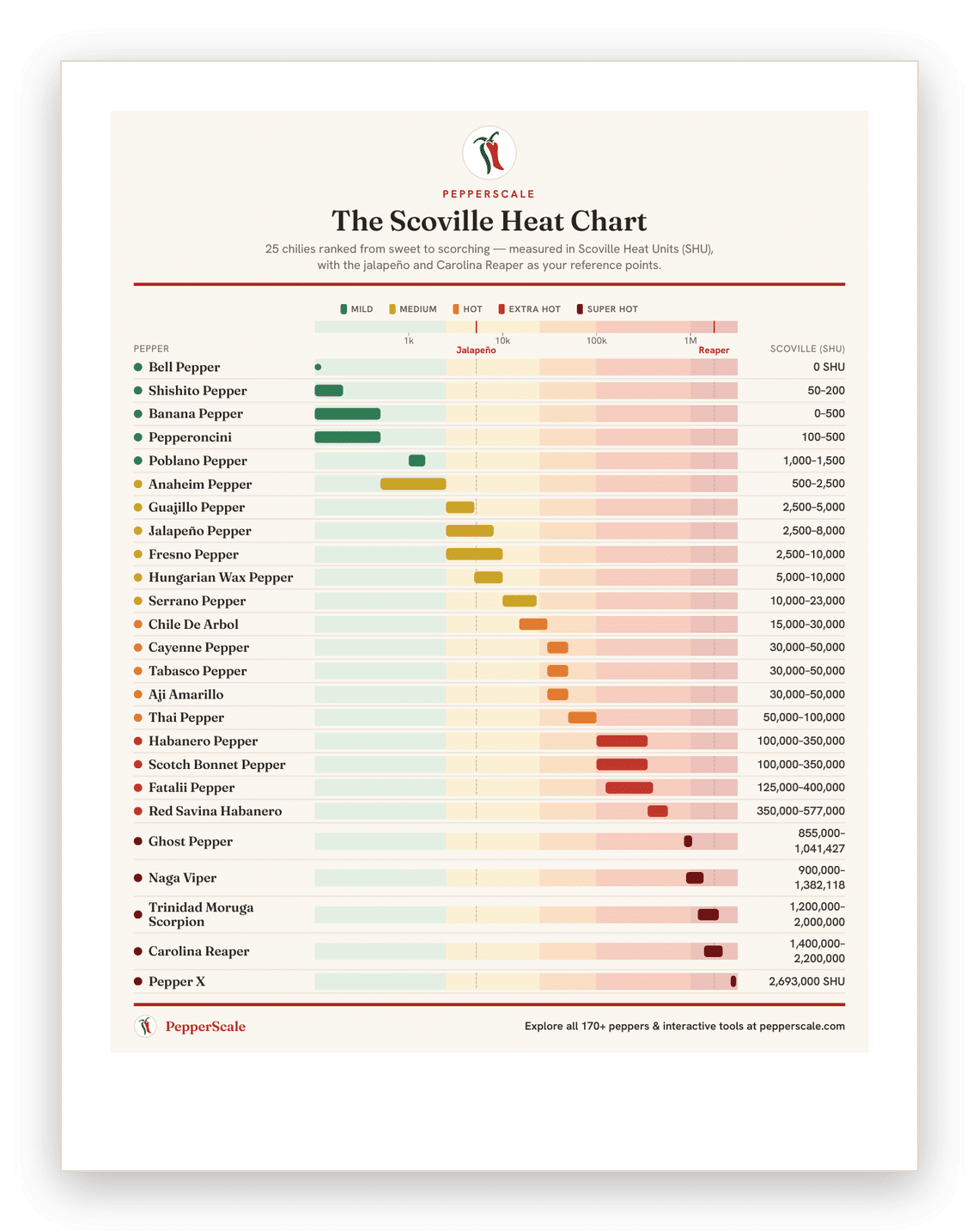
Get the free PepperScale Scoville Heat Chart
A printable, at-a-glance ranking of 25 chilies from sweet to scorching — with the jalapeño and Carolina Reaper as your reference points. Join the newsletter and we’ll send it straight to your inbox.
No spam — just Wicked Wednesday recipes and occasional extra dashes of chili pepper inspiration. Unsubscribe anytime.
Related reading
- Capsicum annuum: bells, jalapeños, cayennes and more than half the peppers on our list.
- Capsicum chinense: the habanero’s species, and the hot end of the genus.
- Capsicum frutescens: tabasco, malagueta and peri-peri, and a close cousin of chinense.
- Capsicum pubescens: the rocoto’s species, with purple flowers and black seeds.
- Genus vs. species: what the two halves of a pepper’s Latin name are telling you.
Photo by: Manuel CC BY 2.0