Capsicum pubescens is the species behind the rocoto and the manzano. It is one of the five chili species people have domesticated, a highland pepper from the Andes. You can spot it the moment you cut a pod open, because the seeds are black, which no other domesticated pepper can claim.

What is Capsicum pubescens?
Every chili pepper belongs to the genus Capsicum, and people domesticated five of its species. Pubescens is one, and the others are Capsicum annuum, Capsicum baccatum, Capsicum chinense and Capsicum frutescens. New to the two-part names? Our genus vs. species primer walks through them.
Pubescens sits in a gene pool with two wild peppers, Capsicum cardenasii and Capsicum eximium, and crosses with them easily. What about the other four domesticated species? Researchers who mapped the genus’s gene pools in PLoS ONE in 2015 found little reproductive compatibility between the pubescens, baccatum and annuum pools. So hybrids between pubescens and the rest are rare and hard to make.
Science has also paid it less attention than any other domesticated pepper. A 2024 study of its genetics calls it the least studied and exploited of the domesticated chiles.
How do you tell a Capsicum pubescens?
Want to know for sure? Cut one open and look at the seeds. Pubescens seeds are black or a very dark brown, a color the other domesticated species don’t have.
The flowers help too. They’re usually purple, though white-flowered plants turn up, and the leaves and stems carry a fine, soft fuzz. Purple flowers alone won’t settle it, since some annuum peppers have them, but if you see purple flowers and black seeds together, you’ve got a pubescens.
| Species | Corolla | Seeds |
|---|---|---|
| annuum | White, occasionally purple | Pale |
| baccatum | White to cream, spotted | Pale |
| chinense | Greenish-white | Pale |
| frutescens | Greenish-white | Pale |
| pubescens | Purple, rarely white | Black |
The pods themselves vary. They can be round, oblong or long, and they ripen red, orange or yellow. And the names change almost everywhere the species is grown, which is where the confusion starts.
Are rocoto, locoto and manzano the same pepper?
As far as the species goes, yes, and the names mostly tell you where a pepper was grown. Rocoto is the Peruvian name, from the Quechua rukutu, and locoto is the Bolivian one, from the Aymara luqutu. In Mexico it’s chile manzano in the State of Mexico, chile perón around Tacámbaro in Michoacán and chile de cera in Veracruz and Puebla.
Our catalog keeps two entries: the rocoto covers the South American pods and runs hotter, and the manzano covers the Mexican ones, named for their apple shape. Our rocoto profile goes into how the two compare, if you want the details.
One name to watch is the rocotillo, which, despite the name, isn’t a pubescens. Our catalog lists it with the baccatum peppers.
Which peppers are Capsicum pubescens?
Our pepper list has over 175 peppers, and two of them are pubescens. Here they are with their Scoville ranges:
The list is short, but the species is far more varied than two entries suggest. A 2026 study in Plants measured 78 different rocoto accessions from Peru’s national agricultural research institute.
How hot does Capsicum pubescens get?
From 12,000 Scoville heat units at the bottom of the manzano’s range to 100,000 at the top of the rocoto’s. The manzano covers much the same ground as a serrano (10,000 to 23,000 SHU) and climbs as high as the point where cayenne starts (30,000 to 50,000 SHU). Against a jalapeño, that’s roughly one and a half to twelve times the heat.
The rocoto picks up at cayenne’s floor and reaches the bottom of a habanero’s range (100,000 to 350,000 SHU), or about four to forty times a jalapeño. And against the rest of the genus? The top of the species matches annuum’s 100,000 ceiling in our catalog, and it’s a long way short of chinense, which reaches 3,000,000.
What does Capsicum pubescens taste like?
If you’re someone who believes they’ve tasted it all in the world of chilies, you just might find that Capsicum pubescens has something new to offer. Both of our pubescens peppers carry a sweet tag. The rocoto adds fruity and grassy notes, and the manzano a citrusy one.
But perhaps most of all, the chilies of Capsicum pubescens set themselves apart from other hot peppers with their meatiness and juiciness. It’s a totally unique eating experience when compared to other peppers, more akin to eating a tomato than a jalapeño. The walls are thick, about 4 millimeters on average across those 78 Peruvian rocotos, and they hold a lot of moisture.
You’ll mostly find them sold and eaten fresh, whether sliced or stuffed with cheeses and meats. Dried rocoto exists, but it’s the exception.
Where does Capsicum pubescens come from?
Bolivia, as far as researchers can tell. That 2024 genetics study places the center of origin in the highlands of central-western Bolivia. Pubescens isn’t known from the wild at all. It exists only as a cultivated plant, and its wild relatives include cardenasii and eximium.
Today it’s grown at mid and high elevations from northwestern Argentina to central Mexico. In Mexico, it’s grown in the cool uplands, at roughly 5,600 to 7,900 feet. Outside the Americas it’s rare, though it has been grown in the mountains of Indonesia for more than a century.
In Peru, it’s the pepper in rocoto relleno, the stuffed rocotos Arequipa is known for. In Bolivia, locotos are the main ingredient in llajwa, the table salsa.
Hipólito Ruiz and José Pavón named the species in 1799, in their Flora Peruviana. Pubescens is Latin for downy, a fair description of those fuzzy leaves.
How do you grow Capsicum pubescens?
Growing your own? Think cool and frost-free rather than hot. Pubescens is a highland pepper, and it wants milder conditions than most chilies.
- Germinate your seed warm all the same. Peru’s national agricultural research institute gives a soil temperature of 75 to 86°F, with seedlings up in about 12 days on average.
- If your summers run hot, expect a struggle. A 2026 review puts its best growth at 61 to 75°F and says performance falls off sharply above 86°F, where a Mexican greenhouse study found flowers failing to set fruit.
- Keep it out of frost, since it handles cool weather well but isn’t frost-hardy.
- You’ll need patience. Fruit takes about 90 to 120 days to ripen after the flower is pollinated, and in Peru the harvest usually starts four to five months after transplanting.
- Leave room, and stake it. Seed companies list rocoto and manzano at three to four feet, plants in Mexican greenhouses have reached nearly nine, and Peru’s growing guidance calls for staking in commercial fields.
- Where winters stay frost-free, the plant keeps going as a perennial and can stay productive for ten years or more.
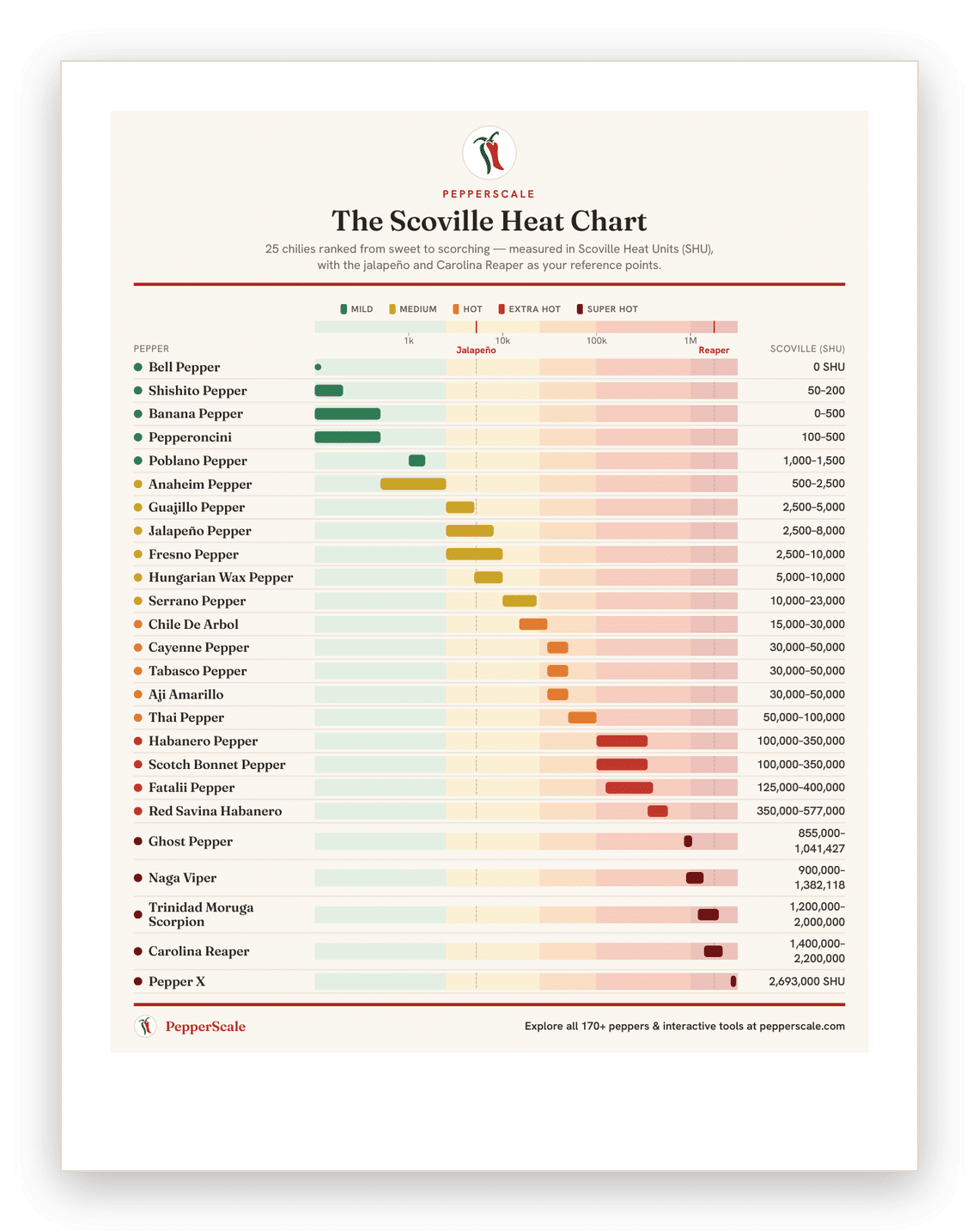
Get the free PepperScale Scoville Heat Chart
A printable, at-a-glance ranking of 25 chilies from sweet to scorching — with the jalapeño and Carolina Reaper as your reference points. Join the newsletter and we’ll send it straight to your inbox.
No spam — just Wicked Wednesday recipes and occasional extra dashes of chili pepper inspiration. Unsubscribe anytime.
Related reading
- Capsicum annuum: 110 of the 178 peppers on our list, from sweet bells to cayenne.
- Capsicum baccatum: aji amarillo and lemon drop, and flowers with spotted petals.
- Capsicum chinense: the habanero and the superhots that hold the heat records.
- Capsicum frutescens: the tabasco pepper and its small, upright pods.
- Genus vs. species: how the two halves of a scientific name fit together.
Photo by: Falcodigiada (Own work) , via Wikimedia Commons

I love the “it can be particularly finicky and somewhat difficult to cultivate” comment. We plant them and have to keep hacking them back, as they try to take over the entire veggie garden. But the flavour and heat profile is right. We tend to use them more in stews, curries and pasta sauces, but they are a lovely chilli. We’re just south of Melbourne…
We grow this chilli in Tasmania, which is the furthest southern State in Australia. The cool climate does not effect its growth or fruiting