Craving shishito peppers with none in the house, or working from a recipe that calls for them? You’ve got options, and which one you want comes down to whether you’re after the eating experience or you’ve just got dinner to make. Here’s the closest match, the one you can grab at any supermarket, and everything in between.

| Pepper | Scoville | Vs. Shishito | Use |
|---|---|---|---|
| Shishitowhat you're replacing | 50–200 | — | — |
| Padron Green & Grassy Closest match | 500–2,500 | ~12× hotter | — |
| Banana Green & Grassy Dials the heat down | 0–500 | ~2× hotter | 2× less |
| Italian Long Hot Green & Grassy Easy to find | 100–1,000 | ~4.4× hotter | 4.4× less |
| Cubanelle Green & Grassy Easy to find | 100–1,000 | ~4.4× hotter | 4.4× less |
| Bell Green & Grassy Easy to find | 0–0 | no heat at all | — |
- Jalapeño Green & Grassy Brings the heat without the smoky that carries Shishito.
Your best alternative: Padrón pepper
Shishito peppers are one of those firecracker chilies where roughly one in ten brings an extra punch of heat. That’s a big part of what makes them fun to eat. Padrón chilies share the same trait: most of the time they’re mild, and every so often you get a surprise.
Padróns are hotter, though. They’re 500 to 2,500 Scoville heat units against a shishito’s 50 to 200, so even a hot shishito doesn’t reach the mildest Padrón. One of the explosive ones’ll land in mild jalapeño territory. Both still sit well down the pepper scale, so this isn’t heat that’s going to chase anyone off.
On flavor they’re close without being identical. The shishito leans citrusy and grassy with a hint of smoke, while the Padrón is nuttier and earthier. You notice it side by side and you don’t notice it much otherwise.
Both are terrific blistered with some oil and salt as a quick appetizer, and that’s what most people are actually asking about. The catch is that Padróns can be just as hard to find as shishitos, so this one’s the right answer only when you’ve got the luxury of hunting.
Your fresh supermarket alternative: Bell pepper
It isn’t an exciting pick, but it’s the one that’s always there. The bell has zero heat to it at all, so it isn’t technically a hot pepper. Then again, a shishito is barely a blip on the scale itself, which puts the bell closer to it than most chilies get.
The flavor holds up better than you’d expect. A green bell’s bright grassiness sits near the shishito’s grassy citrus, and a red bell brings extra sweetness that suits some dishes better. Neither one gives you the occasional hot surprise, so if that’s the point of the dish, this isn’t your swap.
You can blister a bell, but thicker walls and a bigger shape mean you lose the pop-it-in-whole quality. Cut it into strips or squares and treat it as a different dish rather than a copy. What you get in return is a pepper that’s in every grocery store in the country.
On supermarket shelves: Banana peppers
Banana peppers have a similar mild heat profile, running 0 to 500 Scoville heat units, so the burn lines up about as well as anything here. Flavor’s where they part ways. Banana peppers are sweet and tangy, and most of the ones on a shelf are pickled, which pushes the tang further still.
That puts them a long way from the grassy, faintly smoky thing a shishito does. Use them when heat level is what you’re matching and the rest of the dish can carry the flavor. Fresh banana peppers, if you can find them, land closer than the jarred ones do.
Two more worth hunting for: Italian long hots and cubanelles
Two peppers sit between the Padrón and the bell on availability, and both beat the bell on heat. Neither one gets mentioned much here, and that’s a miss.
Italian long hot peppers run 100 to 1,000 Scoville heat units, so they overlap the shishito’s range and go a bit past it. They’re thin-walled, they blister beautifully, and plenty of East Coast markets carry them. Of everything on this page, this is the closest you’ll get to the shishito eating experience without buying shishitos.
Cubanelles land in the same 100 to 1,000 range and turn up in most supermarkets with a Latin section. They’re sweeter and larger than a shishito, so they’re better sliced than popped whole, but the thin walls blister the way you’re after.
One to skip: jalapeños and anything hotter
Jalapeños get suggested for this and they shouldn’t be. At 2,500 to 8,000 Scoville heat units a jalapeño is somewhere between twelve and forty times a shishito, and that’s before you get to the flavor. Serranos and anything above them are further off still.
The problem isn’t only the burn. A plate of blistered shishitos works because you can eat one after another without thinking about it, and the occasional hot one is a surprise rather than the baseline. Swap in a chili that’s hot every time and you’ve made a different dish, whatever the recipe card says.
Match the substitute to the dish
- Blistered and eaten whole: Padrón first, Italian long hots second. Both are thin-walled enough to char fast and small enough to eat in one go, which is the entire point of the dish and the thing a bell can’t do.
- Sliced into a stir fry or a rice bowl: Cubanelle or green bell. Once the pepper is cut up, the pop-in-whole quality stops mattering and you’re just after grassy sweetness and a bit of body.
- Anywhere heat level is the thing you’re matching: Banana peppers, fresh if you can get them. They land in the right Scoville band and let the rest of the dish supply the character.
- Pickled, on a sandwich or a salad: Jarred banana peppers or pepperoncini. Shishitos aren’t really a pickling pepper, so this is a swap of one idea for another rather than a like-for-like.
- Tempura or anything battered: Italian long hots, cut to length. You want a thin wall that softens under the batter, and a bell’s thickness works against you there.
How much should you use?
Shishitos are mild enough that most swaps are about count and size rather than heat. Two exceptions are worth watching.
- Padrón for shishito: One for one by count. They’re a similar size and shape, and though the Padrón is hotter, both are mild enough that a straight swap won’t hurt anyone who eats chilies at all.
- Italian long hot for shishito: Roughly one for two, since a long hot’s a good deal bigger. Cut them into shishito-length pieces if the recipe’s counting peppers rather than weighing them.
- Bell for shishito: Go by weight, not count. One medium bell covers a handful of shishitos, and since the bell brings no heat at all you’ll want a pinch of red pepper flakes to put some back.
- Banana pepper for shishito: One for one fresh, and rather less if they’re pickled. The brine carries a lot of acid, and a jarred pepper will move a dish further than its Scoville rating suggests.
Our pepper conversion tool handles the heat math for any two chilies, and the dish heat calculator shows where the finished dish lands.
Pulling it all together
Nothing on this list is a true shishito replacement, because a shishito’s doing something slightly odd: it’s mild enough to eat by the handful, and then one in ten bites back. Padrón is the only pepper here that keeps both halves of that. Everything else trades one for the other, and the honest question is which half your dish needs. If it’s the eating experience, hunt down Padróns or Italian long hots. If it’s Tuesday and you need dinner, a bell pepper won’t embarrass you.
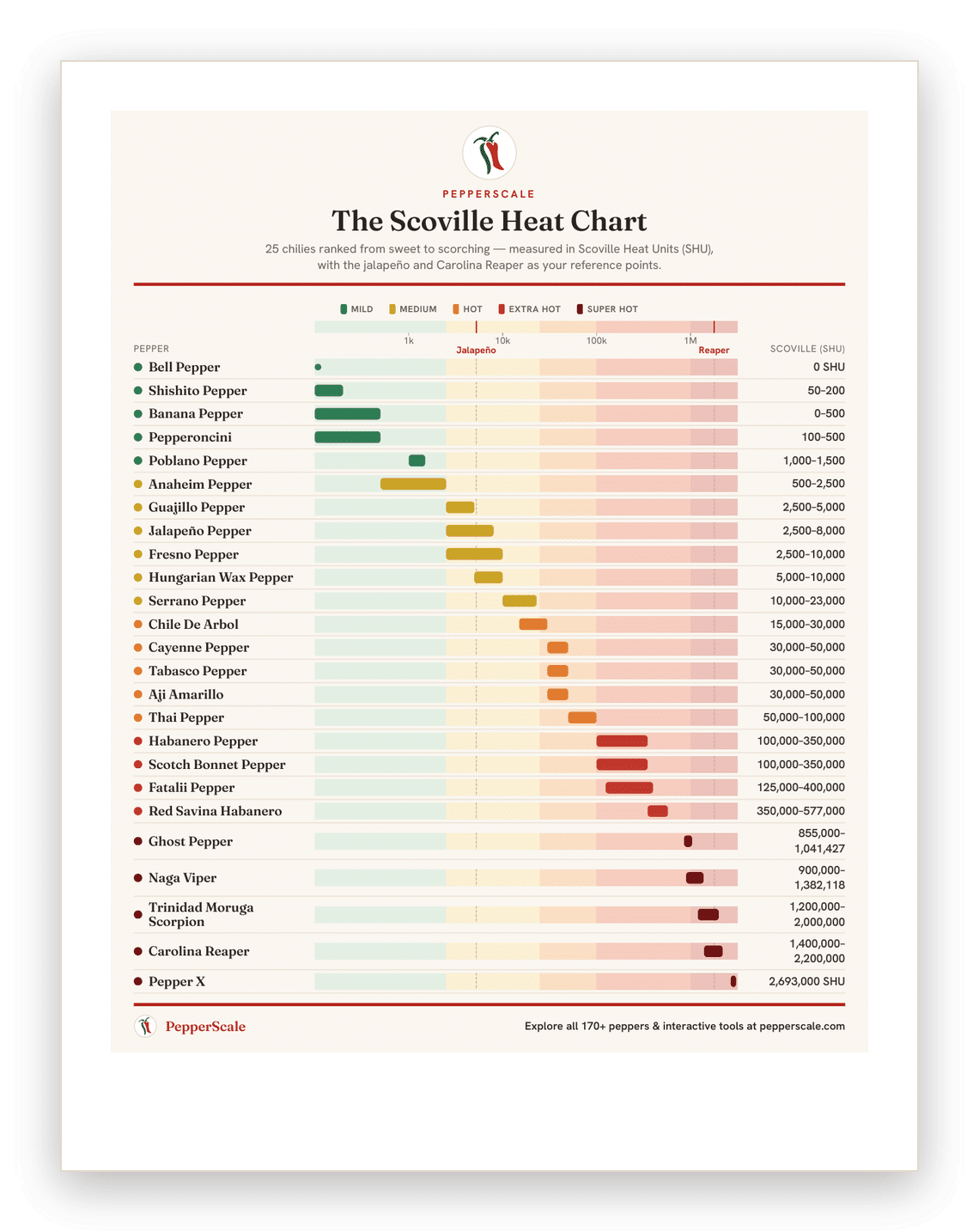
Get the free PepperScale Scoville Heat Chart
A printable, at-a-glance ranking of 25 chilies from sweet to scorching — with the jalapeño and Carolina Reaper as your reference points. Join the newsletter and we’ll send it straight to your inbox.
No spam — just Wicked Wednesday recipes and occasional extra dashes of chili pepper inspiration. Unsubscribe anytime.
Related reading
- Anaheim Pepper: Another mild chili built for roasting and blistering, and one you can actually find. A good next stop if the Padrón hunt comes up empty.
- Pepperoncini: The other jarred mild pepper you’ll run into, and a useful comparison if banana peppers are where you landed.
- Bell Pepper Substitute: Working the problem from the other end: what to reach for when the bell is the thing you’re out of.