Your nose runs when you eat spicy food because capsaicin sets off a nerve reflex that tells the glands in your nose to start pouring. It isn’t an allergy, and your body isn’t flushing out a threat. It’s closer to a wiring quirk: the nerve that reports burns in your mouth also serves your nose, so when chili heat trips it, everything downstream fires at once. Below is what happens step by step, why your eyes water and your face sweats along with it, and whether any of this does a thing for a stuffy nose.

Why does your nose run when you eat spicy food?
Capsaicin, the compound that makes chili peppers hot, binds to a receptor called TRPV1 that sits on trigeminal nerve endings in your mouth and nose. The real job of TRPV1 is reporting heat and damage. Capsaicin opens it chemically, so the nerve fires a burn signal when nothing is actually burning.
That signal doesn’t stop at the pain. It feeds a reflex. The trigeminal nerve passes the message to a junction of nerve cells behind your upper jaw called the sphenopalatine ganglion, and the fibers leaving it release acetylcholine onto the glands that line your nasal passages. Those glands have one job. They start working.
And that’s the whole thing. A sensory nerve reports a burn, a reflex hands the message over to the gland nerves, and the glands run. No immune reaction is involved and nothing is being flushed out. The fluid comes out thin and watery because that’s what those glands make when acetylcholine tells them to go.
What is gustatory rhinitis?
Gustatory rhinitis is the medical name for a runny nose brought on by eating. Gustatory means triggered by eating, and rhinitis covers just about anything that makes a nose run. It’s classed as non-immunological, the clinical way of saying that no allergy is involved.
The giveaway is what you don’t get. Gustatory rhinitis is a clear, watery run from both nostrils that starts within a few minutes of the first bite and stops on its own. It arrives without the itching, sneezing, blocked nose and facial pain that ride along with an allergic reaction.
And chilies are not the only trigger. Onions, vinegar and mustard set it off in plenty of people, and so does food that is simply hot in temperature. If a bowl of plain noodle soup makes your nose run, nothing is wrong with you.
Why do your eyes water and your face sweat too?
Your eyes water for the same reason your nose runs, and the link is more direct than you’d guess. The sphenopalatine ganglion doesn’t only feed the glands in your nose. It also feeds the lacrimal gland, the one that makes tears. One junction, two taps, and chili heat opens both.
Sweating runs on a separate circuit. TRPV1 reports heat, and your brain gets no footnote explaining that this particular heat is chemical, not real. It responds the way it does to actual heat. You sweat, your face flushes, and a hot curry leaves your forehead damp on a cold day. Same receptor, different part of the body, and that’s also what sits behind chili burn on the skin.
Is it the same with horseradish, wasabi and mustard?
Close, but through a different door. The bite in horseradish, wasabi and mustard comes from allyl isothiocyanate rather than capsaicin, and it works on TRPA1, a sibling of the TRPV1 channel that capsaicin uses. Different receptor, same trigeminal nerve, same reflex waiting at the end of it.
The practical difference is that allyl isothiocyanate is volatile and capsaicin is not. It lifts off the food as a vapor and travels straight up into your nose, and that’s why wasabi hits you behind the eyes while chili stays on your tongue. Same runny nose, reached by a different route. We go deeper on that split in pepper heat versus horseradish heat.
Is a runny nose from spicy food an allergy?
No. An allergy means your immune system has singled out a protein and built antibodies against it, and this reflex skips the immune system altogether. The pattern gives it away: a food allergy doesn’t care whether the food is spicy, and this only happens with food that carries heat or a bite.
But the line matters. A clear watery nose, watering eyes and a flushed face during a spicy meal is this reflex doing its ordinary thing. Swelling of the lips or tongue, hives, a tight chest or trouble breathing is something else, and that is something to take to a doctor, not to a food blog.
Does spicy food actually clear your sinuses?
Partly, and it turns on what you mean by clear. A runny nose and a blocked nose are two different problems in two different tissues, and spicy food only acts on one of them.
| A runny nose | A blocked nose | |
|---|---|---|
| What is going on | Glands pouring out thin, watery fluid | Blood vessels in the lining swollen up |
| What it feels like | Dripping, sniffing, reaching for tissues | Cannot get air through |
| What capsaicin does to it | Causes it directly | Leaves the swelling where it is |
So the running is real, and the unblocking is the part to watch. One study put thirty people with colds through a hot drink and the same drink at room temperature. The hot drink produced no significant change in measured nasal airflow. What it did produce was an immediate improvement in how clear their noses felt, and that feeling held for the next half hour.
And that gap between measured and felt is not a fluke. When researchers tested whether the sensation of a clear nose tracks actual airflow, they found no significant correlation between the two. What the sensation tracks is cooling of the nasal lining, picked up by the same trigeminal nerve that started all of this. Your nose judges clear by feel, not by flow.
So a hot bowl of something spicy can really make you feel less stuffed up without opening the airway much. That counts for something when you feel terrible. Just don’t expect it to do what a decongestant does. See our fuller look at spicy food for colds for more.
Will it make your congestion worse afterward?
There’s no good evidence that it will. Rebound congestion is a real thing with a real name, rhinitis medicamentosa, but it comes from a specific group of drugs, and food is not one of them.
The drugs behind it are the topical decongestant sprays that work by squeezing nasal blood vessels shut: oxymetazoline, xylometazoline, naphazoline, phenylephrine and ephedrine. Use one past roughly five to seven days and the vessels stop answering, and the congestion that follows is worse than whatever sent you to the pharmacy in the first place. That’s why the label tells you to stop at three days. Capsaicin works nothing like those drugs, and neither it nor any food shows up on that list.
If anything, the evidence on repeat exposure points the other way. A Cochrane review pooled four trials covering 302 people with non-allergic rhinitis and found that capsaicin nasal spray improved overall nasal symptoms, with benefit still measurable up to 36 weeks after treatment. The proposed mechanism is that repeated capsaicin turns down TRPV1 on the sensory fibers, so the nerve gets quieter instead of louder. Cochrane graded the evidence low to moderate and asked for better trials, so read it as promising rather than settled. The many quick-relief sinus sprays you can buy off the shelf are working from this research, not from the runny-nose effect.
One caveat: That work is a supervised, repeated treatment course for chronic non-allergic rhinitis. It says nothing about whether a hot curry helps a cold.
How do you stop your nose running when you eat spicy food?
- Wait it out. This is the answer most of the time. The reflex runs while you eat and stops when you do, so the fix is a napkin and not a medicine cabinet.
- Turn the heat down without losing the flavor. Less capsaicin means a weaker signal, so a milder chili or a smaller amount of the same one gets you most of the dish with less of the dripping.
- Eat it more often. Repeated capsaicin turns down TRPV1, and that’s the whole basis of the nasal spray research. Whether it carries over to people who simply eat a lot of chili hasn’t been tested directly, so call this one likely but unproven.
- Ask about ipratropium bromide. It’s a nasal spray that blocks the receptors this reflex uses at the gland end, and it can be taken before a meal you know will set you off. It’s prescription, so it’s a conversation with a doctor, not a shopping cart.
The bottom line
A runny nose over a plate of chili is a reflex, not a warning. Capsaicin trips a heat receptor, a nerve junction behind your jaw passes the message along to your nasal and tear glands, and they do the one thing they know how to do. It stops when the meal stops.
It can make you feel less congested, and feeling less congested is not the same as being less congested. Nothing suggests it leaves you worse off afterward either. If it happens every time you eat and it really bothers you, it has a name and it has a treatment, and that’s a short conversation with a doctor.
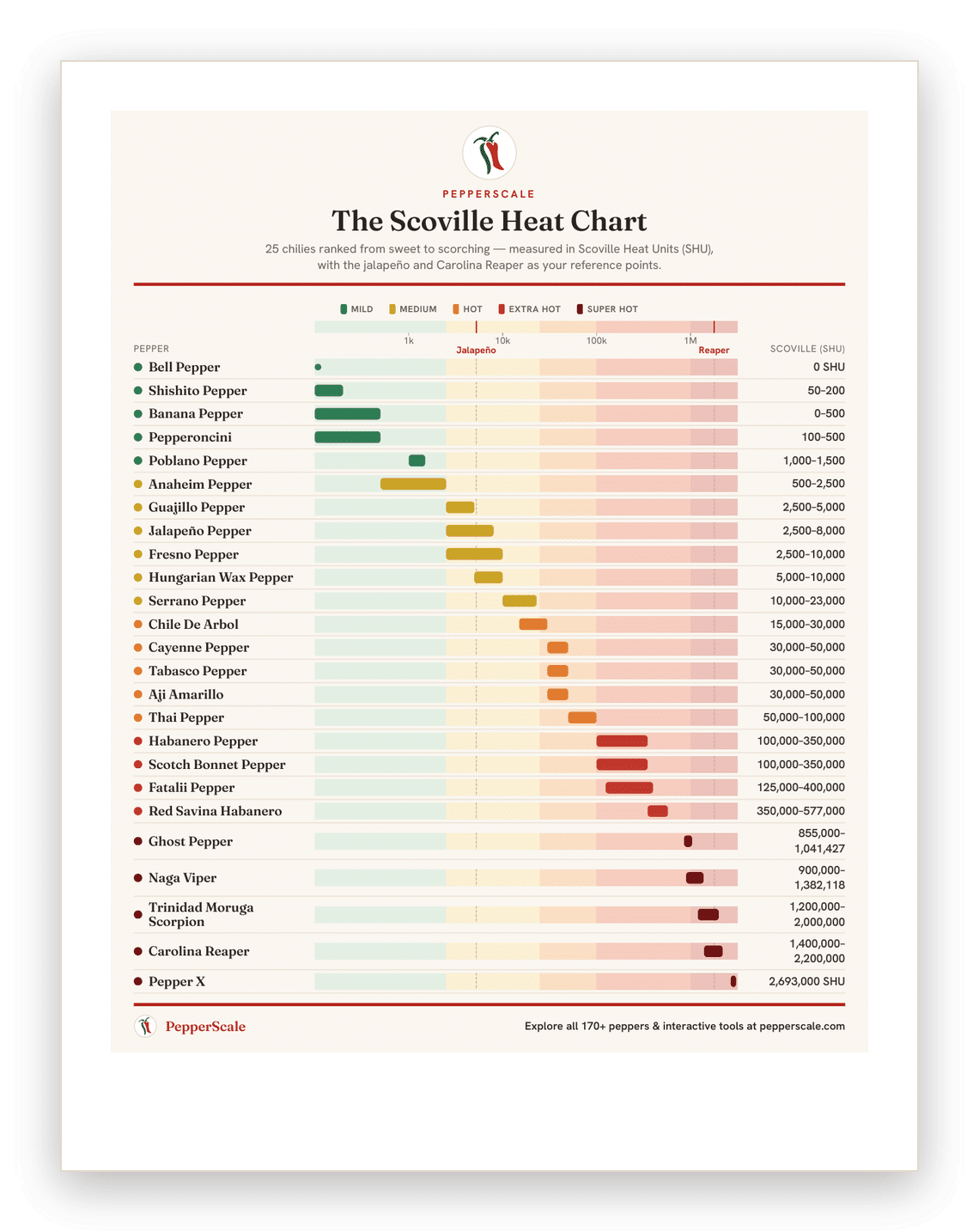
Get the free PepperScale Scoville Heat Chart
A printable, at-a-glance ranking of 25 chilies from sweet to scorching — with the jalapeño and Carolina Reaper as your reference points. Join the newsletter and we’ll send it straight to your inbox.
No spam — just Wicked Wednesday recipes and occasional extra dashes of chili pepper inspiration. Unsubscribe anytime.
Related reading
- Does Spicy Food Affect Metabolism?: The sweating has a twin question behind it, and the calorie-burn claim turns out to be smaller than the internet wants it to be.
- Craving Spicy Food? What Makes Us Want It and Why: If your nose runs every time and you keep going back anyway, there’s a decent body of research on why.
- Do Chili Peppers Cause Cancer?: The other big what-is-this-doing-to-me question about capsaicin, answered against the actual studies.