It may come as a surprise (to some) that bell peppers are botanically chili peppers. What isn’t a surprise (to most) is that bell peppers have no heat. And that’s the answer: a true bell pepper is never spicy. It sits at zero on the Scoville scale every time, in every color, because it lacks a working copy of the gene needed to make the compound behind chili heat. So why do some people swear they’ve bitten into a hot one? They probably have, and you can usually trace it to one of four things, from a lookalike pepper to the seeds a gardener saved last fall.

Why aren’t bell peppers spicy?
Bell peppers are a big goose egg on the Scoville scale. Chili heat comes from capsaicin, and making it takes a working copy of a gene called Pun1. Researchers found that peppers without heat carry a recessive version of Pun1 with part of the gene deleted. A bell pepper inherits that broken copy from both parents, so no capsaicin gets made anywhere in the fruit. No capsaicin means no spiciness. Simple as that.
That’s also why bell peppers are labeled sweet peppers instead of chili peppers. If zero heat is what you’re after, bells have company: plenty of other sweet peppers are mild, too.
Can a bell pepper ever be spicy?
Here is where the confusion occurs. A true bell stays at zero, but a pepper that looks like one can bring real heat. Bitten into an unexpected burn? You’ve probably run into one of these:
- It’s a lookalike. Some chili peppers are bred to look like bells, or simply share the blocky, lobed shape. They can carry anything from a subtle warmth to habanero-level heat.
- It grew from saved seed. If the seed came from a bell that was cross-pollinated by a hot pepper, the plant you grow from it may carry some of the chili’s heat.
- Capsaicin got on it. If you used the same knife, cutting board or hands on chilies first, you can pass the heat along to a sliced bell.
- It’s bitterness, not heat. Green bells are picked young and tend to taste more bitter than ripe red, yellow and orange ones, and some people read that sharp edge as a bite.
How do hot bell pepper hybrids happen in a garden?
To add even more to the confusion: there are popularly sold and commercially grown bell pepper lookalikes and unintentional hybrids grown by unknowing gardeners.
These unintentional bell pepper hybrids occur when a gardener grows bell peppers close to other chili peppers (like jalapeños), then harvests bell pepper seeds for the next year’s growing season. Those seeds may have been cross-pollinated by the hotter pepper, leading to peppers that may look like a bell but contain an unexpected spicy kick when eaten.
Note: these unintentional hybrids don’t happen in the current growth cycle. Any potential cross-pollination does not impact the currently growing plant. Your current crop of bell peppers will be bell peppers, even if planted next to jalapeños or another chili pepper. The seeds inside them are what carry the cross (see University of Illinois Extension’s seed-saving guide). Planning to save seed? Keep varieties well apart, or bag a few flowers before they open.
Which peppers look like bell peppers but are hot?
There are quite a few. How do the common ones stack up? Here’s a quick comparison in Scoville heat units (SHU):
| Pepper | Heat (SHU) | Compared with a jalapeño | How it looks |
|---|---|---|---|
| Bell pepper | 0 | No heat | The real thing, in every color |
| Mexibell | 100 to 1,000 | Much milder | Full bell size, lobed at the base |
| Cajun Belle | 500 to 4,000 | About half as hot | A mini bell, 2 to 3 inches long |
| Rocoto | 30,000 to 100,000 | About 4 to 40 times hotter | Can look like a small bell or a tomato |
| Madame Jeanette | 125,000 to 325,000 | About 43 times hotter | Sometimes like a stretched-out bell |
The Mexibell

The name hints at the hybrid nature of this chili, a cross between a red bell and a hot pepper. The Mexibell looks and tastes a lot like a bell, with a very mild level of heat. It ranges from 100 to 1,000 Scoville heat units, which tops out right where a poblano begins. Green ones barely register; the heat builds as they ripen red. See our full profile on the Mexibell here.
Cajun Belle

This chili also sports a name that hints at its bell-pepper looks. The Cajun Belle, though, has much more of a kick than the Mexibell. It ranges from 500 to 4,000 Scoville heat units. The upper level of its heat places it squarely in the range of milder jalapeño peppers, and a ripe red one is hotter than a green one. As you can see, it looks quite like a small bell pepper, with a comparable flavor as well. See our full profile on the Cajun Belle here.
Then there are the lookalikes that are anything but mild. The rocoto can resemble a bell in shape but runs 30,000 to 100,000 SHU, and the Madame Jeanette can sometimes looks like a slightly stretched-out bell while packing 125,000 to 325,000 SHU. Shopping at a farmers market? Ask before you take a bite of anything bell-shaped you don’t recognize.
Are bell pepper seeds or ribs spicy?
In a bell, they’re as mild as the rest of it. In a hot pepper, capsaicin forms in the placenta, the white inner membrane the seeds cling to, so that membrane and the seeds nearest it carry the most heat. A bell pepper makes zero capsaicin from stem to tip. Cut them out if you dislike the texture; the flesh, ribs and seeds are all equally mild.
Is any color of bell pepper spicier?
Pick any color you like: every true bell pepper is zero heat, whether it’s green, red, yellow, orange or purple. What changes is ripeness, and sometimes the variety. A green bell is picked before it’s ripe, so it tastes more bitter than the others, while red, yellow and orange bells have been left to ripen and taste sweeter. They all stay at zero as they ripen. If you want the sweetest bell, reach past the green ones for a ripe red, yellow or orange.
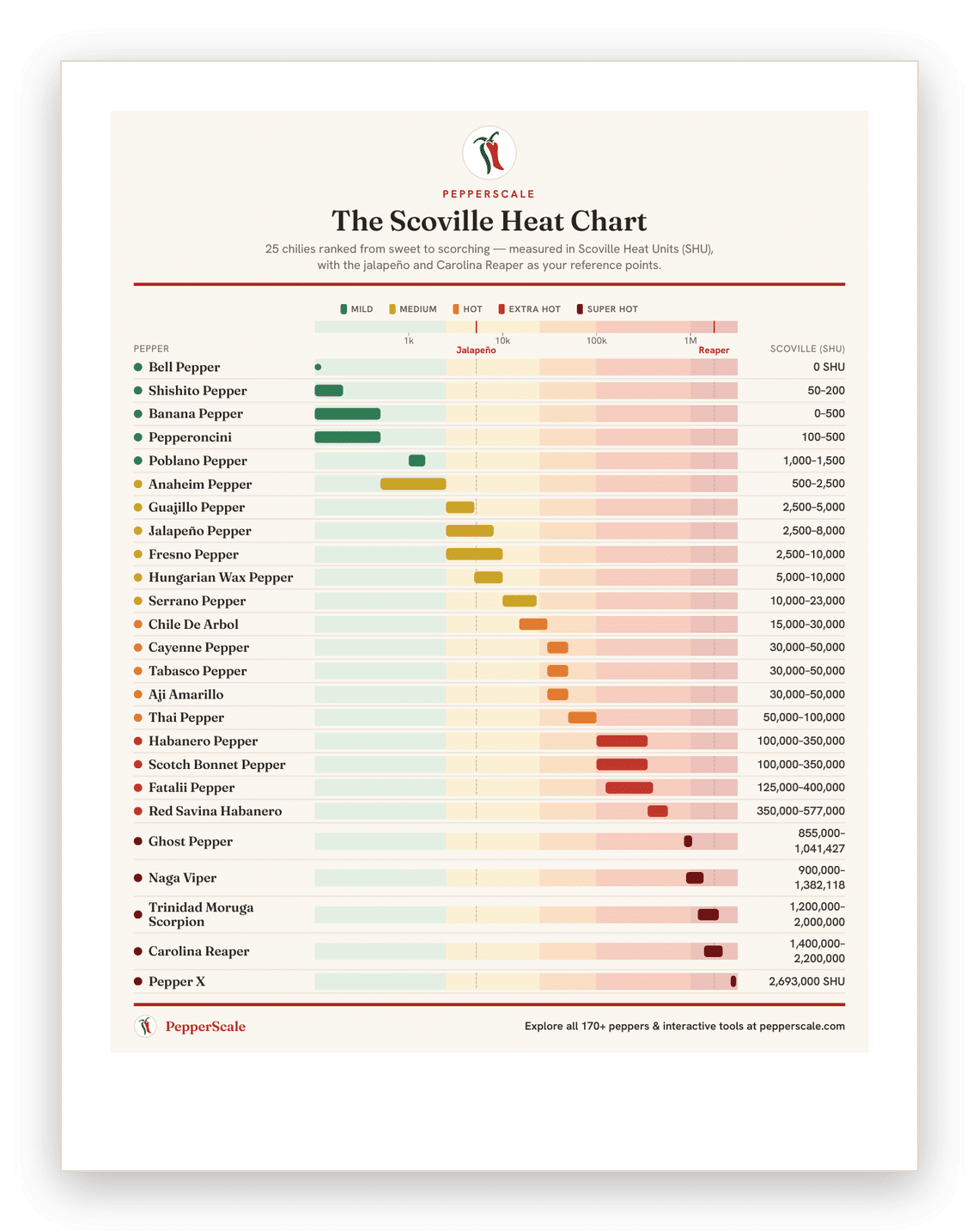
Get the free PepperScale Scoville Heat Chart
A printable, at-a-glance ranking of 25 chilies from sweet to scorching — with the jalapeño and Carolina Reaper as your reference points. Join the newsletter and we’ll send it straight to your inbox.
No spam — just Wicked Wednesday recipes and occasional extra dashes of chili pepper inspiration. Unsubscribe anytime.
Related reading
- Why Are Bell Peppers Different Colors?: What causes those color changes?
- Jalapeños Not Spicy?: Have a crop (or some from the store) that aren’t as fiery as you expected? Here may be why.
- Do Peppers Have Genders?: It’s a common position, but is it true? We cover the fact and fiction here.