Capsaicin, the source of heat behind hot peppers, can help with weight loss, but only a little. In trials with overweight adults, it added about half a kilogram, a little over a pound, of extra weight loss compared with control groups. It nudges your metabolism up by something like 50 to 70 calories a day, and it can take a small bite out of your appetite at a meal. That’s real, and it’s small. It won’t let you eat whatever you want and still lose weight. Here’s what the research shows, how much chili it takes, and what to know before you try a supplement.
A quick note before we get into it: we know chili peppers inside and out, but we’re not doctors. If you’re trying to lose weight, take blood pressure or heart medication, or you’re pregnant or breastfeeding, talk to your doctor before adding capsaicin, especially in pill form. They know your health, and we know peppers.

Does capsaicin help you lose weight?
A little, according to the best evidence we’ve got. A 2023 review of 15 trials with 762 overweight or obese adults found that capsaicin led to about 0.5 kg (1.1 pounds) more weight loss than the control groups. BMI dropped by 0.25 and waist size by about 1.1 cm (under half an inch). The authors called the effects “rather modest,” and that’s fair.
That’s a real effect, but you’d barely notice it on a scale. And it’s an average across trials that used different doses and forms.
How much does capsaicin boost your metabolism?
Not by much. A 2018 analysis of nine studies found that capsaicin and its burn-free cousins, capsinoids, raised energy expenditure by about 59 calories a day and shifted the body toward burning more fat. It’s people with a BMI over 25 who saw the effect, at about 70 calories a day. In studies where the average BMI was under 25, there wasn’t a measurable effect.
An earlier Purdue review came to the same conclusion: capsaicin raises energy expenditure and fat burning, especially at high doses, but the effects are small. You’ll often see a figure of 8% for capsaicin’s metabolism boost. We couldn’t find a study behind it, so we’ve left it out.
Does capsaicin curb your appetite?
It seems to, at least at the next meal. A 2014 analysis pooled 8 studies with 191 people and found that taking capsaicin before a meal cut how much people ate at that meal by about 74 calories. The studies varied a lot, though, so don’t lean too hard on that number.
Does capsaicin turn white fat into brown fat?
That’s mostly been shown in mice. In one University of Wyoming study, mice on a high-fat diet with capsaicin added didn’t gain weight, even though they didn’t eat any less. The researchers think capsaicin turned some of their white fat, the kind that stores energy, into brown fat, which burns it to make heat. They also said it hadn’t been shown in careful human trials.
In people, the evidence is thinner, and it’s mostly about capsinoids. In a 2013 Japanese study, adults who took capsinoids daily for 6 weeks burned more calories when they were exposed to cold, which points to more active brown fat. But their body fat dropped by only about 2%, and that wasn’t statistically significant. You’ll sometimes read that capsaicin gives you the same benefits as working out. Nothing we found supports that.
Does capsaicin help when you’re dieting?
It might help a little. When you eat less, your body tends to burn a bit less too, and that’s working against you. In a 2013 Dutch study, 15 people spent 36-hour sessions in a room that measures how many calories you burn, eating either their full calorie needs or 25% less. With 2.56 mg of capsaicin at every meal, their energy expenditure didn’t drop the way it did on the low-calorie days without it, and they burned more fat. It didn’t raise their blood pressure, either.
It’s a small, short study, and McCormick supplied the red pepper. But it’s a useful one, because it tested capsaicin alongside eating less. That’s the opposite of the popular claim that capsaicin works without cutting calories.
How much chili does it take?
It doesn’t take a lot. The Dutch study’s 2.56 mg of capsaicin per meal came from about 1 gram of ground red chili pepper. That pepper was rated at 39,050 Scoville heat units, which is in cayenne’s range. A teaspoon of ground cayenne weighs about 1.8 grams, so that’s a little over half a teaspoon with each meal.
You don’t need habanero peppers or superhots to get there. And more isn’t always better. Higher doses are harder on your stomach. And the Purdue review noted that nobody knows yet how well people stick with capsaicin over the long run.
Do you need the burn for it to work?
Not necessarily, but the burn-free option’s got less evidence behind it. Capsinoids come from a mild sweet pepper called CH-19 Sweet. They act on the same receptor as capsaicin, but they do it in the gut instead of the mouth, so there’s no burn. They do raise energy expenditure in some studies.
When it comes to weight, though, a 2022 analysis of 13 capsinoid trials with 838 people found no significant effect on body weight, BMI, waist size or body fat overall. There’s a hint of a modest drop in weight in trials that ran at least 12 weeks with overweight people, and the authors called for bigger, longer trials.
Should you take capsaicin supplements?
We’d be careful with them. Capsaicin and cayenne pills are sold as dietary supplements, and the FDA doesn’t have the authority to approve supplements for safety or effectiveness before they’re sold. Doses vary a lot, too. Some research has used 130 to 150 mg of pure capsaicin a day. That’s many times what you’d get from a sprinkle of cayenne.
Memorial Sloan Kettering’s cayenne fact sheet lists sweating, eye and nose irritation, and stomach irritation or pain as side effects. It says people with high blood pressure or heart conditions should check with a doctor first, and that capsaicin may affect blood pressure medications. It also says to avoid it during pregnancy and breastfeeding. If you want to try capsaicin, chili in your food is the easiest way, and it’s how some of the studies did it.
Capsaicin and weight loss: fact or fiction?
- “Capsaicin helps you lose weight.” True, but only a little. In trials with overweight adults, it added about a pound of extra weight loss on average.
- “Capsaicin boosts your metabolism by 8%.” Not supported. The research we found puts the boost at roughly 50 to 70 calories a day, mostly in people carrying extra weight.
- “You can lose weight with capsaicin without eating less.” Fiction. The mouse studies suggested it, but in people the effect is far too small to make up for eating more than you burn.
- “Capsaicin turns white fat into brown fat.” Mostly shown in mice. In people, capsinoids seem to make brown fat more active, but body fat barely changed in the one study we found.
- “Capsaicin gives you the same benefits as exercise.” Fiction. We couldn’t find any research comparing the two, and a few dozen extra calories a day isn’t close to a workout.
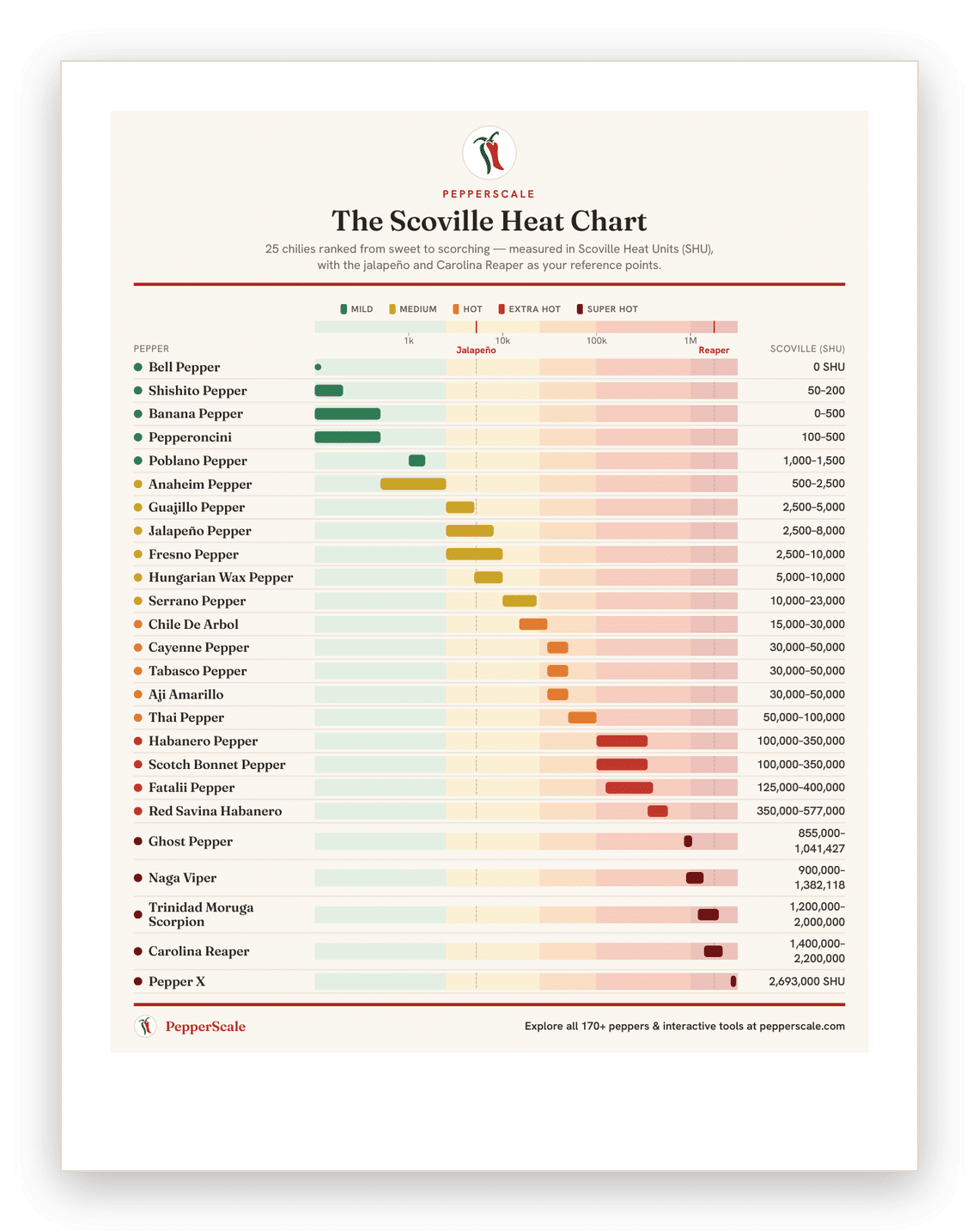
Get the free PepperScale Scoville Heat Chart
A printable, at-a-glance ranking of 25 chilies from sweet to scorching — with the jalapeño and Carolina Reaper as your reference points. Join the newsletter and we’ll send it straight to your inbox.
No spam — just Wicked Wednesday recipes and occasional extra dashes of chili pepper inspiration. Unsubscribe anytime.
Related reading
- Ghost Pepper Nutrition: How Healthy Are They?: What a superhot brings besides heat, and what the research on capsaicin does and doesn’t show.
- Does Hot Sauce Have Calories?: Which sauces come close to zero, and which ones add up.
- Fiber In Peppers: The Fact And Fiction: How much fiber peppers bring, fresh and dried, pepper by pepper.
I will say that as someone who sits for work and has for a while that I usually wait until Im pretty hungry to eat and I do notice that when I take cayenne pepper I can go a little longer. But I heard from an older friend that making the pepper into a paste with water is one way to do it. I use cinnamon in my paste and drink another 16oz of cold water with it first thing in the morning and I feel like it works. NOW ITS NOTHING SIGNIFICANT but its subtle enough to add to… Read more »
Im starting today and I will report my results in a months time
I will be giving this a try….. I will follow up with my updates