If you’re looking to grow sun-like spiciness, there’s little more wicked than the Carolina Reaper, for a decade the hottest pepper in the world. It’s a big plant with a slow start. Its seed may need six weeks to sprout, the plants reach 5 feet or more, and you’ll wait around 90 days after transplanting for red pods.
So don’t approach this chili lightly. The oils of this pepper, even on pods still hanging on the plant, can cause major chili burn. Use gloves when caring for your plants, and double down with kitchen goggles when you’re cooking with the harvest. Still here? Ready for the extreme of extremes? Here’s what you need to know to grow Carolina Reapers.

Last update on 2026-11-17. We earn a commission if you make a purchase, at no additional cost to you.

- Heat
- 1,400,000–2,200,000 SHU
- Start seeds indoors
- 8 weeks before your last spring frost
- Germination
- 7–42 daysIn soil around 70–85°F. Germination is slow and uneven and can take up to 6 weeks.
- Harden off
- 7–14 days before transplanting
- Transplant
- After last frost, once nights stay at 50°F or warmer
- First harvest
- 90 days after transplanting
- Plant height
- 60–72 inches
- Containers
- Can be grown in a large container
Where these figures come from
- Start seeds indoors: Sandia Seed Company, Carolina Reaper
- Germination: PuckerButt Pepper Company, Guide to growing your first Carolina Reaper; Sandia Seed Company, Carolina Reaper; Tomato Growers Supply, Carolina Reaper; University of Minnesota Extension, Growing peppers; Nebraska Extension G1879, Garden Peppers; NMSU Chile Pepper Institute, Special Seed Starting Instructions; Utah State University Extension, Peppers in the Garden
- Harden off: UC ANR, Growing Peppers; Penn State Extension (Chester Co. Master Gardeners), Growing Peppers; Nebraska Extension G1879, Garden Peppers
- Transplant: University of Minnesota Extension, Growing peppers; UGA Extension C1005, Home Garden Peppers; NMSU Chile Pepper Institute, Growing Tips
- First harvest: Sandia Seed Company, Carolina Reaper
- Plant height: Pepper Joe's, Carolina Reaper; Sandia Seed Company, Carolina Reaper; PuckerButt Pepper Company, Guide to growing your first Carolina Reaper
- Containers: Sandia Seed Company, How to grow Carolina Reaper
When to plant Carolina Reapers where you live
A Reaper can’t handle frost, and cold soil leaves it sulking for weeks. The safe window opens after your last frost date, once nights hold at 55°F or above and the top few inches of soil reach about 60°F. In the planner you’ll see that 55°F date alongside the usual 50°F mark.
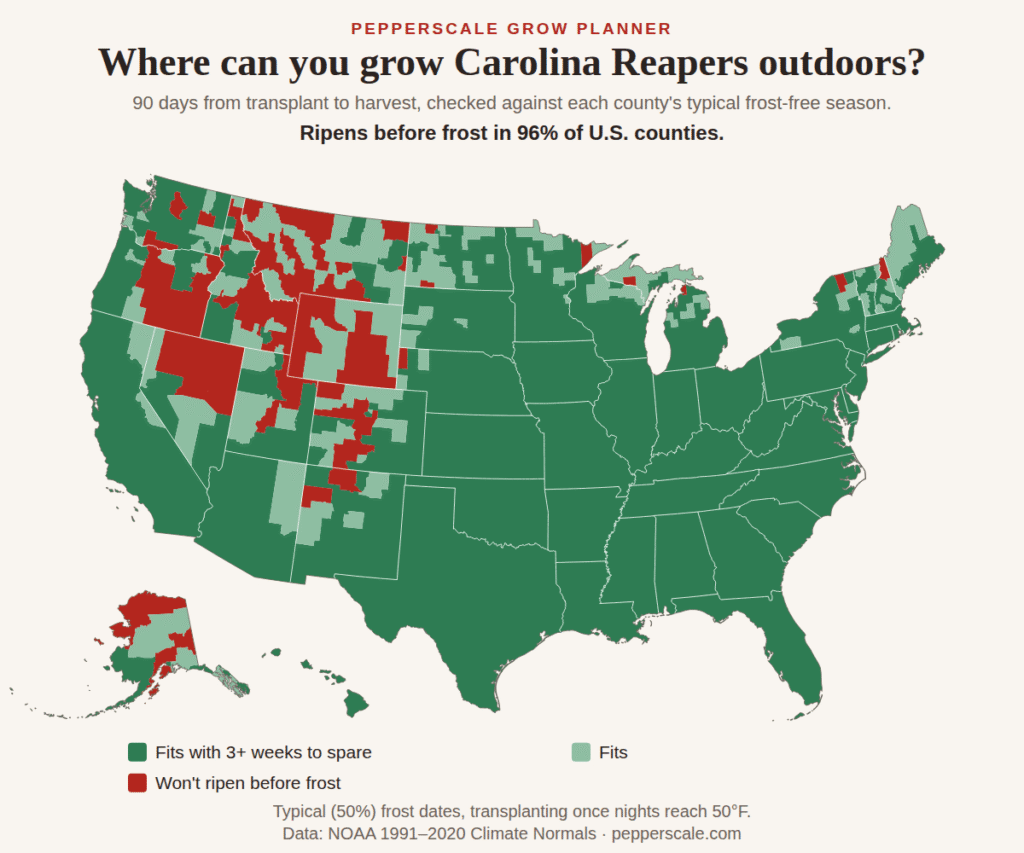
Enter a zip code, and the planner lays out your season from the closest NOAA frost records: sowing day, the start of hardening off, transplant day and a first-harvest estimate. It also tests your summer against the Reaper’s 90 days, and most gardeners pass. According to our county map, the pepper can ripen ahead of fall frost across 96% of the country.
Starting Reaper seeds indoors
Count back about 8 weeks from transplant day and sow then. Reaper seed is slow and wants real warmth, so warm the tray from below with a seedling mat, holding the mix between 80°F and 85°F, and keep it damp rather than soaked. Some seeds pop in a week, others take six weeks, so don’t give up early. Seed from an old packet? Our post on pepper seed shelf life explains what to expect.
After they sprout, put a bright light just above the seedlings and pot them up as they outgrow their cells. Then, in the week or two before planting out, give them a little outdoor time each day, a bit longer every time.
Planting Carolina Reapers outside
Give Reapers the sunniest spot you have. PuckerButt Pepper Company, the Reaper’s originator, calls for full sun all day, and notes that some climates call for a shade cloth.
These are big plants. Expect 5 to 6 feet of height and up to 4 feet of spread, so set them 2½ to 4 feet apart. Drive in a stake or set a cage at planting time, while it’s easy. Need more on layout? See our post on spacing.
Loose soil that drains well suits them, ideally slightly acidic to neutral, pH 6.0 to 7.0. Test first to learn your number, and our pepper soil pH guide covers the fixes.
Once they’re planted, mulch with straw, compost or shredded bark to hold moisture and smother weeds, but keep it an inch or two off the stems. And in a chilly spring, cover the bed with black plastic a few days ahead to give the soil some warmth.
Growing Carolina Reapers in containers
Can you grow one in a pot? Yes, though it’s a large plant for one. Go as big as you can, make sure there are drainage holes, and stake it. By midsummer, a root-packed pot may need a drink every day. Pot size and potting mix are covered in our container growing guide.
A pot does have one big advantage. Peppers are perennial where winters don’t freeze, so you can bring a potted Reaper indoors for the winter and get a head start next year. Our post on growing hot peppers indoors covers the move.
Watering and feeding Carolina Reapers
Plan on roughly 1 inch weekly from rain and hose combined, and water deeply so the roots go down. Steady moisture matters, since wide swings are tied to blossom-end rot, and Reaper seedlings in particular hate wet feet. The planner also lists typical monthly rain near you. For more, there’s our watering guide, plus the warning signs of overwatered pepper plants.
Feed with a light hand. Pile on nitrogen and you’ll grow a huge, leafy plant with few pods. A soil test before feeding tells you what’s missing, and phosphorus only goes on if it shows a shortfall. Our post on fertilizing pepper plants covers the what, when and how, and how to grow hotter peppers looks at what can push the heat up.
When to pick Carolina Reapers
You can pick your Carolina Reapers while they are green, but you will get more heat and flavor from them if you wait for them to ripen. Reapers will turn bright red when they are ripe, starting about 90 days after transplant. Expect wrinkled, bumpy pods 1½ to 2½ inches long, each ending in that pointed tail.
Use pruners to snip each pod, because pepper branches crack if you tug. Note that these are very hot peppers, so handle them carefully. Wear gloves when harvesting, or you may experience one wicked case of chili burn from the oils of these peppers, even from just handling. Read our chili burn remedies before your first harvest.
Frost coming with green pods still on the plant? Harvest them all and see if you can ripen them (somewhat) off the vine. If it’s in a container, carry the plant in instead.
Common Carolina Reaper plant problems
- Lots of flowers, few pods in midsummer: peppers set little fruit once daytime highs climb past 90°F. Check the planner for the weeks that tend to bring that heat.
- Narrow, mottled or misshapen leaves: that can be a mosaic virus. Start with our guide to common pepper plant diseases.
- Clusters of small insects under the leaves: see getting rid of aphids, or look for spider mites.
- Dark, sunken patches at the tip of the pod: that’s blossom-end rot. Our post on calcium and pepper plants explains it.
- Pale, dry patches on the sunny side: that’s likely sunscald.
- Curled or yellowing leaves: start with why leaves curl and why plants yellow.
- A plant that seems stuck: see slow-growing pepper plants.
- An early frost in the forecast: find out what frost does to peppers.
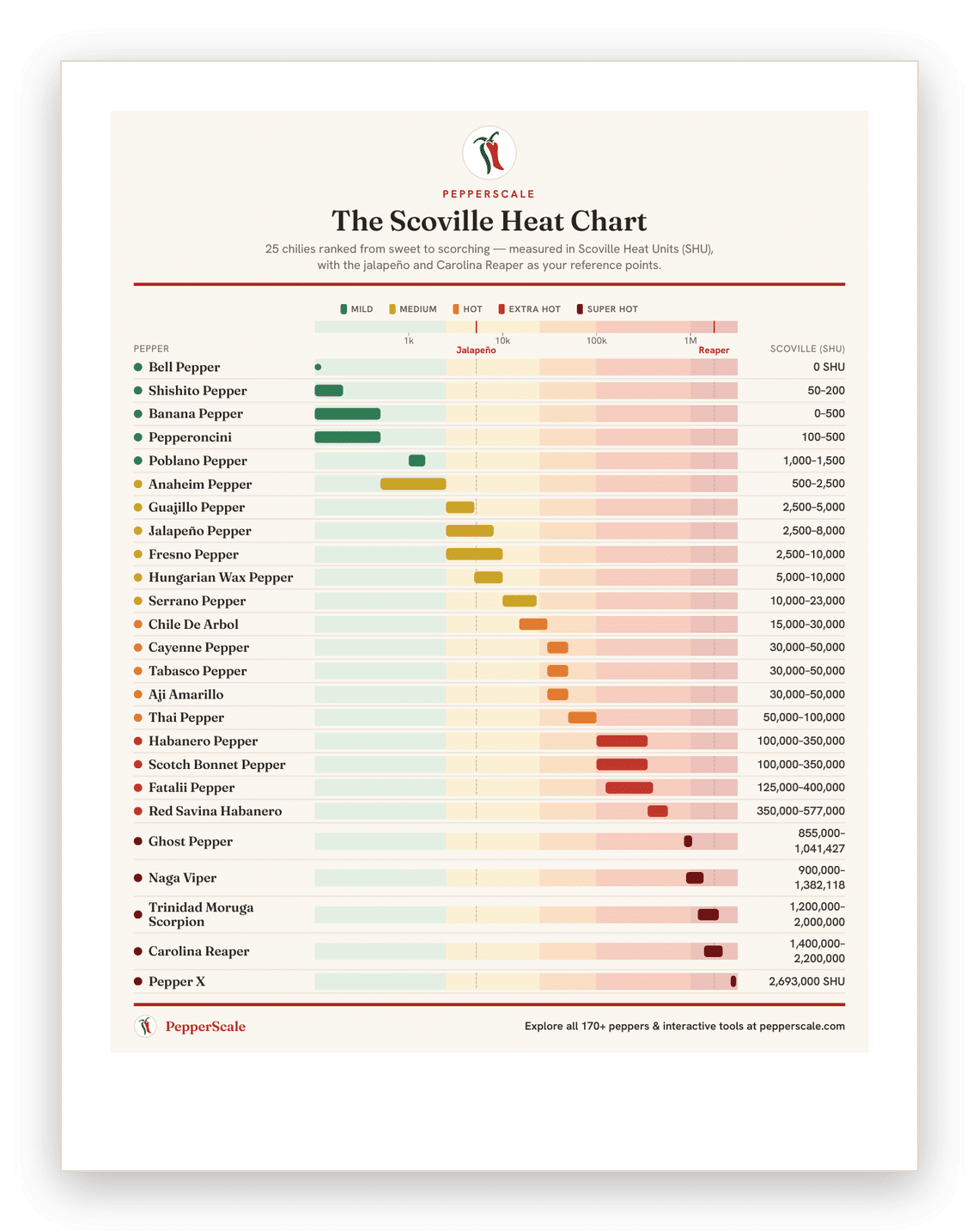
Get the free PepperScale Scoville Heat Chart
A printable, at-a-glance ranking of 25 chilies from sweet to scorching — with the jalapeño and Carolina Reaper as your reference points. Join the newsletter and we’ll send it straight to your inbox.
No spam — just Wicked Wednesday recipes and occasional extra dashes of chili pepper inspiration. Unsubscribe anytime.
Related reading
- The Ghost Pepper Planting Guide: How to raise the ghost, a former record holder that needs an even longer season.
- The Trinidad Moruga Scorpion Planting Guide: Another super-hot with stubborn seed and a long road to red.
- Carolina Reaper Vs. Ghost Pepper: The Reaper and the ghost rank among the best-known super-hots on the planet, but there are a few notable differences, especially in heat.
Can you give a little more direction on fertilizer, brand names that you have had success with , amounts added during bloom , and how to apply this to the plants. I’m a newbie …. Thanks
Very informative Thanks
I’ve grown Carolina Reapers since last year using 5-gallon containers, with great success. I can tell you, though, that these plants are very susceptible to cross-pollination with other varieties of pepper. So, if you live in an agricultural area where peppers are grown, or even if your next-door neighbor is growing a few different peppers outdoors, there’s a good chance that your Reapers will get cross-pollinated and produce odd hybrids that look nothing like the classic Carolina Reapers. In my case, one of my neighbors was growing a couple of varieties of mild hot peppers, and we inadvertently cross-pollinated a… Read more »
Here is my Reaper at 45 days from seed under lamp.
I have a friend who was growing some reapers for me. Unfortunately, he didn’t harvest them and we had our first freeze a few nights ago. The peppers are pretty wrinkled and soft now, but the coloration is still really good.
Are they still good to make a hot sauce with?
Since when is water measured in inches?
i got Carolina seeds and planted them in Uganda a some months ago.
My yield although indeed very hot changed shape completely. The shape is our ordinary small long peppers we call “Kamurali” and not the shape I see online.
I have been told it is a result of Cross Pollination which I cant confirm yet.
The hotness confirms to me that it is indeed Carolina as our ordinary Kamulari is not that hot otherwise I would have thought that I was given fake seeds
I haVe a carolina reaper plant which I have moved indoors. The plant is still green and has small peppers on it. All the leaves are gone. Can I revive the plant and how do I help it stay alive.
I live in Vietnam. I planted this carolina reaper for 5 months. It has a lot of blossoms but just 2 or 3 fruits. Can anyonne help me to produce more fruit? It is full sun and the weather is about 80°F – 95°F. I fertilize it with the following ingredients: N: 12 % ; P2O5: 12% ; K2O: 17%; S + CaO + MgO: 9%; B + Cu + Zn + Fe + MN + Si ≥ 0,4%
Thanks
Hello
I live in the U.K and purchased some reaper seeds of the internet. Temperatures are lower here some the growth process was slow. But I’m starting to think I got ripped off and these aren’t reapers. They don’t resemble the angry looking reaper. But this is the first time I have ever grown any. What do you think they are ? Will they start getting all gnarly looking ? How much longer shall I leave them before picking as autumn is apron us and temperatures are dropping fast.
Thank you.
I live in the Midwest, and I purchased a plant in a pot. $4.00. I was like Ok? lets see where this goes. That was June 29th, the plant was about 10 inches tall. It is now about 14 inches tall, flowers and peppers every where. I have just watered them, and have not added any kind of fertilizer , I will be adding Epsom salt today. My question is, I will want to keep this plant alive, so there for be bringing it in during the winter. Would a grow light help the plant live healthier ? I keep… Read more »
my plant is doing really well. My question is that it says not to over water. My plant is about 4 feet tall with around 200 mostly green peppers. Should I keep it watered more than the two inches a week to allow for growth of this much fruit? I’m in oklahoma temps are around 95 right now.
I seem to remember reading that terroir applies to peppers as well as to grapes and hops. So, in order to get premium results, these (or any) peppers must be grown in the original climate and soil conditions. Any thoughts on this? Also, it could be possible to get hotter peppers with the right terroir.
F or C? Like what temperature measurements, are we talking about here.
Hello I successfully grew the Carolina Reaper last year. It made it through the winter and now I have a Woody stem plant and no leaves. Does it grow again for a second year or third year or do I start a new plant please help thanks Bob
I bought 2 plants they got about 2-3 feet with lots of flowers. one made flowers then peppers(4 in all on one plant) then flowers again but looks like it is about to die now. The other just flowers and is still healthy looking. I live in southeast Texas. Temps have been over 95 degrees maybe even the 100s. I am calling this a success. Just picked the first peppers today.
I live in Hawaii, and as I’m sure you can guess, the climate is tropical and humid. Usually very sunny and around 85-90 during the day, and cool (65-75) and humid at night. I planted 4 each: Carolina Reaper, Trinidad Moruga Scorpion, Naga Viper, Kraken Scorpion. It’s been about 2 weeks, and although I think I may have over-watered, The Trinidads have sprouted, and the reapers and others don’t look to be too far behind. Any tips moving forward from someone with experience in a similar climate?
So, I live in Michoacán, Am I going to have problems with the maturation of my plant?
So my plant was inside over winter, and i put it back outside a few weeks ago, and they just started blooming flowers. My plants are about 1 foot and a half tall
I read that they do not do well indoors.
I find your “A to Zing” very informative. I bought seeds from EBAY about a month ago and when my order arrived, I started to germinate the seeds. I placed 4 per paper (origami) box, ended up six boxes, placed all six in big plastic (like shoebox) container so I may transport them in and out the deck in one carry. I use water spray bottle the wet the soil when I notice the paper box are dry. I hope I started the right way!. I live in Mississauga (Ontario, Canada) where winter can be a hassle clearing my driveway,… Read more »