To say the Trinidad Moruga Scorpion is hot would be like saying the surface of the sun is hot. It’s true, but you’d be really underselling it. The Trinidad Moruga Scorpion pepper is a scorching hot chili (1,200,000 to 2,000,000 Scoville heat units). It’s one of the hottest peppers in the world, and in 2012 it was the hottest ever measured. Like many other super-hots, there is some flavor here, a fruity sweetness, if you can handle the extreme heat. It’s a popular chili for extreme hot sauces, salsas, and other on-the-edge-of-sanity dishes.

Last update on 2026-11-13. We earn a commission if you make a purchase, at no additional cost to you.

- Species
- C. chinense
- Origin
- Trinidad
- Uses
- Culinary
- Closest swap
- Ghost
How hot is a Trinidad Moruga Scorpion, really?
If there could be a category on the Scoville scale named “sweat just thinking about them” hot, the Trinidad Moruga Scorpion would be one of those leading the pack. It ranges from 1,200,000 to 2,000,000 Scoville heat units (SHU), squarely among the hottest of the hottest. The infamous Carolina Reaper comes in hotter (1,400,000 to 2,200,000 SHU), and Pepper X, the Guinness record holder since 2023, averages about 2.69 million. Then there are contenders that aren’t yet fully stable, like the Dragon’s Breath and the Apollo pepper.
Compared to the jalapeño, our reference point, the Moruga Scorpion makes a jalapeño look like child’s play. It’s 150 to 800 times hotter, and roughly 300 times hotter if you line up the middle of each range. Even the still very hot habanero pepper is way distant in overall heat: a Moruga runs roughly 3 to 20 times hotter, depending on which two pods you match up.
And versus a ghost pepper? On paper, the Moruga Scorpion is much scarier, with a median heat about 1.7 times the ghost’s. Grown side by side, the gap shrinks. In New Mexico State University’s 2011 field trial, the Moruga Scorpions averaged 1,207,764 SHU and the ghost peppers 1,019,687. Two of the Moruga plants topped 2 million, the first chili ever reported past that mark, according to the HortTechnology study that reported the trial. The mildest Moruga plant in the trial tested at about 1.08 million, so a 2-million pod is the top of the range, not the norm. Our Moruga Scorpion vs. ghost pepper showdown compares the two in more detail.
Like the ghost, the heat of eating the Moruga Scorpion raw is not something that hits you right away. It takes some time to build. And when it starts, it builds for quite a long time. Paul Bosland, who led that NMSU study, described it this way: “It doesn’t seem so bad, and then it builds and it builds and it builds.” It’s sort of like a fire building from inside of you, and you most likely will experience hiccups, sweating, numbness and even more along the way.
What a Trinidad Moruga Scorpion actually tastes like
Like many other super-hots, there is a flavor here. The Moruga Scorpion has a sweet, fruity taste that tends to grow in depth as it ages on the vine to its final red color. You get that taste typically right at the start of eating the chili, and it’s soon drowned out by the intensity of the spiciness.
Which flavor family is it in? Fruity & Tropical, alongside the habanero and the ghost pepper. In our ratings, fruit leads, sweetness follows close behind, and there’s a faint floral note on top, the same profile we give the Carolina Reaper. So if you know how a Reaper tastes before the heat arrives, you know this one.
How to pair a Trinidad Moruga Scorpion
The sweet, fruity flavor sitting atop this extreme heat does make the Moruga Scorpion a natural to pair with tropical fruits and other sweet ingredients, particularly in extreme hot sauces and salsas. It’s there that this extreme chili shines the most. Mango, pineapple, papaya and peach all echo its fruit, and they let a tiny amount of pepper flavor a big batch.
For contrast, bring in something creamy or rich. Sour cream, yogurt, coconut milk and soft cheeses all help keep the burn in check, and a little honey rounds out a sauce. With a chili this hot, be generous with them.
Want a direction to take it? Allspice, thyme, garlic and lime lead toward the Caribbean, where this pepper comes from. We haven’t added the Moruga Scorpion to the Chili Pepper Flavor Pairing Tool so far, so use the habanero’s matches as your starting list.
Cooking with Trinidad Moruga Scorpions
If you’re using it in general cooking, a Moruga Scorpion can be used to heat up any dish. Just remember, a little goes a very long way when it comes to super-hot chilies. A small sliver can provide enough spiciness for an entire pot of soup or stew. Don’t be heavy-handed here, as its potency can certainly ruin a dish. If you need some ideas on how to temper an over-spiced meal, read our post on making food (in general) less spicy.
These are not chili peppers that you’ll find at your local grocery store, that’s for sure. You’re going to need to buy online to get the best options, including Trinidad Moruga Scorpion seeds, dried scorpion peppers, hot sauces, and seasonings. For most people, their experience with this super hot chili will come in the form of those hot sauces. Two we’ve reviewed: Elijah’s Xtreme Regret leads with Moruga Scorpion and Carolina Reaper, and Devilfish Kitchen Pirate Panic mixes it with ghost, habanero and scotch bonnet.
- Take precautions when handling Moruga Scorpion peppers. Again, this chili sits among the hottest in the world. Handling them, even whole without cutting, can provide severe discomfort in the form of chili burn. When NMSU researchers picked them for their heat study, the capsaicin kept getting through their latex gloves, and the pickers went through about four pairs. So wear kitchen gloves at minimum, especially when cutting. We also recommend wearing kitchen goggles, as one rub of an eye with the capsaicin from the scorpion can be extremely painful.
- Know how to treat chili burn. Do your homework before even touching this chili. Read our post on combatting chili burn (spoiler: milk is #1), as well as our post on how to handle chili burn when it’s in your eye. The latter is specific to jalapeños, but the solutions work for any pepper.
- This chili is often found as dried pods for use in cooking. You can rehydrate the pods or simply grind them into flakes and powders, depending on the use case you need. But a cautionary note: the capsaicin level (the compound behind the heat) is still the same in a dried Moruga Scorpion. Don’t think because it’s dried that you can ignore the precautions listed above.
- Understand how cooking impacts the overall heat of a chili pepper. If you’re cooking with super-hots, the extreme spiciness was likely the draw, and certain cooking methods can change how hot your dish ends up. Read our article, Does Cooking Peppers Make Them Hotter? It will provide the detail you need to maximize (or minimize) the overall spiciness of your recipe.
How to spot a Trinidad Moruga Scorpion
These chilies grow to about 2 to 2½ inches long, roughly golf ball size. The shape is bulbous, sometimes tapering to a short, stinger-like tail. The Moruga Scorpion’s skin is wrinkled and pockmarked, hinting hard at the danger hidden within its wall.
The common variety ages from green to red on the vine. And as the pepper matures and changes color, it also grows in spiciness and flavor (if you can get beyond the extreme heat).
Other scorpion pepper varieties look a lot alike but bring different heat levels, colors and flavors. Here are just a few to compare:
- Trinidad Scorpion Chocolate: the same heat range in a deep brown pod, with a smokier, earthier taste.
- Trinidad Scorpion “Butch T”: 800,000 to 1,463,700 SHU, and the Guinness record holder when the Moruga was tested.
- Apocalypse Scorpion: an Italian scorpion type recorded at 1.4 million SHU and up.
And the Carolina Reaper? Our scorpion pepper vs. Carolina Reaper showdown puts the two side by side.
Where does the Trinidad Moruga Scorpion come from?
The Moruga Scorpion is a landrace, a local pepper passed down by growers rather than a modern bred variety. It comes from Moruga, a village on the south coast of Trinidad, and it’s a Capsicum chinense, the species of the habanero and the ghost.
It made its name in 2012. Researchers at New Mexico State University’s Chile Pepper Institute grew it in a replicated field trial alongside four other super-hots, from seed supplied by San Diego grower Jim Duffy. That February, they announced that it had the highest average heat of the group. It was significantly hotter than the ghost pepper, the record holder they had confirmed five years earlier. At the time, Guinness World Records listed the Trinidad Scorpion “Butch T” at 1,463,700 SHU. The Carolina Reaper took the Guinness title in 2013.
The same study looked at the peppers’ DNA. The Moruga grouped closely with the other Trinidad super-hots in the trial, including the 7 Pot Jonah and the 7 Pot Douglah, while the ghost pepper stood apart. The authors concluded that none of the Trinidad peppers was likely a parent of the ghost.
Growing Trinidad Moruga Scorpions
Want to grow your own? Plan for a slow start. Moruga Scorpion seed can take five weeks or more to sprout, the plants reach about 3 feet, and the pods need a long, warm summer to turn red. Our Trinidad Moruga Scorpion planting guide covers it from seed tray to harvest. For your own sowing and transplant dates, try the Pepper Grow Planner, which works them out wherever you garden.
The best Trinidad Moruga Scorpion substitute
Can’t find one? Look to its relatives first. The Trinidad Scorpion Chocolate matches its heat with a smokier flavor, and the Carolina Reaper brings the same fruity sweetness with a little more heat at the top end.
Prefer to come down the scale? A ghost pepper keeps the fruit at a bit over half the heat, midpoint to midpoint. For the flavor without the danger, use a habanero, and see our habanero substitutes for more options.
The bottom line
So the Trinidad Moruga Scorpion is no chili pepper to be trifled with lightly. Proceed with caution. But there are lots of surprisingly tasty (and mega-hot) sauces and seasonings through which you can try this bad boy of the chili world out. They’ll introduce you to flavors and heat that you’ve never experienced before.
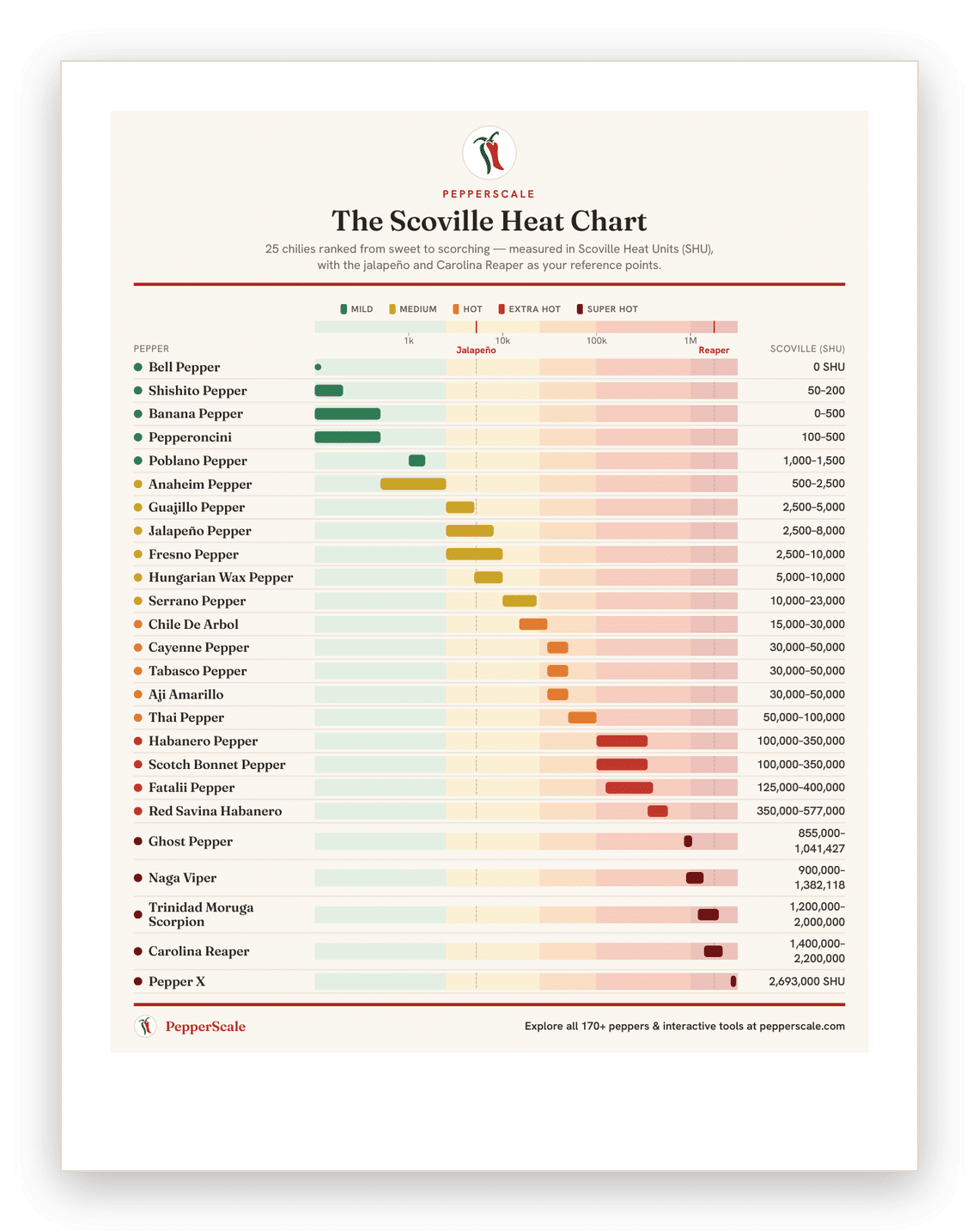
Get the free PepperScale Scoville Heat Chart
A printable, at-a-glance ranking of 25 chilies from sweet to scorching — with the jalapeño and Carolina Reaper as your reference points. Join the newsletter and we’ll send it straight to your inbox.
No spam — just Wicked Wednesday recipes and occasional extra dashes of chili pepper inspiration. Unsubscribe anytime.
Related reading
- Tabasco Scorpion Pepper Sauce Review: Tabasco jumps into the super-hot game with its scorpion-based sauce. We review it in detail.
- The Hot Pepper List: The Trinidad Moruga Scorpion is only one of over 175 chilies that we profile. See our sortable list that covers heat, flavor, uses, origin, and more.
- Our Hot Sauce Rankings: Looking for your next “best hot sauce” to try? We review in detail 100+ hot sauces, covering flavor, heat balance, usability, and collectibility.