Peppers are one of the best everyday sources of vitamin C you’ll find. A cup of chopped red bell pepper has about 190 mg, more than twice the Daily Value and nearly three times what’s in an orange. Peppers are fruits, but most people treat them like vegetables, and when it comes to vitamin C, few fruits or vegetables can keep up with them. How much you’ll get depends on the pepper, how ripe it is and what you do with it, though, and a few popular claims don’t hold up. Below, we’ll go pepper by pepper, and then we’ll sort the fact from the fiction.
Before the numbers, one quick note: we know chili peppers well, but we’re not doctors. If you’re looking at vitamin C for a health reason, whether that’s a supplement, a condition or a diet you’ve been put on, talk it over with your doctor. They know your health, and we know peppers.
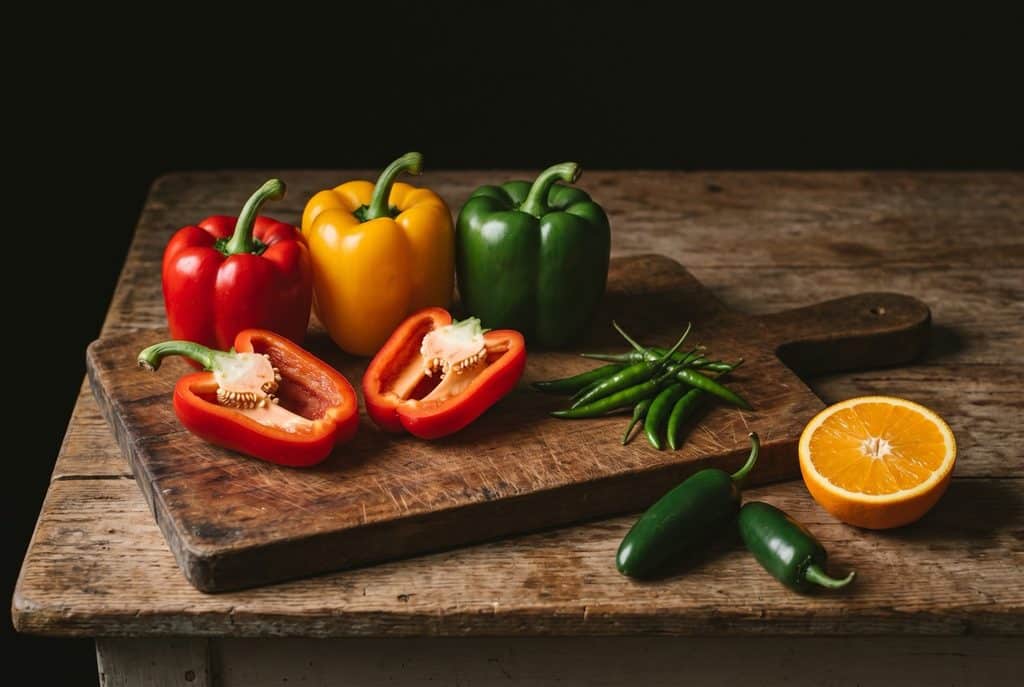
How much vitamin C is in peppers?
It depends on the pepper, but fresh ones usually carry a lot. The Daily Value for vitamin C on food labels is 90 mg, and a cup of chopped bell pepper covers it whether the pepper’s green or red. Here’s how they compare, per 100 grams and per a serving size USDA lists for each.
| Pepper | Per 100 g | Serving | Per serving (% DV) |
|---|---|---|---|
| Green chili, hot, raw | 242.5 mg | 1/2 cup chopped (75 g) | 182 mg (202%) |
| Yellow bell pepper | 183.5 mg | 10 strips (52 g) | 95 mg (106%) |
| Red bell pepper | 127.7 mg | 1 cup chopped (149 g) | 190 mg (211%) |
| Green bell pepper | 80.4 mg | 1 cup chopped (149 g) | 120 mg (133%) |
| Jalapeño | 118.6 mg | 1 pepper (14 g) | 17 mg (18%) |
| Serrano | 44.9 mg | 1 cup chopped (105 g) | 47 mg (52%) |
| Green chilies, canned | 34.2 mg | 1 cup (139 g) | 48 mg (53%) |
| Hot chilies, sun-dried | 31.4 mg | 1 cup (37 g) | 12 mg (13%) |
| Cayenne, ground | 76.4 mg | 1 teaspoon | 1.4 mg (2%) |
| Ancho (dried poblano) | 2 mg | 1 pepper (17 g) | under 0.5 mg (under 1%) |
| Orange, for comparison | 53.2 mg | 1 medium (131 g) | 70 mg (77%) |
The green hot chili comes out on top by weight, but you’re not likely to eat half a cup of them. For the vitamin C you’ll get in a normal meal, bell peppers count for more, since a cup of them is an easy side or salad. A jalapeño or two on a plate doesn’t add up to much of your day.
There’s more than vitamin C in peppers, too. For vitamin A, B6 and K, pepper by pepper, see our guide to vitamins in peppers.
Which peppers have the most vitamin C?
Bell peppers, especially ripe bells, are among the best vitamin C sources available. Part of this has to do with the pepper’s high concentration of the nutrient. Another factor is that it’s easy to eat a one-cup serving of bell pepper. Most people would have a hard time finishing a cup of hot peppers, and they wouldn’t enjoy trying.
A cup of chopped green bell pepper gives you about 120 mg of vitamin C, a bit more than the Daily Value. Red bell peppers provide more than twice the Daily Value in each cup, about 190 mg. And yellow bells come in higher still, with about 184 mg per 100 grams to the red’s 128.
In comparison to bell peppers, a cup of sliced jalapeños contains about 107 mg of vitamin C, and a cup of chopped serranos has about 47 mg.
Do ripe peppers have more vitamin C than green ones?
The color of chili peppers often indicates their degree of ripeness. Peppers can ripen to different colors depending on the variety, with red or yellow being common colors. (Here’s why bell peppers come in different colors.)
For bell peppers, ripening adds a lot of vitamin C, and it’s not a small bump. USDA’s figures put green bells at about 80 mg per 100 grams and red ones at about 128. Hot chilies don’t follow that pattern, though. In the same database, raw green hot chilies have 242.5 mg and red ones have 144 mg. So if you’re picking a hot pepper for its vitamin C, green’s the better bet.
Keep in mind that these are averages. The real number in any one pepper moves with the variety and the growing conditions. It also depends on how long it’s been since harvest, so they’re a guide to which peppers are rich in vitamin C.
How do peppers compare to oranges for vitamin C?
You’ll be surprised. One cup of chopped red bell pepper has nearly three times the vitamin C in a medium orange. A cup of orange sections gives you about 95 mg, and that’s about the same as one medium green bell pepper.
The National Institutes of Health lists it by serving. Half a cup of raw red bell pepper has about 95 mg. A medium orange has 70 mg, a kiwi has 64 mg and half a cup of sliced strawberries has 49 mg.
Granted, oranges have the advantage of being easy to eat on their own, and you can’t say that about a bell pepper. Limes have even less vitamin C than oranges, about 29 mg per 100 grams to the orange’s 53. You’ll get about 20 mg from a lime, roughly a fifth of the Daily Value.
Do dried peppers and chili powder have vitamin C?
Dried chilies don’t keep much of it. Anchos, which are dried poblanos, have about 2 mg of vitamin C per 100 grams in USDA’s data. Sun-dried hot chilies keep a bit more, about 31 mg per 100 grams, but that’s small next to the 144 mg in a fresh red chili.
Ground cayenne looks better on paper at 76 mg per 100 grams, but nobody eats it by the cup. A teaspoon gives you about 1.4 mg. Canned green chilies keep about 34 mg per 100 grams, and that’s a fraction of a fresh green chili’s 242. So use dried chilies and chili powder for their flavor and heat, and go fresh when it’s vitamin C you’re after.
Does cooking destroy the vitamin C in peppers?
It does, but how much depends on how you cook them. Vitamin C dissolves in water and is sensitive to heat, the NIH notes, so cooking and long storage both lower it.
A 2024 review of cooking research on red peppers put numbers on it. Boiling cut vitamin C by anywhere from 6% to 93% depending on how long, and roasting took out 8% to 80%. Stir-frying did the least damage of the cooking methods, and microwaving without water made no significant difference.
So if you’d like to keep more of it, eat peppers raw, or cook them fast with little or no water. A quick stir-fry won’t cost you nearly as much as a long simmer in a pot of soup.
How much vitamin C do you need?
The Daily Value you’ll see on food labels is 90 mg. The NIH’s recommended amounts for adults are 90 mg a day for men and 75 mg for women, plus an extra 35 mg for smokers. They’re higher during pregnancy and breastfeeding, at 85 mg and 120 mg.
There’s an upper limit, too: 2,000 mg a day for adults. Regularly going over it can cause diarrhea, nausea and cramps. You’d have a hard time getting there from food, though. It’d take more than ten cups of chopped red bell pepper.
Vitamin C also helps your body absorb the iron that’s in plant foods, so a few strips of bell pepper alongside beans or lentils make a good pairing. But if you’ve got hemochromatosis, high-dose vitamin C can make iron overload worse. That’s one more reason to check with your doctor before you take supplements.
Vitamin C in peppers: fact or fiction?
Here’s where the common claims stand, and there’s a fair bit of fiction in them.
- “Oranges are the best source of vitamin C.” Fiction. A cup of chopped red or green bell pepper beats an orange, and gram for gram, so do most fresh peppers.
- “Red peppers always have more vitamin C than green ones.” Half true. It’s right for bell peppers, but in USDA’s data raw green hot chilies have more than red ones.
- “Chili powder counts toward your vitamin C.” Fiction. A teaspoon of ground cayenne has about 1.4 mg, and that’s under 2% of the Daily Value.
- “Cooked peppers have no vitamin C left.” Fiction. Long boiling can take out a lot of it, but a quick stir-fry or microwaving without water won’t take nearly as much.
- “All that vitamin C will knock out a cold.” Mostly fiction. A Cochrane review found regular vitamin C didn’t lower how often people caught colds. It shortened them only a little, about 8% in adults and 14% in children. Starting it after symptoms began didn’t make a difference. We dig into it in spicy food for colds.
- “If some is good, more is better.” Fiction. There’s an upper limit of 2,000 mg a day for adults, and regularly going over it can cause stomach trouble.
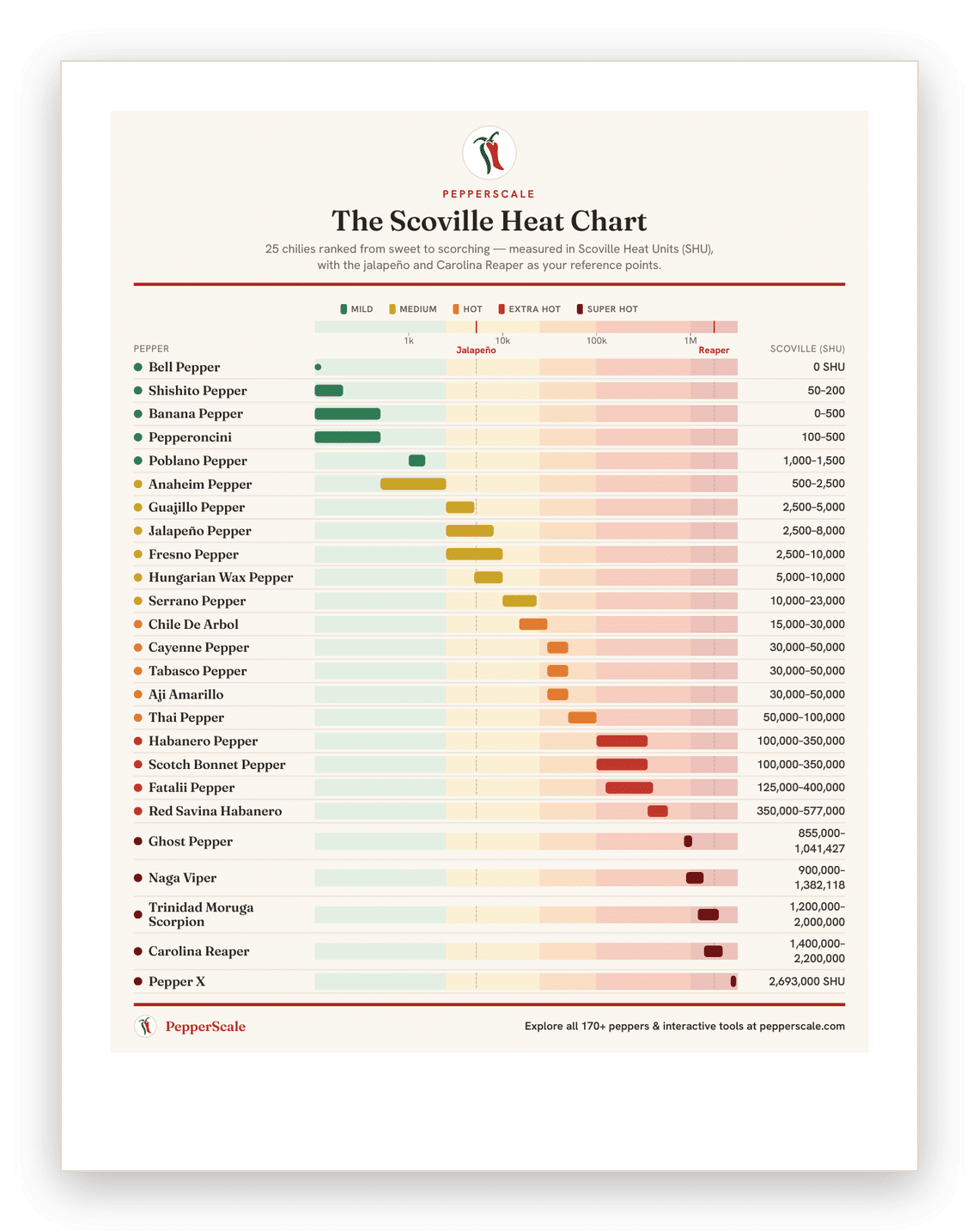
Get the free PepperScale Scoville Heat Chart
A printable, at-a-glance ranking of 25 chilies from sweet to scorching — with the jalapeño and Carolina Reaper as your reference points. Join the newsletter and we’ll send it straight to your inbox.
No spam — just Wicked Wednesday recipes and occasional extra dashes of chili pepper inspiration. Unsubscribe anytime.
Related reading
- Jalapeño Nutrition: How Healthy Are They?: What else a jalapeño brings besides its heat.
- Capsaicin: The Compound Behind The Pepper Scale: What makes peppers hot, and which of its health claims hold up.
- The Hot Pepper List: More than 170 chilies you can sort by heat and filter by flavor and use.