Ask a group of chili lovers which country has the spiciest food, and you’ll hear India, Thailand, Mexico and maybe Jamaica, usually with a story attached. We wanted numbers instead of stories, so we pulled together three kinds of data: how much dried chili people eat, how often recipes call for chilies, and how hot the go-to chilies are. Only one country comes out near the top of all three, and it’s Thailand. South Korea, India and Mexico aren’t far behind, and a few of the countries that fill out the top ten aren’t the ones most people would guess.
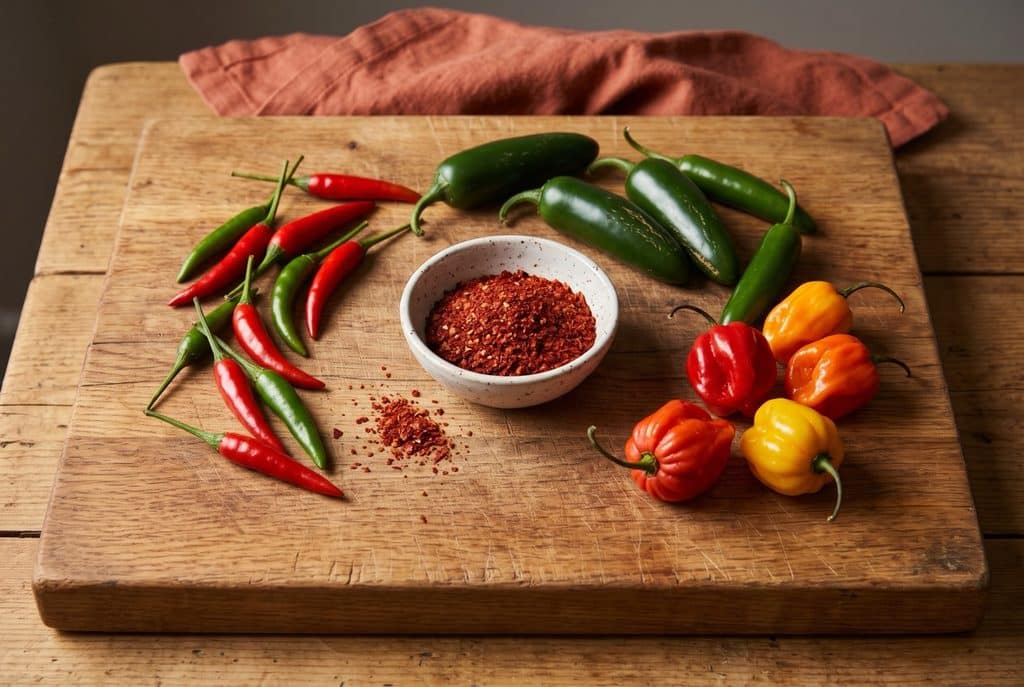
How do you measure which country has the spiciest food?
There’s no official ranking, and no single number captures it. A country can eat lots of mild chilies or a little of very hot ones, and a national average can hide a fiery region like Sichuan. If you only count how much chili gets eaten, you miss how hot it is, and if you only count heat, you miss how often it’s used. So we looked at three things, and each one catches something the others miss:
- How much chili people eat: Dried chili per person per year, from the FAO food balance sheets, averaged over 2021 to 2023.
- How often recipes call for chilies: The share of recipes in each cuisine with at least one hot chili ingredient. We counted them across the 45,772 recipes in CulinaryDB, a recipe database built by researchers at IIIT-Delhi.
- How hot the go-to chilies are: The Scoville range of the chilies each cuisine leans on, from our own pepper data.
None of these is perfect on its own, and we’ll point out where each one goes wrong. But when all three agree, you can trust the answer.
The spicy food scorecard
Here’s how the leading countries compare, along with a few familiar cuisines for reference. Blank spots mean a country isn’t in that dataset, not that it scored zero.
| Country | Dried chili per person, per year | Recipes that use chilies | Go-to chilies (Scoville heat units) |
|---|---|---|---|
| Thailand | 5.5 kg | 56% | Thai peppers, 50,000 to 100,000 |
| South Korea | 0.2 kg (incomplete) | 49% | Gochugaru, 1,500 to 10,000 |
| India | 1.0 kg | 46% | Kashmiri, 1,000 to 2,000, up to the ghost pepper, 855,000 to 1,041,427 |
| Mexico | 0.5 kg (dried only) | 43% | Jalapeño, 2,500 to 8,000, and serrano, 10,000 to 23,000 |
| Ethiopia | 1.9 kg | African bird’s eye, 50,000 to 100,000 | |
| Jamaica | 6.6 kg (includes allspice) | Scotch bonnet, 100,000 to 350,000 | |
| China | 0.1 kg | 28% | Facing heaven, 30,000 to 50,000 |
| United States | 0.5 kg | 21% | Jalapeño and cayenne, 2,500 to 50,000 |
| Italy | Under 0.1 kg | 16% | Calabrian, 25,000 to 40,000 |
| France | 0.1 kg | 5% | Espelette, 500 to 4,000 |
Want the short version? Thailand is first or close to it on every line. South Korea, India and Mexico all have chilies in more than four in ten recipes, but each one has a gap in the FAO column that we explain below. And the reference cuisines show how far apart the extremes are: French recipes call for chilies about one time in twenty.
Which countries eat the most chili?
FAO’s food balance sheets estimate how much of each food a country has available to eat, divided by its population. For dried chilies, these are the top countries, out of about 170 with data:
- Bosnia and Herzegovina: 7.5 kg per person per year
- Jamaica: 6.6 kg
- Thailand: 5.5 kg
- Côte d’Ivoire: 4.1 kg
- Ghana: 3.1 kg
- Bangladesh: 3.0 kg
- Cabo Verde: 2.7 kg
- Nepal: 2.7 kg
- Myanmar: 2.3 kg
- North Macedonia: 2.1 kg
- Sri Lanka: 1.9 kg
- Ethiopia: 1.9 kg
If you ate like the average person in Thailand, you’d get through about 15 grams of dried chili a day. India comes in 19th at 1.0 kilogram, and the United States is 33rd at 0.5.
But look closer at the top two. Why would Bosnia and Herzegovina outrank Thailand? FAO’s dried chili category also counts paprika and other sweet dried peppers, along with allspice. Sweet peppers are the likeliest reason Bosnia and Herzegovina and North Macedonia rank so high, since the figure can’t tell paprika from chili. And in Jamaica, “pimento” is the local name for allspice, the backbone of jerk seasoning. FAO doesn’t split the two, so we can’t say how much of Jamaica’s total is allspice.
The figure also misses fresh chilies, which FAO lumps in with other vegetables. That’s a big reason Mexico, where so many chilies are eaten fresh, shows just 0.5 kilograms. And South Korea’s 0.2 kilograms counts imports but not the country’s own harvest. Statistics Korea counted 68,074 tons of dried red pepper grown in 2024, which comes to about 1.3 kilograms a person before a single import.
How often do recipes call for chilies?
For this one, we went through CulinaryDB recipe by recipe. A recipe counted if it listed at least one hot chili ingredient: fresh or dried chilies, chili powder, cayenne, red pepper flakes, gochugaru, gochujang, hot sauce, Thai red or green curry paste and the like. Paprika and bell peppers didn’t count. Here’s the share for every country in the database with its own cuisine label:
- Thailand: 56% of 667 recipes
- South Korea: 49% of 301
- India: 46% of 4,058
- Mexico: 43% of 3,138
- China: 28% of 941
- Portugal: 28% of 138
- Spain: 24% of 816
- United States: 21% of 16,118
- Italy: 16% of 7,504
- Canada: 14% of 1,112
- Japan: 12% of 580
- Greece: 9% of 934
- France: 5% of 2,703
One caveat: most of these recipes come from English-language sites like Allrecipes, Epicurious and Food Network, so they’re dishes as written for American and British home cooks. The Indian group is the exception, since most of it comes from Tarla Dalal, an Indian recipe site. Cooks in Bangkok or Seoul probably use chilies even more often than these numbers show. But the order matches what you’d expect, and it lines up with the FAO data where the two overlap.
The 10 countries with the spiciest food
Putting the three measures together, here’s our ranking, along with what you can expect from each cuisine. The first four are backed by every dataset that covers them, and the rest stand out mainly for how much chili they eat.
1. Thailand
Thailand is the clearest answer in the data. Only two countries rank higher for dried chili per person, and both of their figures are probably inflated by paprika or allspice. More than half of Thai recipes call for chilies, the highest share in CulinaryDB. The chilies are hot, too. Thai peppers run 50,000 to 100,000 Scoville heat units, 6 to 40 times hotter than a jalapeño.
Not all Thai food is super spicy. If you’ve only eaten Thai food outside Thailand, there’s a good chance it was toned down for you. Thai restaurants in the West have largely adjusted their dishes to suit delicate palates. Even so, the spicy stuff is usually very spicy by Western standards, and you will have a hard time finding mild dishes if you visit Thailand. Traditional dishes like phat phrik and tom yum soup depend on the liberal use of chili peppers for their flavor profile.
2. South Korea
Korea’s heat comes from how much chili it uses, not how hot each chili is. Gochugaru, the Korean chili flake, runs only about 1,500 to 10,000 Scoville heat units. But it goes into kimchi, stews and marinades, and gochujang, a fermented chili paste, is a staple too. That’s how Korea ends up with chilies in nearly half its recipes, second only to Thailand. If you like steady heat more than a hard burn, Korean food is a good fit.
3. India
There is much more to Indian food than the heat from chili peppers, but it would be incorrect to say that peppery heat is not a fundamental part of Indian food. FAO puts India’s dried chili harvest at about 2.8 million tons in 2023, and roughly two-thirds of it stays home to be eaten. Per person, that’s 1.0 kilogram a year, and close to half of the Indian recipes we counted call for chilies.
The chilies cover the full range. Kashmiri chilies, used as much for their red color as their heat, run just 1,000 to 2,000 Scoville heat units. At the other end, northeast India is home to the ghost pepper, at 855,000 to 1,041,427. Examples of the spiciest Indian foods include vindaloo, the spicy curry from the former Portuguese colony of Goa, and Chicken 65 from South India. Phaal, a curry created in British curry houses, is hotter still.
4. Mexico
Mexico is where people domesticated Capsicum annuum, the chili pepper species behind jalapeños, cayenne and bell peppers. Chilies show up in nearly every corner of the cuisine, from salsas and stews to fruit and corn. While other parts of the world have opted for hotter peppers and more concentrated heat, Mexican food is mostly only moderately hot. The workhorses are jalapeños, at 2,500 to 8,000 Scoville heat units, and serranos, at 10,000 to 23,000.
What Mexico lacks in intensity, it makes up for in reach: you’ll find chilies in 43% of the Mexican recipes we counted. Its FAO figure looks low mostly because so many of those chilies are eaten fresh, and the dried category doesn’t count them.
5. Sri Lanka
Sri Lanka has been part of the global spice trade for centuries, and its cooking leans hard on chili. FAO puts its supply at 1.9 kilograms of dried chili per person, 11th in the world and almost twice India’s. Chilies show up in dishes like coconut sambal, and kottu, a chopped roti stir-fry, usually comes with a spicy curry sauce.
6. Ethiopia
Ethiopia also eats about 1.9 kilograms of dried chili per person, and grows almost all of it at home. Much of it goes into berbere, the brick-red chili blend behind doro wat and many other stews. Want to cook with it? Our berbere spice mix shows you how to make your own. For more heat there’s mitmita, a hotter blend built on African bird’s eye chilies, the same pepper as the peri-peri, at 50,000 to 100,000 Scoville heat units.
7. Ghana and Côte d’Ivoire
These two West African neighbors are easy to overlook, but the FAO numbers put them near the very top: 4.1 kilograms of dried chili per person in Côte d’Ivoire and 3.1 in Ghana. Ghana’s shito, a dark, oily pepper sauce made with dried fish or shrimp, is a good place to start if you want a taste. Neither country is in the recipe database, so the FAO figure is the main evidence here.
8. Bangladesh, Nepal and Myanmar
All three eat more dried chili per person than India: 3.0 kilograms in Bangladesh, 2.7 in Nepal and 2.3 in Myanmar. Laos, at 1.7 kilograms, isn’t far behind. None of them has its own label in CulinaryDB, so you won’t find them in the recipe count.
9. Malaysia
Spicy food is popular all over Malaysia, with Malaysian cuisine exhibiting heavy Chinese and Indian influences. FAO puts it at 1.5 kilograms of dried chili per person. Dishes like laksa are known for including large amounts of hot chili peppers. Other hot dishes include otak-otak, a fish cake that’s heavily seasoned with dried chili peppers.
10. Jamaica and Trinidad and Tobago
These two make the list for intensity. The best-known Jamaican dish is also the hottest. Along with the flavor of allspice, jerk pork is known for its extremely high level of heat. It’s typically seasoned with Scotch bonnet peppers, which can run as high as 350,000 on the Scoville scale. Other hot dishes include Jamaican goat curry, which is also typically seasoned with Scotch bonnets.
With its large Indian population, Trinidad offers some of the hottest food in the Western world, with curries and fiery pepper sauces. It’s also home to some of the hottest peppers on Earth, like the Trinidad Moruga Scorpion, which can reach 2,000,000 Scoville heat units. If you want to taste one, start small.
Which spicy cuisines does the data miss?
Why aren’t some famous spicy cuisines in the top ten? National averages and dried-chili figures leave a few of them out, and you’d be right to put any of these on your list:
- China: Just 0.1 kilograms per person and 28% of recipes nationally, but Sichuan and Hunan cooking are among the hottest anywhere. A national average for 1.4 billion people buries them. Sichuan’s go-to facing heaven peppers run 30,000 to 50,000 Scoville heat units.
- Bhutan: Its national dish, ema datshi, treats chilies as the vegetable, simmered with cheese. FAO’s Bhutan figures jump from year to year, and its 2023 figure is zero, so we didn’t lean on them.
- Indonesia: Sambal is a fixture of Indonesian meals, but it’s mostly made from fresh chilies, so FAO shows only 0.1 kilograms of dried chili per person.
- Peru: Ají peppers like ají amarillo, at 30,000 to 50,000 Scoville heat units, are central to the cuisine. They’re mostly used fresh or as pastes, and FAO’s dried chili figure for Peru is close to zero.
Do the countries with the hottest peppers have the spiciest food?
Mostly not. Of the 25 peppers on our hot pepper list that can top a million Scoville heat units, 20 come from Trinidad, the United Kingdom or the United States. The British and American ones are mostly modern crosses, bred by growers competing for the title of hottest pepper in the world.
Of those three, Trinidad is the only one where the peppers and the food line up. British and American cooking isn’t known for heat, and the numbers agree: the U.S. comes in at 0.5 kilograms of dried chili per person and 21% of recipes. So a country’s hottest pepper tells you more about its growers than about what’s for dinner.
Why do some countries eat spicier food than others?
Scientists have been arguing about this for decades. A well-known 1998 study by Jennifer Billing and Paul Sherman looked at 4,578 traditional meat recipes from 36 countries and found that 24% called for chili peppers. Countries with hotter climates used them more often, and the authors argued that spices helped keep food from spoiling.
A 2021 study led by Lindell Bromham at the Australian National University tested that idea on 33,750 recipes from 70 cuisines. Once it accounted for the fact that neighboring and related cuisines share habits, the link between temperature and spice use went away. Spice use tracked lower incomes and poorer health more closely than infection risk, and chili use in particular wasn’t linked to foodborne illness. So history, trade and tradition probably matter more than climate.
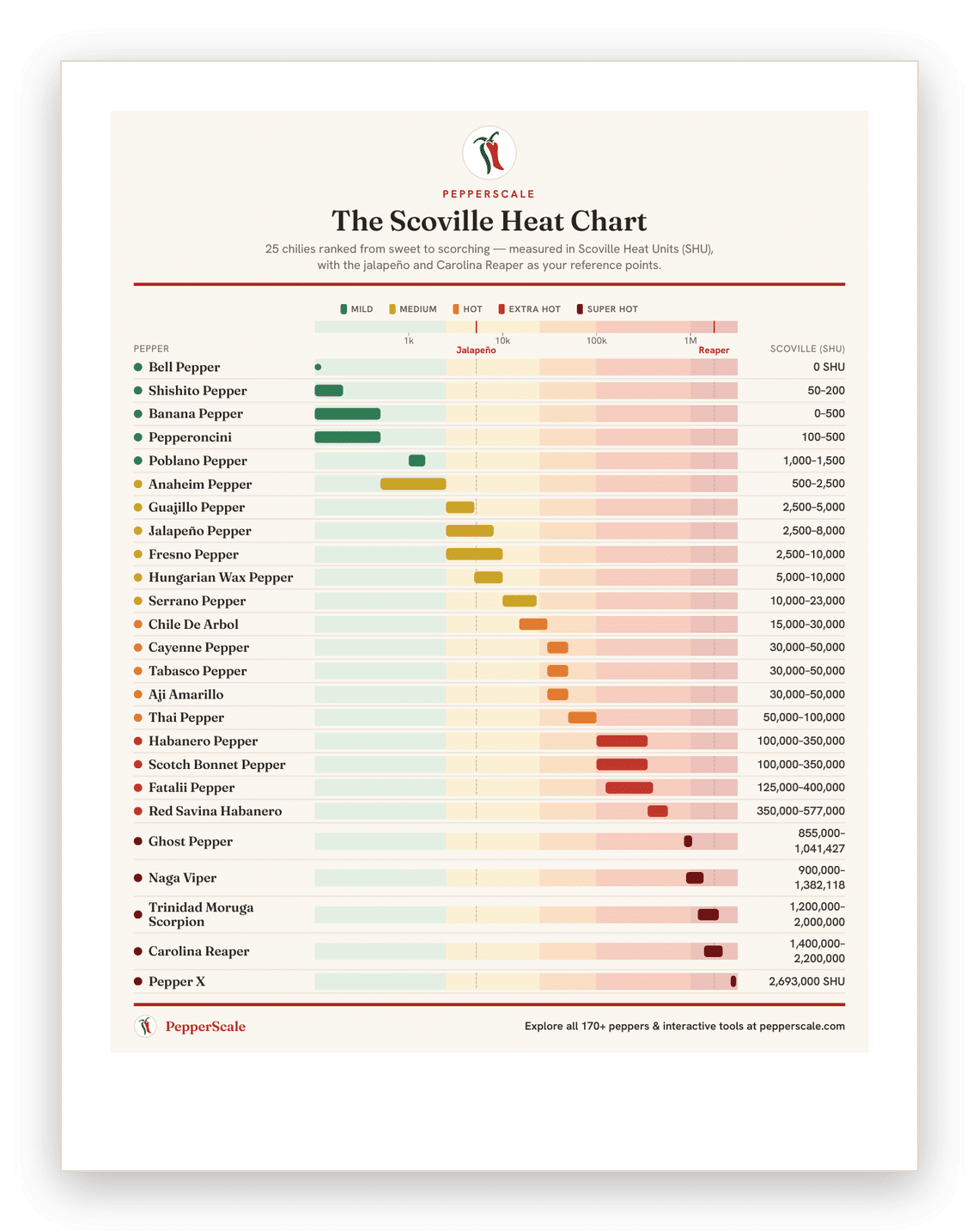
Get the free PepperScale Scoville Heat Chart
A printable, at-a-glance ranking of 25 chilies from sweet to scorching — with the jalapeño and Carolina Reaper as your reference points. Join the newsletter and we’ll send it straight to your inbox.
No spam — just Wicked Wednesday recipes and occasional extra dashes of chili pepper inspiration. Unsubscribe anytime.
Related reading
- Why Do People Like Spicy Food? Behind The Love Of Heat: The science of why a painful burn feels good.
- Craving Spicy Food? What Makes Us Want It and Why: What’s behind the pull toward heat.
- Dish Too Hot? How to Make Food Less Spicy: What to do when a dish runs hotter than you planned.