Every sauce in our rankings was bought, opened, and eaten. Nobody here is scoring a bottle from its label copy.
How we taste
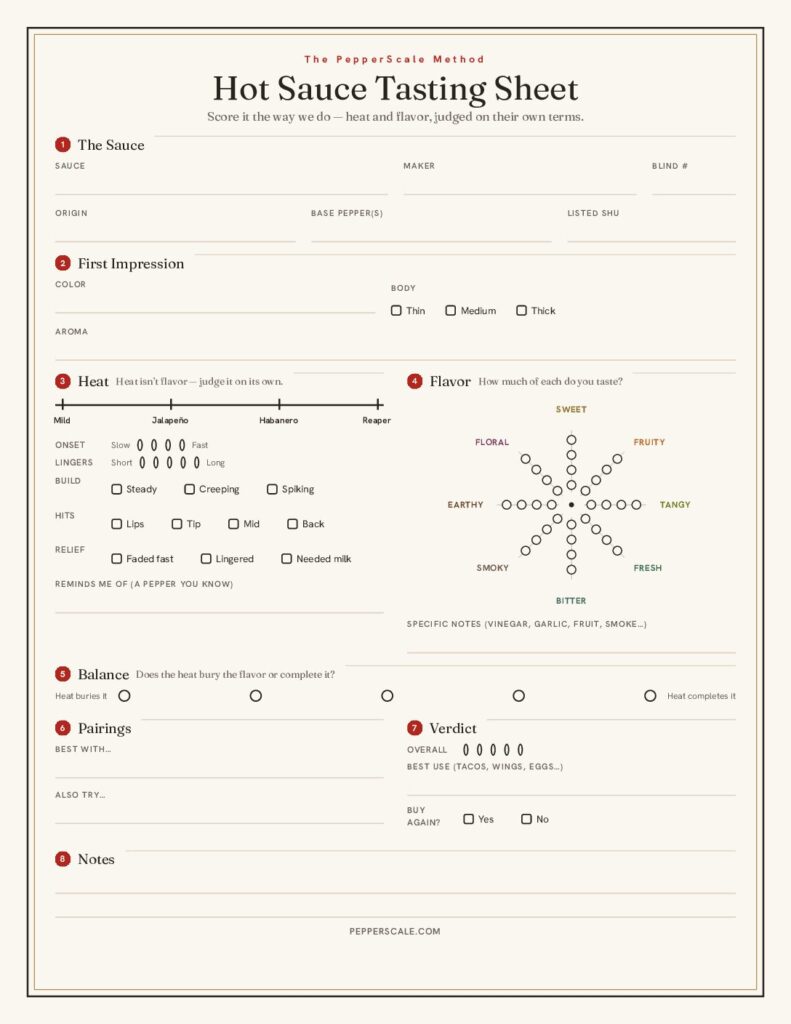
Each bottle of hot sauce is used for at least one week before writing a review. The hot sauce is tasted both on its own (a spoon test) and across foods that make sense for the hot sauce type. When comparisons are made in a review, they are done with side-by-side testing with the hot sauce its being compared to.
The reviewer then completes our hot sauce tasting framework (example provided here, to the right) to establish their overall thoughts on the sauce through PepperScale’s tasting lens.
What we score
Four things, each 1 to 5, half points allowed, determing an “Eating Score” and a “Collectibility Score”.
The Eating Score:
- Overall Flavor — what it tastes like, on its own terms. Not how hot it is.
- Heat Balance — whether the heat serves the flavor or buries it. A sauce can be mild and badly balanced, or brutally hot and perfectly balanced.
- Usability — how many things you’d actually put it on. A daily driver scores high. A one-dish specialist doesn’t, however good it is on that dish.
Heat is a label, not a score: Mild, Medium, Extra-Hot, Super-Hot. A hotter sauce isn’t a better one, so heat alone doesn’t move the rating. Heat balance does.
The Collectibility Score:
This score focuses on the reasons you’d want the bottle on the shelf that have nothing to do with what’s inside it. The label and the bottle itself. The story behind the maker. Whether it’s a small run, a regional sauce you can’t get anywhere else, or one with some history behind it.
A sauce can be excellent on eggs and score low here because it arrives in a plain bottle from a company that’s been doing the same thing competently for fifty years. Another can score high for a hand-numbered bottle out of a two-person kitchen and still be one we’d tell you to think twice about before pouring.
That independence is the point, and it’s why we’ve started reporting this score separately. If you’re after a daily driver, collectibility should carry no weight at all, and folding it into one number meant it did. If you’re building a shelf, it might be the only score you care about.
How the score is worked out
The Eating Score is the unweighted mean of the three eating-related focuses (flavor, balance, usability.)
The Collectibility Score is a single score as provided by the reviewer.
We round scores to the tenth decimal, following standard rounding principles (hundredth positions below five round down, five and above round up.)
The change in progress
We’re splitting eating-based scores from collectibility, so a sauce you’d cook with every day isn’t competing against one you’d keep for the bottle. Reviews on the new format show an Eating Score (flavor, balance, usability) and Collectibility separately.
While the migration runs, some scores differ between a review and the rankings table. This adjustment has an expected completion timeframe of Q4 2026.
What we don’t do
We don’t take payment for a score, a ranking, or a placement. We don’t accept a sauce on condition of a positive review. Affiliate links earn a commission at no extra cost to you and have no bearing on the score.
We also don’t score a sauce we haven’t eaten.