Hello, and welcome to PepperScale. I’m Matt Bray, and this is my chili pepper site (or as I think of it, my lifelong passion project.) I started it in 2013, though it really started about twenty years before that, in a restaurant in Washington, DC.
Where this came from
In the early 90s, while I was in college, I took a job waiting tables at Red Sage. It was Mark Miller’s Southwestern restaurant in DC, and the training was unlike anything I’d been through before or since. New hires spent days on the two things the place cared most about: tequila and chilies.
Most people gravitated to the tequila. I couldn’t stop thinking about chilies.
Miller had, more or less literally, written the book on them. The Great Chile Book and The Great Chile Poster were his, and that seriousness ran all the way down to the people carrying plates. I learned how to handle a chili there. More importantly, I learned the thing this whole site is built on: a hot pepper isn’t only heat. It’s an ingredient, with depth and flavor of its own.
Twenty years later
That never wore off. By the early 2010s I wanted to go deeper, so I went looking for somewhere online that took chilies as seriously as Red Sage had.
Mostly what I found was a Scoville number and a full stop. How hot, and nothing else. Very little on what a pepper actually tastes like, what it does to a dish, or what to put it next to.
So in 2013 I started PepperScale to be the thing I’d gone looking for and couldn’t find.
Where it is now
Thirteen years on, the site covers 176 chili peppers, several hundred recipes, a growing set of hot sauce reviews, tools to help you work, and even a quiz engine to help you truly become a chili pepper pro. Somewhere in there, millions of people have used it. Mostly I take that to mean I wasn’t the only one who went looking and found a Scoville number and little else.
It’s run by Cindermint LLC, which is me. This is a passion project through and through.
What’s here
Pepper profiles. Heat range, flavor, what it’s like to cook with, and what to use instead. And pairings, lots of them, because that’s where a pepper’s flavor actually pays off. All of it built on one shared dataset, so the numbers on a profile match the numbers everywhere else on the site.
Comparisons and substitutes. Direct answers to “which is hotter” and “I don’t have this, now what.”
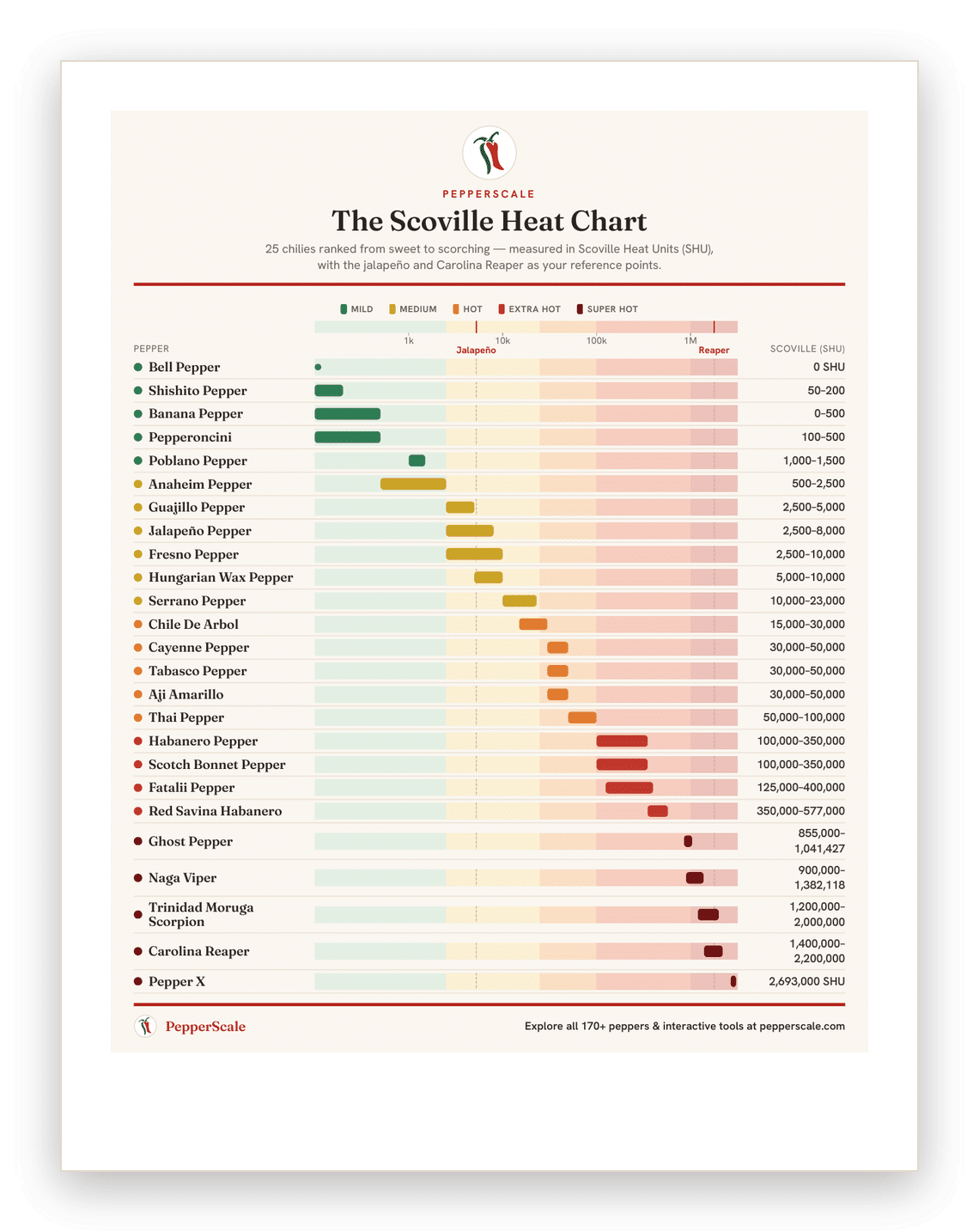
Tools. A Scoville heat chart covering the full catalog, a substitute finder, a conversion tool for fresh-to-dried and powder-to-flake, a flavor pairing tool, a dish heat calculator, and a rescue tool for when you’ve overdone it.
Recipes. Spicy cooking, from weeknight to weekend project.
Hot sauce reviews. Scored on flavor, balance, usability and collectibility. How that works is on the review methodology page.
If you want the full tour, How To Use PepperScale walks through all of it.
How it’s paid for
Ads, affiliate links, and a small shop of ebooks and printables. Affiliate links earn a commission at no extra cost to you. None of it buys a score or a placement. The editorial policy has the lines in full.
Getting in touch
Corrections, questions, and sauce submissions all go through the contact page, which comes straight to me. If you spot something wrong, tell me. I’d rather fix it than be wrong.
If you’ve read this far down an About page, I’m going to assume your chilihead credentials are in order. Welcome. I hope you find what you came for.