Here’s how PepperScale is written, where the numbers come from, and what happens when something’s wrong.
Who writes it
Every post carries a byline that links to that writer’s other work. PepperScale is a small operation, not an anonymous content farm, and if you want to know who told you something you should be able to find out in one click. PepperScale has hired many fellow chiliheads through the years to support content growth, but the site is mainly written by Matt Bray, the founder of PepperScale.
Where the heat numbers come from
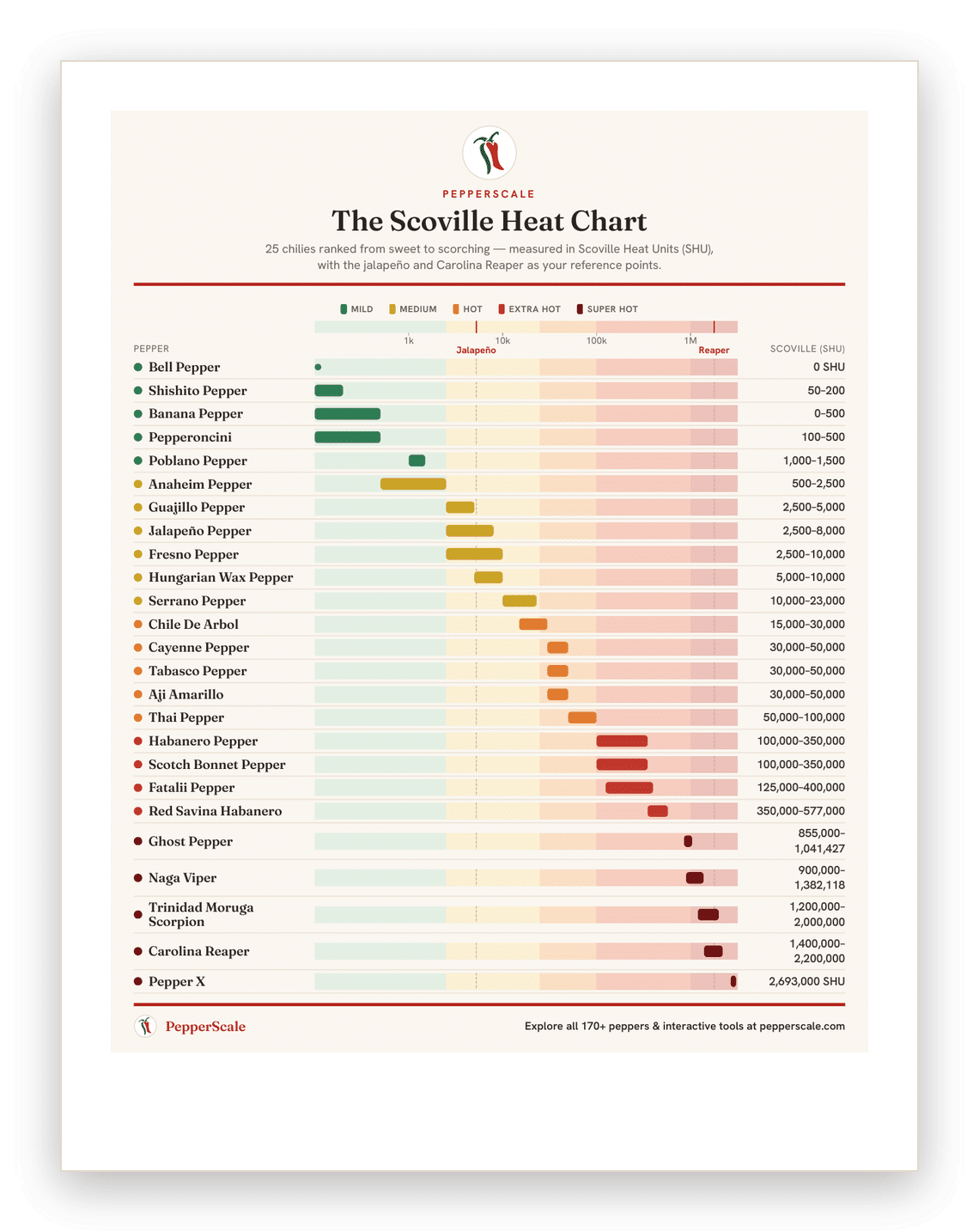
Scoville figures are ranges, not single values, because the same pepper varies by growing conditions, ripeness and individual plant. We publish the range and, where it helps, the midpoint.
We express heat as a multiple of a jalapeño alongside the raw number. Most people have eaten a jalapeño and almost nobody has an intuition for what 225,000 Scoville heat units (SHU) feels like.
One thing worth being straight about: the Scoville Organoleptic Test was a dilution method scored by human tasters, and it has largely been replaced by HPLC, which measures capsaicinoid content directly and converts to Scoville units. Published figures come from a mix of both, plus decades of secondary sources that don’t always agree. Where sources conflict we say so rather than picking the most dramatic number.
Flavor descriptions
Flavor profiles come from The Capsaicin Code, our own framework for how chili flavor works, and are shown on an eight-axis scale. Those values are editorial estimates, not laboratory measurements. They’re useful for comparing peppers to each other through an easily digestible method.
Health and nutrition
We’re not doctors and we don’t give medical advice. Where we discuss research, we link the study. Where a claim is contested or preliminary, we say that rather than writing around it. Nutrition figures on recipes are calculator estimates — see the nutrition disclaimer.
Corrections
If something here is wrong, tell us and we’ll fix it. Send the URL and what’s incorrect, with a source if you have one. Substantive corrections are noted on the page rather than made silently.
Money
Ads are served by Raptive. Affiliate links, mainly Amazon, earn a commission at no extra cost to you. We sell our own ebooks and printables. The newsletter carries paid sponsorships, and every one is labeled “Sponsored.”
No advertiser, affiliate, or sponsor gets to influence a score, a ranking, or a recommendation. We don’t accept payment for a positive review or for placement in a ranking.
Product submissions
We accept hot sauce submissions for possible review. Submission doesn’t guarantee a review and doesn’t influence the score.
Updates
Evergreen posts get revisited. When a post is substantively revised we update its last-reviewed date. We don’t refresh dates on posts we haven’t actually re-read.