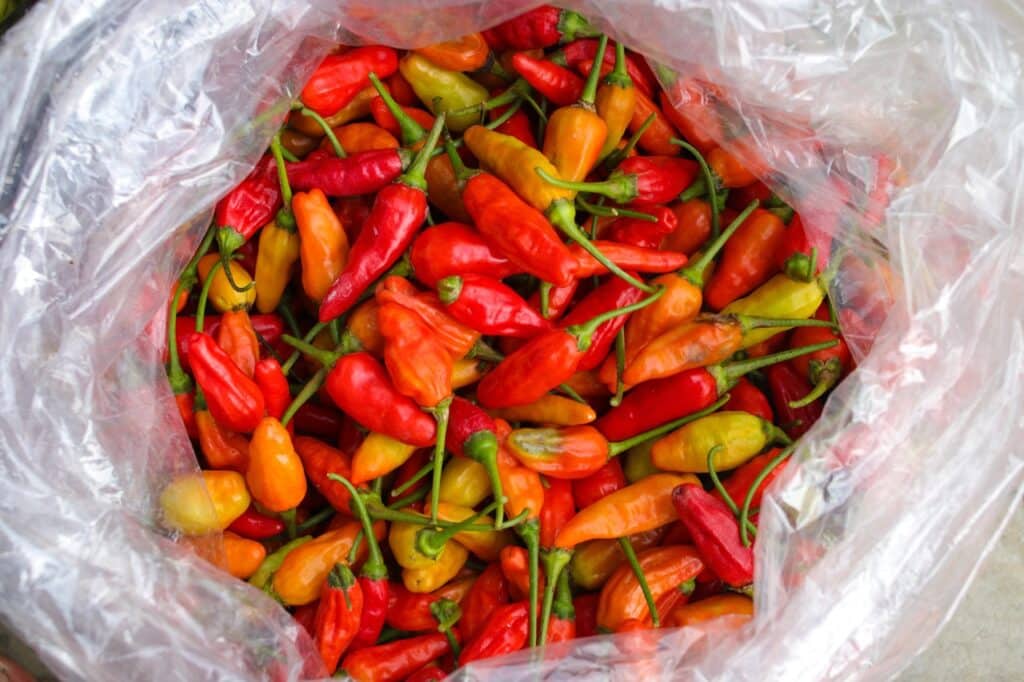
The datil has a specific problem: almost nobody can buy one fresh. It grows in and around St. Augustine, Florida, in small batches, for local families and local restaurants, and it barely leaves. So if a recipe calls for fresh datil peppers and you don’t live in northeast Florida, you’re not looking for a substitute because you ran out. You’re looking for one because you never had any.
The good news is that the datil is easier to replace than most peppers with a cult following. It’s sweet, fruity, and tropical, it runs 100,000 to 300,000 Scoville heat units, and it has two very close relatives you can buy almost anywhere.

Last update on 2026-10-12. We earn a commission if you make a purchase, at no additional cost to you.
| Pepper | Scoville | Vs. Datil | Use |
|---|---|---|---|
| Datilwhat you're replacing | 100,000–300,000 | — | — |
| Scotch Bonnet Fruity Closest match | 100,000–350,000 | about the same | 1:1 |
| Habanero Fruity Closest match | 100,000–350,000 | about the same | 1:1 |
| Fatalii Fruity Closest match | 125,000–400,000 | ~1.3× hotter | 1.3× less |
| Aji Amarillo Fruity Dials the heat down | 30,000–50,000 | ~5× milder | 5× as much |
| Jalapeño Green & Grassy Easy to find · flavor change | 2,500–8,000 | ~38× milder | — |
| Serrano Green & Grassy Easy to find · flavor change | 10,000–23,000 | ~12× milder | — |
- Cayenne Sharp Brings the heat without the fruity and sweet that carries Datil.
- Ghost Fruity Same aroma family, but the heat sits ~4.7× hotter, which is hard to balance.
The best swaps: peppers in the datil’s flavor family
All three of these are Capsicum chinense, the same species as the datil, and all three bring the sweet tropical fruit that makes datil sauces taste the way they do. Any of them will work. They differ in what they add on top.
Scotch bonnet pepper
The closest match, and the one to reach for first. The scotch bonnet runs 100,000 to 350,000 SHU against the datil’s 100,000 to 300,000 — the same floor and a slightly higher ceiling, close enough to swap without recalculating anything. It carries the same sweetness and the same fruitiness, and what it adds is a light earthy undertone the datil doesn’t usually have. In a sweet-hot sauce that reads as a little more depth, not as a wrong turn. Easy to find in Caribbean groceries and increasingly in ordinary supermarkets.
Habanero pepper
Just as close on the numbers, and far easier to buy. The habanero shares the datil’s heat range and its sweet fruity base, and adds a thread of smoke instead of the bonnet’s earth. That smoke is the only reason it’s second here rather than first: in a ketchup-and-molasses datil sauce, the smoky note nudges the whole thing toward barbecue. Sometimes that’s an improvement. If you want the datil’s cleanness, the bonnet is nearer. If you want to be able to buy it on a Tuesday, this is your pepper.
Fatalii pepper
The one that looks most like a datil — same slim conical shape, same yellow-orange — and the one people most often confuse it with. The fatalii runs a bit hotter at 125,000 to 400,000 SHU, and it brings a distinct citrus sharpness alongside the fruit. That citrus is genuinely good in a hot sauce and noticeable, so this is a swap that changes the flavor a little more than the first two. Hardest of the three to find outside a specialty grower.
Dialing the heat down without losing the fruit
If the problem isn’t availability but the fact that 200,000 SHU is more than you want in your kitchen, the pepper to know about is the ají amarillo. It carries the same sweetness and the same fruitiness as a datil on our flavor data, with a slight tang on top, but it runs 30,000 to 50,000 SHU — roughly a fifth of the datil’s heat. That makes it the rare mild-side swap that doesn’t cost you the flavor you were after.
The rocoto (30,000 to 100,000 SHU) works on the same principle and is also fruity, though it’s harder to find fresh in the US. Both are far better answers than simply using less of a hotter pepper, because a small amount of habanero gives you a small amount of everything, while a full measure of ají amarillo gives you the fruit at a manageable burn.
One to skip: cayenne, and the super-hots
Don’t reach for cayenne. It’s a fine chili and it’s in everyone’s cupboard, but it’s a neutral one — its whole job is to add heat without adding flavor, and the datil’s whole point is the flavor. You’d get the burn and none of the reason for it. Any other pure-heat chili has the same problem.
The other trap runs in the opposite direction. It’s tempting to assume that because the datil is a fruity chinense, another fruity chinense will do, and reach for a ghost pepper. It starts around 855,000 SHU — three to eight times the datil — and brings an earthy note besides. You’d be making a different and considerably more painful dish. Same caution for anything else on the hottest peppers list.
Pantry options when there’s no fresh pod
Here’s the thing that makes the datil unusual: for most peppers this section is the compromise, and for the datil it might be the best answer you have.
Fresh datils barely leave St. Augustine, but bottled datil does. Datil hot sauces (like Dat’l Do It or Minorcan Mikes), salsas, jellies, mustards, and powders all ship nationally from the same local makers who grow the peppers, which means you can often get the actual datil flavor more easily than you can get the actual datil. If a recipe wants datil heat in a sauce, a finishing condiment, or anything wet, a bottled datil sauce gets you closer than any fresh substitute will. And dried datil pods or powder does the same job for rubs and dry seasoning.
Failing that, habanero powder and scotch bonnet sauces are widely stocked and follow the same logic as the fresh swaps above.
Match the substitute to the dish
- A hot sauce or a sweet-hot jelly: scotch bonnet, or a bottled datil sauce if you can get one. This is where the datil’s cleanness matters most and where the bonnet’s near-identical profile pays off.
- A ketchup-based sauce for shellfish — the St. Augustine classic: habanero. Its smoke actually suits a sweet, tomato-based sauce, and this is the dish where you’ll notice availability more than nuance.
- A barbecue marinade or rub: habanero, or datil powder. Smoke belongs here anyway, so the habanero’s one extra note stops being a compromise.
- A fresh salsa: scotch bonnet or fatalii. Raw is where the citrus edge of a fatalii comes through best.
- Anything you’re feeding to a mixed crowd: ají amarillo. Same fruit, a fifth of the fight.
- You only have supermarket peppers: a jalapeño or serrano will make the dish spicy, but be clear with yourself that you’re making a different dish. They’re bright and grassy where the datil is sweet and tropical, and no quantity of them turns into fruit.
How much should you use?
Heat varies pod to pod, so treat these as starting points and taste as you go. All of them compare the middle of each pepper’s range:
- Scotch bonnet: one for one.
- Habanero: one for one.
- Fatalii: start at about three quarters, since it runs a little hotter.
- Ají amarillo: you’d need roughly five times as much to match the heat, which is more flesh than most recipes have room for. Better to accept a milder dish and use two or three times as much for the flavor.
- Serrano: around twelve times as much, which is well past the point of practicality.
- Jalapeño: getting on for forty times as much. Don’t. Use them for heat and let the fruit go.
Our pepper conversion tool does this math for any two chilies, and the dish heat calculator will tell you where the whole dish lands before you commit to it.
Pulling it all together
Reach for a scotch bonnet. It matches the datil on heat and on flavor and adds only a whisper of earth, which is as close as one pepper gets to another. A habanero is just as close on paper and much easier to buy, at the cost of a little smoke. And if what you actually want is the datil taste rather than a datil-shaped hole in the recipe, buy a bottle. The sauces travel in a way the peppers never have.
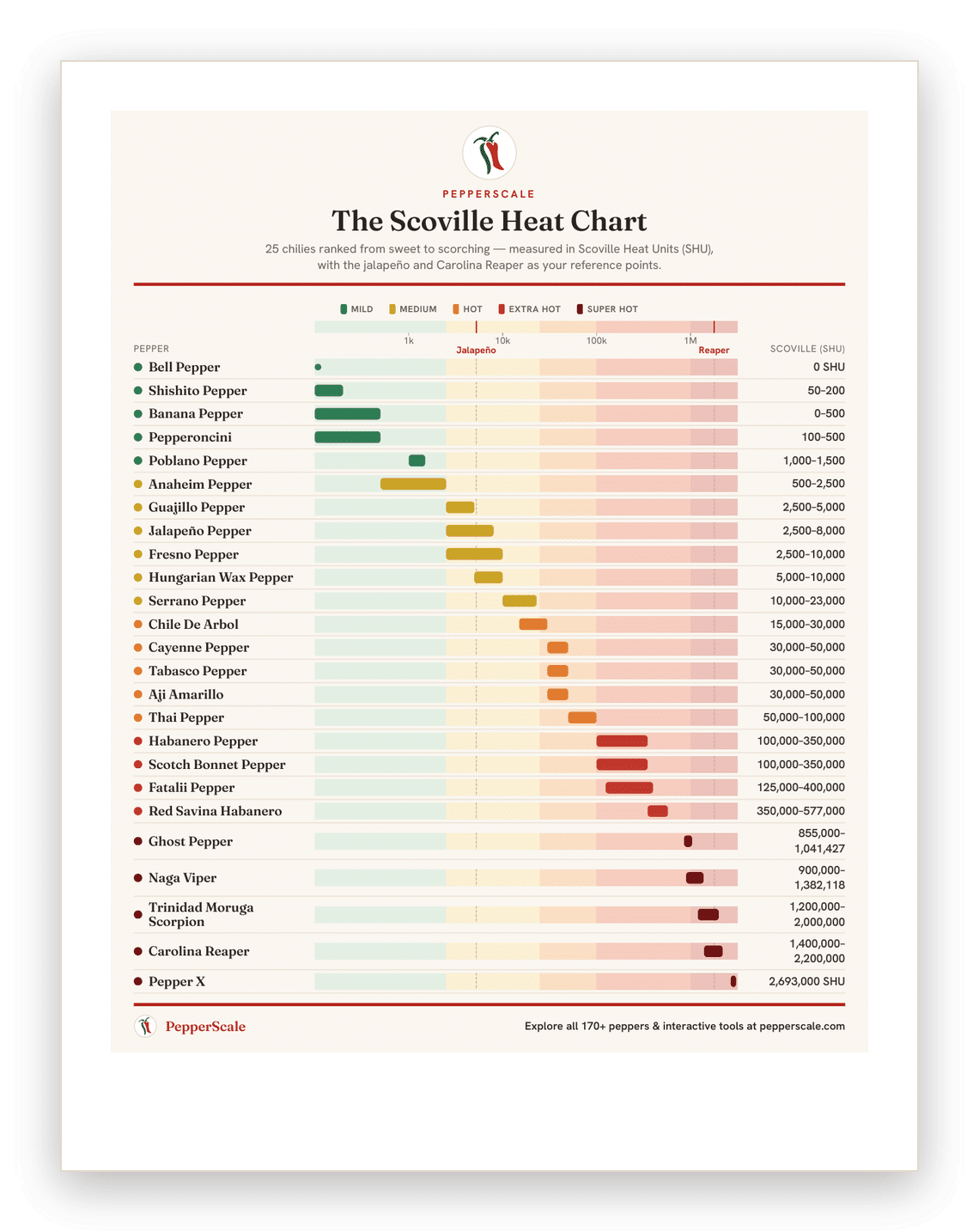
Get the free PepperScale Scoville Heat Chart
A printable, at-a-glance ranking of 25 chilies from sweet to scorching — with the jalapeño and Carolina Reaper as your reference points. Join the newsletter and we’ll send it straight to your inbox.
No spam — just Wicked Wednesday recipes and occasional extra dashes of chili pepper inspiration. Unsubscribe anytime.
Related Reading
- Datil Peppers: Heat, Flavor, Ingredient Pairings: The full profile — where the pepper comes from, what it tastes like, and how to cook with it.
- Habanero Pepper Substitutes: The habanero is the easiest swap here, and this guide covers what to do when you can’t get one of those either.
- The Hot Pepper List: If none of these are quite right, we profile 170-plus chilies, searchable by heat, flavor, and origin.