If you eat a lot of chili peppers, your feed probably served you something alarming a couple of weeks ago (July 2026 in this case, but, as you’ll see…these dates are not alone.)
“Eating chili peppers may raise the risk of one deadly cancer.” (Science Daily)
“Common cooking ingredient could raise the risk of one deadly cancer.” (Newsweek)
The number that traveled with those headlines was a big one: heavy chili pepper eaters were 64% more likely to get gastrointestinal cancer, and nearly three times more likely to get esophageal cancer.
That’s the kind of thing that makes you look at the eight hot sauce bottles on your counter a little differently.
So I went and reviewed the research. Not the press release. The actual paper. What’s in there is a lot more interesting, and a lot more useful to you, than the headline version.
One thing up front: I’m not a doctor and I’m not a research scientist. I won’t be telling you what’s safe to eat. That’s not my lane, and anyone who says otherwise from a blog should be ignored. What I do know is how to read a study without getting fooled by the summary, and I know hot peppers about as well as anybody. That’s the lens here. I’m going to walk you through what this paper says, what it doesn’t say, and why the gap between those two things is so wide.
First surprise: the study isn’t new
Every article treating this as breaking news in July 2026 is describing a paper published in Frontiers in Nutrition on November 3, 2022, by Changchang Chen, Man Zhang, Xutong Zheng, and Hongjuan Lang. It’s open access, so you can read the whole thing yourself.
It’s a real paper in a real peer-reviewed journal. But it’s coming up on four years old. Nothing was discovered this month. The paper just went back around the science-news wire and got picked up like it had landed that morning.
That doesn’t make it wrong. It does mean the right reaction is “huh, interesting” rather than “throw out the habaneros.” If this paper had really changed what we know about capsaicin and cancer, the three and a half years since it came out would have shown it by now.
What the study actually found
Here are the real numbers, straight from the paper. The search turned up more than 11,000 records, which the authors narrowed down to 14 studies covering 11,310 people, 5,009 of whom had a gastrointestinal cancer. Then they compared the heaviest chili pepper eaters to the lightest.
An odds ratio above 1.0 means higher risk. Below 1.0 means lower risk. The confidence interval is the range the true number is likely to fall in. If that range includes 1.0, the finding could just be noise.
| Cancer type | Odds ratio | 95% confidence interval | Solid finding? |
|---|---|---|---|
| All GI cancers | 1.64 | 1.00 – 2.70 | Not quite: the range reaches all the way down to 1.00 |
| Esophageal | 2.71 | 1.54 – 4.75 | Yes |
| Gastric (stomach) | 1.77 | 0.84 – 3.73 | No |
| Colorectal | 0.62 | 0.26 – 1.47 | No, and it points downward |
Now look at what the headlines did with that.
The famous “64% increase” is the top row, and its range runs from 1.00 to 2.70. In plain English: the low end of that range is no effect at all. It sits right on the line instead of clearing it. That’s the number that became the headline.
Two of the four rows don’t hold up on their own. And the colorectal result of 0.62, which if anything hints at lower risk, didn’t make a single headline I saw.
To be fair to the researchers: they read that top row as a real finding and concluded chili is a risk factor for some GI cancers. I’m reading it more cautiously than they did, and you’re welcome to side with them. But you can only make that call if somebody shows you the range, and that’s exactly what the news coverage left out, though Newsweek had solid expert quotes also positioning caution when interpreting the data.
The design problem: all 14 studies were the weaker kind
This is the part that matters most. A few of the news write-ups did mention that the studies were observational and based on questionnaires. What none of them explained is why that’s a problem here.
All 14 studies were case-control studies. Not one was a cohort study. That sounds like statistics trivia. It isn’t.
A case-control study finds people who already have cancer, finds similar people who don’t, and asks both groups what they used to eat. So it depends entirely on people remembering their diet from years back, after being diagnosed with something serious. That’s recall bias, and it’s brutal in diet research. Someone with esophageal cancer hunting for an explanation may honestly remember their chili habit as bigger than it was. Someone healthy has no reason to.
A cohort study works the other way: write down what healthy people eat, then follow them for years and see who gets sick. No recall bias, because nobody knows yet who’s going to get cancer. It’s the stronger design, and this paper contains none of them.
The authors say so themselves. They flag recall bias, they flag other factors they couldn’t rule out, and they note they couldn’t test for a dose response at all, because there wasn’t enough data. That last one matters: it means they can’t tell you whether more chili means more risk, which is the one thing you’d actually want to know.
The studies badly disagreed with each other
Here comes a geeky number. The paper reports a heterogeneity score of I² = 90.3%. Put simply, that means roughly 90% of the difference between these studies’ results is real disagreement, not random chance. Anything over 75% is considered high. This is way past that.
You can see the disagreement in the regional breakdown:
- North America: 2.61 (higher risk)
- Asia: 2.50 (higher risk)
- Africa: 1.62 (higher risk)
- South America: 0.50 (lower risk)
- Europe: 0.30 (much lower risk)
Same ingredient, opposite answers depending on the continent. Before you read anything into that, though, look at how thin those slices are. Asia’s figure comes from eight studies. North America’s comes from two, both conducted in Mexico and both looking at stomach cancer rather than esophageal. Africa’s rests on a single study. So does South America’s. Europe gets two.
So this isn’t a map of how chili behaves around the world. It’s one or two papers per continent, and continent-sized conclusions drawn from a single study are how you end up with numbers swinging from 0.30 to 2.61.
To their credit, the authors see this too. Their first explanation for the regional spread is exactly the one I just gave: too few studies, and in their words, “the results should be cautiously interpreted.”
Then they add something more interesting. Europeans eat roughly 1.5 mg of capsaicin a day. In parts of Asia and in Mexico, the figure runs anywhere from 25 to 200 mg. So “the highest category of chili consumption” in a European study might be an ordinary Tuesday in Thailand. Two studies can use identical wording and be measuring wildly different amounts of pepper.
Follow that thought and it goes somewhere genuinely useful. If the amount matters that much, then chili isn’t simply good for you or bad for you. A little might do one thing and a lot might do something else entirely. That would explain how European studies land on a protective result and Asian ones land on the opposite while both are honestly reporting what they saw: they’re sampling different ends of the same curve. Plot risk against dose and you’d get a dip at the low end and a climb at the high end. Roughly a U.
The authors raise this possibility themselves, and they’re careful about it. Their wording is that further confirmation is needed to determine whether such a relationship exists, which is the language of a hypothesis rather than a finding.
They couldn’t take it further, and it’s hard to see how anyone could have. Testing a dose curve requires dose data, and the 14 studies didn’t record how much chili anyone ate in any consistent way. Even the capsaicin figures above come from outside the analysis, borrowed from a Korean exposure study and a European committee opinion. So one of the most interesting ideas in the paper is also the one nobody currently has the evidence to settle. That’s not a knock on the researchers. It’s a fair description of where this whole question stands.
One finding does hold up (and a possible culprit)
To be fair to the paper, the esophageal number is real. 2.71, and its range never dips down to 1.0. Brushing that off would be as sloppy as the headlines were.
It’s also the thinnest slice in the whole thing. Only four of the fourteen studies looked at esophageal cancer at all: two in India, one in China, one in Tanzania.
That list is worth sitting with, because those four studies were run in places where the risk factors pile up on top of each other.
Tanzania sits inside what researchers call the African esophageal cancer corridor, a stretch of East Africa running roughly from Ethiopia to South Africa with some of the highest rates on the planet. China accounts for something like 44% of the world’s esophageal cancer cases, with severe regional hotspots. India is the interesting one: its national rate is close to the world average, but it has bad pockets in the northeast and in Kashmir, and it has enormous tobacco use, with nearly 267 million adult users, most of it smokeless rather than smoked.
And in all of those places, people drink their tea extremely hot.
That’s not a throwaway observation. Back in 2016 the World Health Organization’s cancer agency concluded that drinking very hot liquids, anything above about 65°C or 149°F, probably causes esophageal cancer. In the same review they cleared coffee. They cleared cold and warm maté. As the IARC director put it, “it is the temperature, rather than the drinks themselves, that appears to be responsible.”
And it’s been tested in exactly these places. A 2018 study using the same huge Chinese cohort I’m about to cite for the good news found that people drinking burning-hot tea daily had substantially higher esophageal cancer risk, though mostly when they also smoked or drank alcohol. In Malawi and Tanzania, researchers built a thermal exposure index out of how hot people take their tea, coffee and porridge, how fast they get through it, and how often they burn their mouths. The higher someone scored, the higher their esophageal cancer risk.
So in those four chili studies, chili was on the table. So was scalding tea. So was tobacco. Ask people about one of those and not the others, and you’ll pin it on the one you asked about.
Heat physically scalding your throat is a documented mechanism. Capsaicin doing the same thing isn’t.
I can’t prove that’s what happened here, and neither can anyone else, no matter their degree. That’s the point. When several risk factors sit stacked on top of each other in the same population, a questionnaire asking about one of them can’t cleanly separate it from the rest. Four studies, four places, same tangle.
The studies nobody quoted
Here’s what got left out of most of the media coverage. The biggest research ever done on spicy food points the other way, and it’s built the right way round: start with healthy people, follow them for years, see what happens.
In China, researchers tracked 487,375 adults for about seven years. The people eating spicy food almost every day had a 14% lower risk of dying than the ones who rarely touched it. Most of that showed up at just one or two days a week, so you don’t need a heroic habit to get whatever’s on offer.
In Italy, 22,811 people followed for eight years. Those eating chili more than four times a week were about 23% less likely to die during the study.
A 2021 review pooled those and others into a pile of more than half a million people and landed in the same place. Worth knowing, though: about 86% of those people are the Chinese study, so it’s less a separate verdict than the same one restated with tighter margins.
Now the honest part, because I’m not going to pull on you what the headlines pulled. Those studies counted deaths, not esophageal cancers. They’re good evidence that chili eaters aren’t dying younger. They are not proof that the esophageal finding is nothing.
And notice something nice about that Chinese cohort. It’s the same half-million people where hot tea turned up as an esophageal cancer risk. Same population, same researchers, two different findings: the spicy food looked fine, the scalding tea didn’t. That’s what it looks like when a study is big enough and built well enough to actually tell two things apart.
So what should you actually do?
For most chiliheads, nothing. Carry on. But four things are worth knowing.
Let it cool for a minute. This is the only change in this whole article with real evidence behind it, and it has nothing to do with capsaicin. If your chili, curry, tea, or coffee is hot enough that the first mouthful hurts going down, give it two minutes.
If you get bad reflux, mention it to your doctor. Chili makes reflux worse for some people, and long-term reflux is a known esophageal cancer risk on its own. Worth raising with someone who knows your history rather than with a blog.
Pepper challenges are their own thing. Eating a Carolina Reaper on camera isn’t “high chili consumption” in any sense these studies measured. One man ruptured his esophagus after a ghost pepper eating contest and spent 23 days in the hospital, though the tear came from violent retching rather than the pepper burning through anything. Another gave himself thunderclap headaches and temporarily narrowed the arteries in his brain after a Reaper. Whatever you decide about your hot sauce habit, none of it carries over to that.
The boring stuff matters more. Smoking and heavy drinking are far better established esophageal cancer risks than anything in this paper. It isn’t close.
The bottom line
A 2022 paper built on 14 memory-based studies that flatly contradict each other is not a reason to change how you eat. It’s a reason to be suspicious of nutrition headlines generally, including the ones that flatter your habits. Those mortality studies I just cited deserve a raised eyebrow too.
Best read of the evidence right now: normal chili eating looks fine and might even be doing you a favor. Let your food cool a bit. If you’ve got reflux, loop in your doctor. And when a headline hangs everything on one dramatic percentage, treat it like an unlabeled bottle at a hot sauce festival.
Now go make something spicy.
This article is general information, not medical advice. If you have specific concerns about cancer risk, digestive health, or your diet, please talk to a qualified healthcare provider.
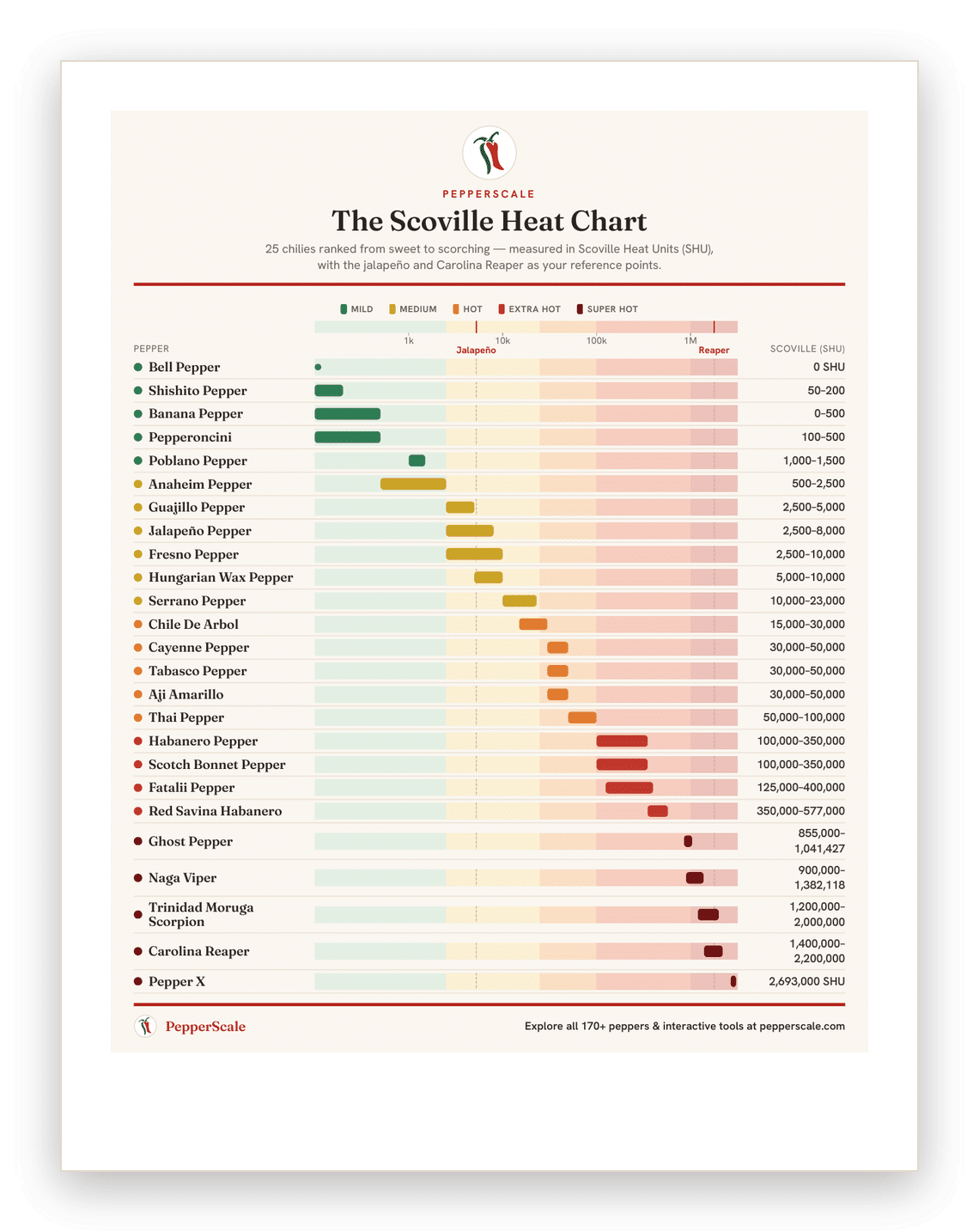
Get the free PepperScale Scoville Heat Chart
A printable, at-a-glance ranking of 25 chilies from sweet to scorching — with the jalapeño and Carolina Reaper as your reference points. Join the newsletter and we’ll send it straight to your inbox.
No spam — just Wicked Wednesday recipes and occasional extra dashes of chili pepper inspiration. Unsubscribe anytime.