Scotch bonnets are hard to find on purpose-built trips and nearly impossible on accidental ones. Outside the sub-tropics and neighborhoods with a strong Caribbean population, most supermarkets simply don’t carry them. So you find the jerk recipe, you read the ingredient list, and you’re stuck.
The good news is that the scotch bonnet belongs to a well-populated flavor family, and that family is where the answer lives. On our flavor map it sits in Fruity & Tropical, with fruitiness at the top of the scale, sweetness right behind, and a modest earthy undertone underneath. A good substitute has to deliver fruit and sweetness at serious heat. Anything that brings heat alone will give you a spicy dish that tastes nothing like the one you were trying to make.

Last update on 2026-10-02. We earn a commission if you make a purchase, at no additional cost to you.

| Pepper | Scoville | Vs. Scotch Bonnet | Use |
|---|---|---|---|
| Scotch Bonnetwhat you're replacing | 100,000–350,000 | — | — |
| Habanero Fruity Closest match | 100,000–350,000 | about the same | 1:1 |
| Datil Fruity Closest match | 100,000–300,000 | about the same | 1:1 |
| Fatalii Fruity Closest match | 125,000–400,000 | about the same | 1:1 |
| Aji Amarillo Fruity Dials the heat down | 30,000–50,000 | ~5.6× milder | 5.6× as much |
| Jalapeño Green & Grassy Easy to find · flavor change | 2,500–8,000 | ~43× milder | — |
| Serrano Green & Grassy Easy to find · flavor change | 10,000–23,000 | ~14× milder | — |
- Cayenne Sharp Brings the heat without the fruity and sweet that carries Scotch Bonnet.
- Thai Sharp Brings the heat without the sweet and fruity that carries Scotch Bonnet.
The best swaps: peppers in the scotch bonnet’s flavor family
Every pepper below is a Capsicum chinense, same species as the scotch bonnet, and every one lands in the same fruity, sweet, high-heat corner. They’re ranked by how easy they are to actually get.
Habanero: the closest thing to a straight swap
The habanero is the answer for most people most of the time. It shares the scotch bonnet’s exact range on the Scoville scale, 100,000 to 350,000 heat units, so you can swap one for one without recalculating anything. The flavor is close but not identical: habaneros are fruity, but a touch less sweet, and they carry a smoky edge where the scotch bonnet carries an earthy one. In a raw sauce you may notice. In jerk, curry, or anything simmered, almost nobody would.
It’s also the practical winner. Habaneros turn up in ordinary supermarket produce sections across North America, often in the same bin real scotch bonnets would occupy if the store carried them.
Datil: the sweetest match on the list
If sweetness is the part of the scotch bonnet you’re chasing, the datil is the better pick. It runs 100,000 to 300,000 SHU, so the heat lands in the same place, and its flavor leans harder into sweet fruit than the habanero does. The catch is geography: datils are closely associated with St. Augustine, Florida, and outside that area you’ll usually be ordering them online or buying them as a sauce rather than a fresh pod. If the datil turns out to be just as hard to find, our datil substitute guide picks up from there.
Fatalii: the same heat, with citrus instead of sweetness
The fatalii runs hotter on the top end, 125,000 to 400,000 SHU, and swaps the scotch bonnet’s sweet-fruit character for a sharp citrus one. That makes it a real substitute rather than a perfect one. It works beautifully in hot sauce and marinades where a lime or orange note is welcome, and it works less well in something like jerk, where the sweetness is part of the dish’s structure.
The near-identical cousins: Madame Jeanette, aji chombo, and the goat pepper
These three are functionally scotch bonnets under other names and other growing conditions. The Madame Jeanette is Suriname’s version, 125,000 to 325,000 SHU, fruity and sweet. Aji chombo is what the scotch bonnet type is called in Panama, running 125,000 to 325,000 SHU. The goat pepper is the Bahamian one, matching the scotch bonnet’s 100,000 to 350,000 range almost exactly. If you find any of them, use them one for one and don’t think twice. Finding them is the hard part.
The easy-to-find compromise: jalapeño or serrano
Nearly every grocer carries jalapeños and most carry serranos. Neither is in the scotch bonnet’s flavor family, and neither is remotely as hot, but they’re what’s actually in the store, and a dish made with the wrong pepper beats a dish you never made.
Be clear-eyed about the gap, though. Jalapeños run 2,500 to 8,000 SHU and serranos 10,000 to 23,000, which puts a serrano at something like a tenth of a scotch bonnet’s heat and a jalapeño well below that. You cannot close that distance by adding more peppers, at least not without changing the texture of the dish entirely.
Flavor is the bigger tradeoff. Both sit in our Green & Grassy family, and in their common green form they bring a bright, vegetal bite that pulls a Caribbean dish somewhere else entirely. If this is the road you’re taking, look for the fully ripened red versions. They’re sweeter and much less grassy, which gets you meaningfully closer. Learn more: Green Vs. Red Jalapeño — How Do They Compare?
Dialing the heat down without losing the fruit
Sometimes the problem isn’t availability, it’s that 200,000 Scoville units is more than you want at the table. There are peppers in the same fruity family at every rung below.
Aji amarillo is the best of them, 30,000 to 50,000 SHU with the same sweet, fruity profile at roughly a fifth of the heat. It’s a Peruvian pepper rather than a Caribbean one, and it’s widely sold as a paste, which makes it easier to source than most fresh alternatives.
Below that, Trinidad perfume and aji dulce are the interesting ones. Both are seasoning peppers in the scotch bonnet’s own species, carrying the fruity aroma with effectively no heat at all, under 1,000 SHU. They’re what you use when you want a dish to smell and taste like it has scotch bonnet in it while staying edible for everyone at the table. Pair one with a small amount of a hotter chili and you can set the fruit and the fire independently.
The rocotillo fills the gap between, at 1,500 to 2,500 SHU. It’s a good low-heat fit, and, like many other chilies here, hard to find outside of specialty growers and seed catalogs.
One to skip: cayenne, Thai chilies, and other pure-heat peppers
The instinct when a recipe calls for a hot pepper you don’t have is to reach for whatever hot pepper you do have. Resist it here. Cayenne (30,000 to 50,000 SHU) and Thai chilies (50,000 to 100,000 SHU) both sit in our Sharp, Pungent & Floral family (mainly sharp and pungent for these two), with essentially no sweetness and no fruit on the profile. Substitute either one into a jerk marinade or a Caribbean pepper sauce and you’ll get a dish that burns correctly and tastes wrong, which is the worst of both outcomes. The same goes for the various super-hots: they’re in the right flavor family, but the heat is so far past the scotch bonnet’s that you’d be dosing in fractions of a pod and hoping.
Pantry options when there’s no fresh pod
Dried scotch bonnets are the most direct fix, and the easiest one to keep on hand. Drying pulls the water out and concentrates what’s left, so the sweetness and fruit survive in tighter form; toast and rehydrate them for sauces and stews, or grind them into a powder you can dose by the pinch. Habanero powder does the same job with the same small flavor tradeoff as the fresh pepper.
Beyond that, a Caribbean-style pepper sauce or a bottled jerk paste will both carry real scotch bonnet or habanero as a primary ingredient. They come with their own vinegar, salt, and aromatics, so treat them as a seasoning decision rather than a like-for-like pepper swap, and pull back on the other seasonings in the recipe accordingly.
Match the substitute to the dish
- Jerk marinade or rub: Habanero first, datil if you have it. The sweetness matters here more than anywhere else.
- Caribbean pepper sauce: Habanero, fatalii, or any of the near-identical cousins. Fatalii’s citrus is an asset in a bottled sauce.
- Curry or stew where the pod simmers whole: Any of the family swaps, one for one. Long cooking flattens the small differences between them.
- Fresh salsa or fruit salsa: Habanero or datil, since the raw application is where the flavor gap is most visible.
- Cooking for a mixed-tolerance table: Trinidad perfume or aji dulce for the aroma, plus a small amount of something hot to taste.
- You only need heat, not character: Red jalapeño or red serrano, and accept that the dish is now a different dish.
How much should you use?
- Habanero, Madame Jeanette, aji chombo, goat pepper: One for one. The heat ranges overlap almost completely.
- Datil: One for one, with a slightly sweeter result.
- Fatalii: One for one, but taste as you go, since the top of its range runs above the scotch bonnet’s.
- Aji amarillo: Roughly four to six times the volume for comparable heat, which usually means using it as a paste rather than a pod.
- Jalapeño or serrano: Don’t try to match the heat by volume. Use the amount the dish can structurally handle and treat the result as a milder version.
- Anything else: Run the numbers with our pepper conversion tool, which converts between peppers by Scoville range rather than by guess.
Pulling it all together
If you take one thing from this: the substitute has to share the scotch bonnet’s fruit, not just its fire. The habanero is the answer for nearly everyone, close enough on heat to swap without arithmetic and close enough on flavor that a cooked dish won’t give you away. Datil is the upgrade if you can get it, fatalii the option when a citrus turn suits the recipe, and the Caribbean cousins are all fine when they happen to appear.
Everything else is a compromise, and compromises are fine as long as you’re making them on purpose. Reach for a red serrano when that’s what the store has, reach for aji dulce when the table can’t take the heat, and keep dried pods or powder in the pantry so the question comes up less often in the first place.
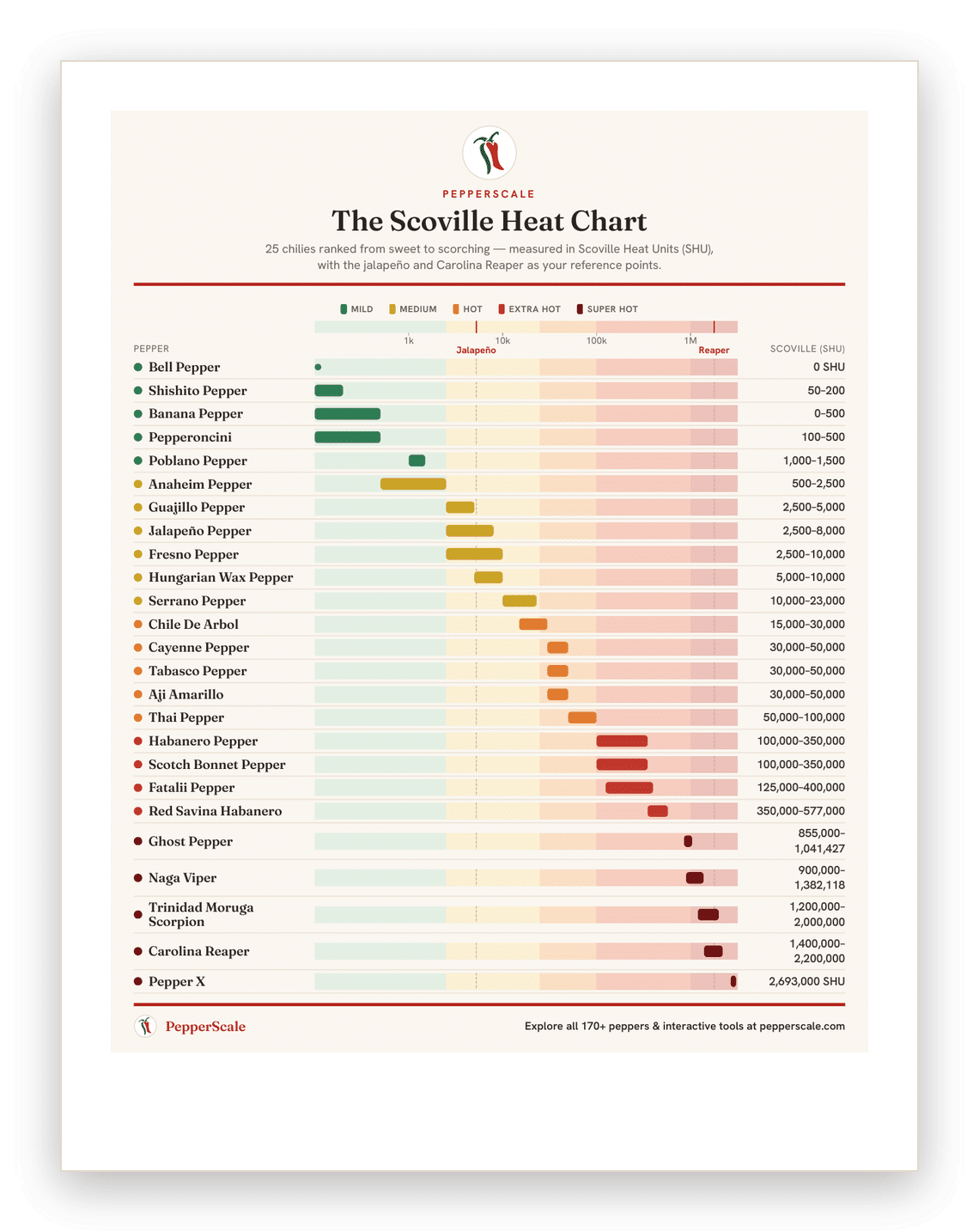
Get the free PepperScale Scoville Heat Chart
A printable, at-a-glance ranking of 25 chilies from sweet to scorching — with the jalapeño and Carolina Reaper as your reference points. Join the newsletter and we’ll send it straight to your inbox.
No spam — just Wicked Wednesday recipes and occasional extra dashes of chili pepper inspiration. Unsubscribe anytime.
Related reading
- The Hot Pepper List: Explore 170-plus chilies, searchable by name, flavor, heat, and origin.
- Scotch Bonnet Orange Hot Sauce: The recipe that makes the case for this pepper in a single taste.
- Scotch Bonnet Vs. Ghost Pepper: How far the jump really is when you go up a tier from here.
going in with my new harvest of Fish peppers will keep y’all posted