Jalapeño peppers are the most popular chilies on the planet. Their very eatable low-medium heat and bright, grassy flavor make the chili very versatile in the kitchen. But unless you’re a gardener with a penchant for spicy food, you may not know that there are many different jalapeño varieties out there, from one sold as a sweet pepper to one its breeders call significantly hotter than its parent.
Below, we break down 23 of them, grouped from mildest to hottest. Some are bred for heat, some for size or color, and one or two might be just the jalapeño your garden needs this year.

Jalapeño varieties at a glance
Here’s the short version. Heat figures are in Scoville heat units (SHU) when a breeder or seller publishes one, and otherwise we quote how the breeder describes it. Varieties marked with an asterisk carry New Mexico State University’s lab figures, which run on a different footing from the rest (more on that below).
| Variety | Heat (SHU) | Known for |
|---|---|---|
| Below standard heat | ||
| Fooled You | Sold as a sweet jalapeño | The jalapeño look, minus the heat |
| Señorita | Under 600 | Barely-there heat |
| TAM Mild Jalapeño | About 1,080 to 1,620 (TAM Mild II) | The Texas A&M mild line |
| NuMex Primavera* | 8,500 | Mild 2-inch pods |
| Within standard heat | ||
| Early Jalapeño | Medium-hot | The open-pollinated standard |
| Purple jalapeño | 2,500 to 8,000 | Green, purple and red on one plant |
| Black jalapeño | 2,500 to 10,000 (seller figure) | Very dark pods |
| Jalafuego | 4,000 to 6,000 | Smooth 3½- to 4-inch pods |
| Jalapa | Medium | Early, about 65 days |
| Jaloro | “Pungent” | Yellow pods that ripen red |
| Chichimeca | “Pungent” | Pods about 4 by 1½ inches |
| Firenza | Not rated | Dark green, cylindrical pods |
| Mammoth | “Pleasing” | Pods about 4¾ by 1¾ inches |
| Chilipeño | Not rated | Pods up to about 6 inches |
| NuMex Jalmundo* | 17,000 | Jumbo pods for poppers |
| NuMex Pumpkin Spice* | 22,000 to 25,000 | Ripens pumpkin orange |
| NuMex Lemon Spice* | 25,000 | Ripens bright yellow |
| NuMex Vaquero* | 33,000 | Resists Phytophthora blight |
| Above standard heat | ||
| Mucho Nacho | Slightly hotter than most | Thick-walled 4-inch pods |
| Mitla | “Highly pungent” | Big, uniform yields |
| Biker Billy | “Very hot” | Broad 3½-inch pods |
| NuMex Piñata* | 52,000 | Green, yellow, orange, then red |
| NuMex Orange Spice* | About 80,000 | Ripens bright orange |
What makes a pepper a jalapeño?

A jalapeño is a pod type of Capsicum annuum, the species that also gives us bell peppers and cayenne pepper. It takes its name from Xalapa, in the Mexican state of Veracruz. The classic pod is thick-walled and 2 to 3½ inches long, turning from green to red as it ripens.
Every name on this list is a cultivar, bred and selected for something in particular: less heat, more heat, bigger pods for stuffing, a new color, or resistance to a disease that troubles growers. Some are open-pollinated, so seed you save will grow the same pepper next year (as long as it didn’t cross with a neighbor). Others are F1 hybrids, and their saved seed won’t come true. When we quote a variety’s “listing” below, it’s the breeder’s description as collected in Vegetable Cultivar Descriptions for North America (peppers A to L and M to Z).
Comparing NMSU’s numbers? Do it carefully, because the university tests its own jalapeños in the lab, and its figures sit far above the 2,500 to 8,000 SHU you’ll see on most seed packets. NuMex Vaquero tests at 33,000 SHU there, and NMSU’s cultivar report calls that similar to Early Jalapeño, a garden standard. The report says outright that its Jalmundo figure is on a dry-weight basis. So line up NMSU varieties against each other, not against a seed-packet range.
Below standard jalapeño heat
These four were bred to go easy on you. Cooking for kids, a crowd or a tender palate? Start here.
Fooled You
Fooled You is a sweet jalapeño, a 1999 hybrid that Jim Waltrip bred for Seminis’s Petoseed line. The pods are about 3 inches long, tapering and medium to dark green. That’s the joke in the name: it looks like a jalapeño on the plate, but it’s sold as a sweet one. So if you want the look of jalapeño poppers with none of the burn, this is your pepper.
Señorita
Want the jalapeño’s crunch with barely a tingle? Señorita, a Petoseed jalapeño from 1995, keeps the shape and gives up almost all of the fire. Its breeder rated it under 600 SHU in most growing conditions, and it resists three of the viruses that hit pepper crops. Its catalog listing names TAM Mild Jalapeño as its closest match.
TAM Mild Jalapeño
The TAM jalapeño is a mild one with a long track record. Ben Villalon bred TAM Mild Jalapeño at Texas A&M, and it came out in 1981 as a compact, open-pollinated plant with mildly hot pods, fruit set that holds up in summer heat and resistance to four viruses. In 2001 trials, the follow-up TAM Mild Jalapeño II came in around 1,080 to 1,620 SHU. So you get roughly the heat of a mild poblano pepper (1,000 to 1,500 SHU).
NuMex Primavera
NuMex Primavera came out of NMSU in 1998, bred by Paul Bosland and Eric Votava, and the university calls its heat uniformly mild, much milder than industry-standard jalapeños. It tests at 8,500 SHU on NMSU’s scale. Its pods measure roughly 2 by 1 inches, with little to no corking, and NMSU says it’s a favorite of home gardeners.
Within standard jalapeño heat
Where do most garden and grocery jalapeños fall? Right here, and what sets these apart from each other is size, color or toughness in the field rather than heat.
Early Jalapeño
Early Jalapeño is the open-pollinated standard, and most of NMSU’s newer jalapeños descend from it. Its listing calls it medium-hot, with pods about 3 inches long that ripen green to red. You’ll likely see a little corking, the tan lines that can crack across a pod’s skin.
Purple Jalapeño

Purple jalapeños are standard in terms of flavor and heat, with their color being their only unique characteristic. Their heat is in the 2,500 to 8,000 SHU range, fitting them even with the typical common jalapeño. The pods go from green to a deep purple and then to red, and you’ll often find all three colors on the same plant.
Black Jalapeño
Are black jalapeños truly black? Not quite, and the name belongs to sellers more than to a single variety. One seed company sells it as another name for Black Magic, a hybrid that Johnny’s Selected Seeds describes as an extra-dark green jalapeño, the darkest it carries, with 3½- to 3¾-inch pods. So expect very dark pods rather than truly black ones. Sellers list 2,500 to 10,000 SHU, so the hottest pods could reach the bottom of the serrano pepper range (10,000 to 23,000 SHU).
Jalafuego

The jalafuego is a big, smooth hybrid whose range of 4,000 to 6,000 SHU starts above a standard jalapeño’s floor and stops below its ceiling, so think steadier rather than hotter. Johnny’s lists the pods at 3½ to 4 inches and resistant to checking, the small cracks that show up on corky jalapeños. On vigorous plants, you can expect very high yields.
Jalapa Hybrid
If you want peppers early, the Jalapa hybrid from Petoseed is ready in about 65 days. Its listing gives it medium heat and a concentrated set of thick-walled pods, about 2½ inches long, tapering to a blunt tip and ripening from medium green to red.
Jaloro
Want a jalapeño that stands out in the salsa bowl? Jaloros (you’ll sometimes see them spelled Jalaro) are colorful: instead of the usual green, the pods are bright yellow, and they turn bright red at maturity. Texas A&M released them in 1992, bred by Ben Villalon and colleagues. Each pod is around 2 inches by 1, and the plants resist five viruses and keep setting fruit at 100°F (38°C). Their breeders describe the pods as pungent, so don’t mistake the color for mildness.
Chichimeca
Chichimeca is a big Seminis hybrid from 2004. The pods run about 4 inches long and 1½ inches wide, weighing around 1¼ ounces each, and they mature early, in a concentrated set. Its listing calls it pungent, so you shouldn’t count on it being mild, and it names Conchos as a similar jalapeño.
Firenza
Firenza is a 1994 hybrid from Rogers, with dark green, cylindrical pods that ripen to red. Its listing pairs it with Mitla as a similar jalapeño.
Mammoth Jalapeño
As their name suggests, Mammoth jalapeños are a large variety. One seed supplier, Seedway, lists the pods at 4¾ inches long and 1¾ inches across, with very thick flesh, which makes them excellent as a popper pepper. Seedway calls the heat level pleasing.
Chilipeño Hybrid
The Chilipeño hybrid is the giant of this group. Its listing calls it a super-sized jalapeño, about 6 inches long and 1¼ inches wide, with thick walls, on very productive plants that tolerate heat and drought. The pods ripen from a dark, shiny green to bright red.
NuMex Jalmundo
Making poppers for a crowd? NuMex Jalmundo is NMSU’s jumbo jalapeño, from a cross between a bell pepper and Early Jalapeño, released in 2010. The pods average 3.7 inches long and 1.4 inches wide, ripening green to red, and NMSU calls them perfect for poppers. It’s medium heat by NMSU’s measure, 17,000 SHU on a dry-weight basis, a step below Early Jalapeño.
NuMex Lemon Spice and NuMex Pumpkin Spice
Want color without extra heat? These two come from a cross NMSU made in 1995 between Permagreen bell pepper and Early Jalapeño, released in 2015 alongside NuMex Orange Spice. Lemon Spice ripens bright yellow and has a slightly smaller pod than Early Jalapeño. Pumpkin Spice ripens pumpkin orange on a longer pod. Both have smooth skin with no corking, and NMSU puts both at about the heat of Early Jalapeño.
NuMex Vaquero
Has Phytophthora blight taken out your peppers before? Then NuMex Vaquero (1997) is the one to grow. NMSU bred its resistance in from Criollo de Morelos 334, a landrace from Mexico. Expect pods around 2½ inches long and nearly an inch across, smooth-skinned, green and free of purple blushing. NMSU gives it traditional jalapeño flavor with more sweetness, at about the heat of Early Jalapeño.
Above standard jalapeño heat
Want a jalapeño with more kick? These five run hotter. The order is loose, since breeders describe heat in different ways, but NuMex Orange Spice has the highest lab number.
Mucho Nacho
Mucho Nacho is a Burpee hybrid from 1999, and its listing says it runs slightly hotter than other jalapeños. The pods are big, about 4 inches long with thick walls, ripening green to red on vigorous plants with very high yields in about 72 days.
Mitla Hybrid
Mitla, a Petoseed hybrid from 1990, is a workhorse: large, uniform pods and exceptional yields, ripening green to red. NMSU even used it as the yield benchmark for NuMex Vaquero. Its listing calls it highly pungent, so this is no middle-of-the-road jalapeño.
Biker Billy
Named after motorcyclist, cookbook author and TV host Bill Hufnagle, better known as Biker Billy, this Burpee hybrid from 1999 is hot by most standards. Its listing calls it very hot. The pods are broad, about 3½ inches long and 2 inches across the shoulders, and you can start picking in about 66 days.
NuMex Piñata
Similar to purple jalapeños, NuMex Piñatas come in multiple colors. The variety turned up as a natural mutation of Early Jalapeño and was released by NMSU in 1998. Pods go from light green to yellow, orange and finally red, and even the leaves are yellowish. Don’t let the party colors fool you, though. NMSU calls it hot, at 52,000 SHU in its tests, with the flavor and aroma of a traditional jalapeño.
NuMex Orange Spice
Need the hottest jalapeño on this list? NuMex Orange Spice is the hothead of NMSU’s 2015 spice trio. It ripens bright orange on a longer pod than Early Jalapeño, with the same corky skin. In NMSU’s tests it averaged about 80,000 SHU, which the university calls significantly hotter than Early Jalapeño.
Is chipotle a jalapeño variety?
No. A chipotle is a way of preserving a jalapeño rather than a variety of one. Chipotle peppers are dried, smoked red jalapeño peppers, used in a variety of Mexican and Tex-Mex dishes. Chipotle peppers have a unique flavor that is smoky, earthy, and slightly sweet, and typically maintain the 2,500 to 8,000 Scoville heat range of fresh jalapeños.
–> Learn More: Chipotle Vs. Jalapeño: How Do They Compare?
Which jalapeño variety should you grow?
Start with what you want from the plant:
- For little to no heat: Señorita or TAM Mild Jalapeño, or Fooled You if you want the look without the heat.
- For poppers: Mammoth, Chilipeño, NuMex Jalmundo or the jalafuego.
- For color: NuMex Piñata, Jaloro, the NuMex spice trio or a purple jalapeño.
- For the most heat: NuMex Orange Spice, NuMex Piñata or Biker Billy.
- For a garden with blight problems: NuMex Vaquero.
- For saving your own seed: an open-pollinated type like Early Jalapeño, TAM Mild Jalapeño, Jaloro, NuMex Primavera, NuMex Piñata or NuMex Vaquero.
Our jalapeño planting guide has the rest of what you need. And if a variety you bought as hot comes up mild, here’s why that happens.
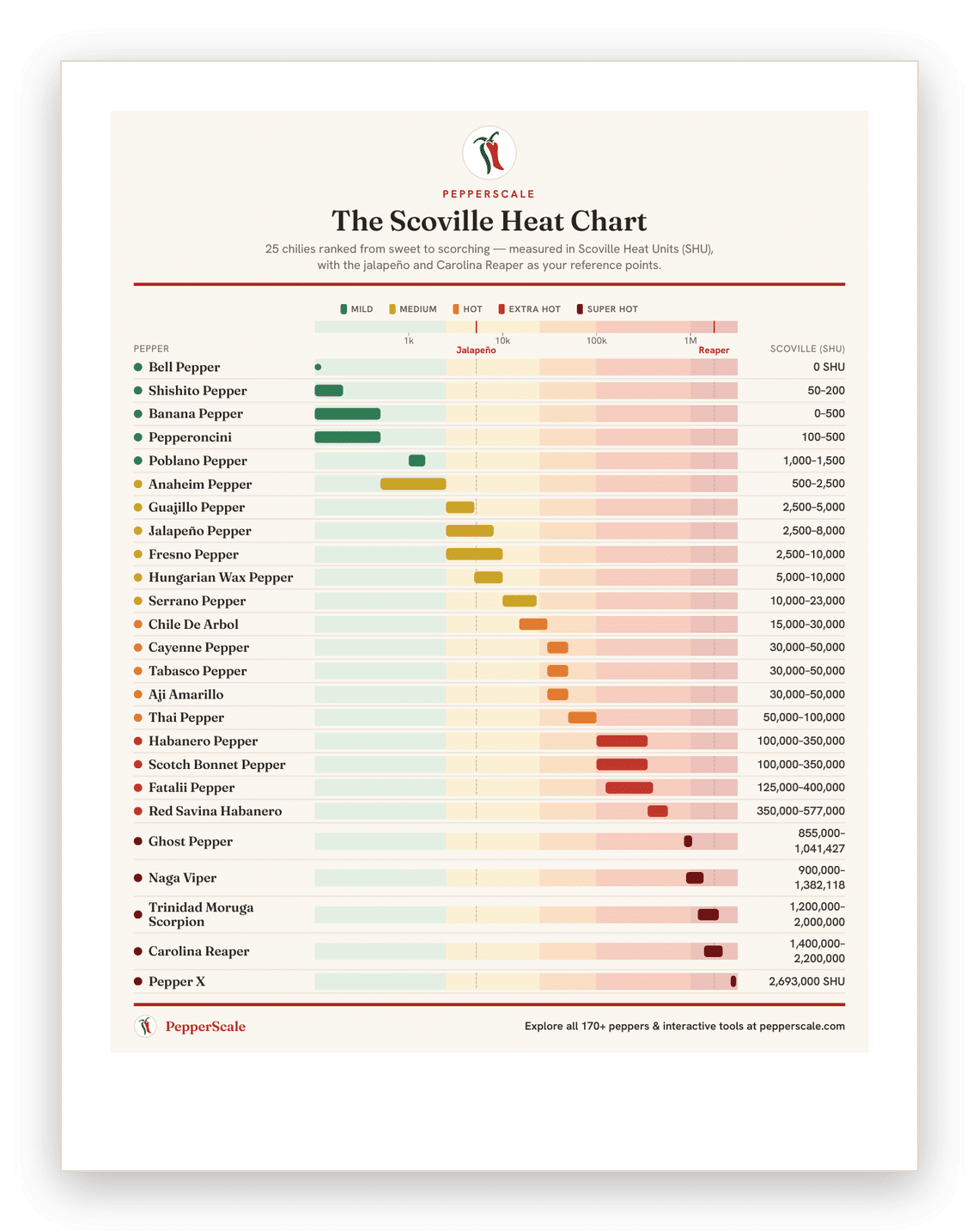
Get the free PepperScale Scoville Heat Chart
A printable, at-a-glance ranking of 25 chilies from sweet to scorching — with the jalapeño and Carolina Reaper as your reference points. Join the newsletter and we’ll send it straight to your inbox.
No spam — just Wicked Wednesday recipes and occasional extra dashes of chili pepper inspiration. Unsubscribe anytime.
Related reading
- The Hot Pepper List: We cover over 150 chilies here at PepperScale. Search our list by name, heat levels, flavor, origin, and more.
- Are Dried Peppers Hotter Than Fresh? What happens in the drying process? Do chilies taste hotter after being dried?
- Pickled Jalapeño Vs. Fresh: How do they compare?