What’s A Good Banana Pepper Substitute?

Need fresh banana peppers and the store hasn’t got them? Or you’re out of banana pepper rings and the recipe wants them? You’re in luck, because this is one of the easier substitutions to make. Two of the alternatives look so much like a banana pepper that you’d have trouble telling them apart in a jar.

Banana Pepper Substitute
Banana peppers have some excellent substitutions, varying in availability
Banana substitutes, compared
Banana Group A Aroma families sort peppers by their loudest smell, not their heat. A swap inside the family changes the heat; a swap across families changes the dish.AGreen & Grassyjalapeño · green, vegetal, just-cutBFruity & Tropicalhabanero · tropical fruit, sweet on the noseCNutty, Earthy & Driedancho · dried and smoked: raisin, cocoaDSharp, Pungent & Floralcayenne · terpene top notes, heat unmasked Banana is Green & Grassy. A swap from the same aroma family changes the heat but keeps the character; a swap from another family changes the dish. 5 of the 5 options below sit in the same family.
The swaps, side by side
PepperScoville Vs. BananaUse
Bananawhat you're replacing 0–500
Pepperoncini Green & Grassy Closest match 100–500 ~1.2× hotter 1.2× less
Bell Green & Grassy Dials the heat down 0–0 no heat at all
Cubanelle Green & Grassy Easy to find 100–1,000 ~2.2× hotter 2.2× less
Pimento Green & Grassy Easy to find 100–500 ~1.2× hotter 1.2× less
Anaheim Green & Grassy Easy to find 500–2,500 ~6× hotter 6× less
Ratios match heat by volume, worked from the midpoint of each Scoville range. They are a starting point, not a substitute for tasting as you go — and they say nothing about flavor, which is what the aroma family tags are for.
Where they land on the scale
Bell Banana Pepperoncini Pimento Cubanelle Anaheim
PoblanoJalapeñoSerranoCayenneHabaneroReaper
Flavor, one by one
Each solid shape is that pepper’s flavor profile, with Banana dashed underneath for comparison. Axes run clockwise from the top: sweet, fruity, tangy, fresh, bitter, smoky, earthy, floral.
Pepperoncini Near-identical profile
Bell Near-identical profile
Cubanelle Less tangy
Pimento Less tangy
Anaheim Fruitier, less tangy
Flavor axes are editorial estimates on a 0–10 scale, not laboratory measurements.
Skip these
  • Jalapeño Green & Grassy Brings the heat without the tangy that carries Banana.

Your best bet: Pepperoncini pepper

There aren’t many pepper pairings that share as much as the pepperoncini and the banana pepper. They look alike, down to the same pale banana-yellow color and long tapered shape. They’ve got the same tang and sweetness. Even the heat’s nearly the same, with the only real gap being that a banana pepper can bottom out at no heat at all (0 to 500 Scoville heat units) while the Italian pepperoncini keeps a little something in reserve (100 to 500 SHU).

That closeness runs deeper than the appearance. Both peppers land in the same green-and-grassy family and both read sweet and tangy in the same proportions. A swap between them survives even in dishes where the pepper is the point rather than the background, which is more than most substitutions manage.

You’ll find pepperoncini just as easily, too, both pickled in jars and, at better-stocked grocers, fresh in the produce aisle. When you need a banana pepper substitute, this is the one. We put the two head to head in Banana Pepper Vs. Pepperoncini – How Do They Compare? if you want the full breakdown.

A step up in spiciness: Hungarian wax pepper

If the banana pepper and the pepperoncini are near twins, the Hungarian wax is the older brother nobody warns you about. It’s slightly larger, it has the same banana-yellow look, and it brings a similar tang.

The difference is heat, and it’s not a small one. Hungarian wax peppers run 5,000 to 10,000 SHU, which puts them level with jalapeño peppers and often past them. Against a banana pepper’s 0 to 500, you’re looking at something on the order of ten to twenty times the burn. Swap one for the other without thinking and you’ll notice.

That makes this the pick for when you actually want the heat rather than the pepper. They turn up in most grocery stores, both as hot pickled rings and sometimes fresh, so availability isn’t the problem. Just don’t reach for them on autopilot.

If you must: Anaheim pepper

This one’s a recommendation of convenience, not of similarity. Anaheim peppers are lightly sweet rather than tangy, so the flavor doesn’t line up the way the pepperoncini does. What they’ve got going for them is that they’re mild (500 to 2,500 SHU), they’re versatile, and they’re turning up in more stores every year.

If the fresh produce aisle is all you’ve got, an Anaheim beats a jalapeño by a wide margin. A jalapeño starts at 2,500 SHU, right where the Anaheim tops out, and it’ll take the dish somewhere the recipe didn’t intend.

Two the list was missing: cubanelle and pimento

Two more peppers belong on this list, and they’re both easier to find than the Anaheim.

Cubanelles run 100 to 1,000 SHU and they’re in the same sweet, thin-walled family. They’re longer and a touch bigger than a banana pepper, but the shape and the pale color are close enough that they get confused in the produce bin. For anything fried, roasted or stuffed, that’s the best fresh swap on the page.

Pimentos are the other one, at 100 to 500 SHU, which is the pepperoncini’s exact band. They’re sweet rather than tangy and they’re shaped nothing like a banana pepper, so they’re a poor visual match. Where they win is in anything blended or chopped, where the shape stops mattering and you just want a sweet, mild pepper that’s already in a jar on the shelf.

One to skip: the jalapeño

The jalapeño is the swap people reach for because it’s the mild-ish chili they know, and it’s the wrong one. At 2,500 to 8,000 SHU it starts where the Anaheim finishes and runs up from there. A banana pepper tops out at 500.

Flavor is the rest of it. Banana peppers are lightly sweet and tangy, and a jalapeño’s bright and grassy with no sweetness to speak of. Put jalapeño rings on a sandwich built for banana peppers and you haven’t made a spicier sandwich, you’ve made a different one. If heat’s what you’re after, the Hungarian wax gets you there and keeps the tang.

Match the substitute to the dish

  • Pickled, on sandwiches, pizza or a salad: Pepperoncini, straight from the jar. This is the swap nobody at the table will catch, since the brine does most of the talking and the two peppers taste nearly the same underneath it.
  • Stuffed, fried or roasted whole: Cubanelle. You want a thin wall and a long cavity, and a cubanelle gives you both at a slightly larger size, so plan on fewer peppers than the recipe lists.
  • Sliced raw into a salad or a sandwich: Pepperoncini again if you’ve found them fresh, or a cubanelle cut into rings. A softer pepper goes limp here, and both of these keep their crunch.
  • Chopped into a dip, a spread or pimento cheese: Jarred pimentos. The shape is wrong and it doesn’t matter once the pepper is diced, and you get the sweetness without any real heat.
  • When you want the dish hotter, not just filled in: Hungarian wax. It’s a deliberate upgrade rather than a stopgap, keeping the tang and the look while taking the heat up to jalapeño level.

How much should you use?

Banana peppers are mild enough that most of these swaps are one for one. The two that need watching are the ones that move the heat.

  • Pepperoncini for banana pepper: One for one, pickled or fresh, no adjustment needed. They’re the same size and nearly the same heat, and the tang is close enough that the brine covers any gap.
  • Cubanelle for banana pepper: Go by weight rather than count, since a cubanelle’s longer and wider. Two cubanelles will usually cover three banana peppers, and the heat’s close enough to ignore.
  • Pimento for banana pepper: One for one by volume once it’s chopped. You’ll lose the tang, so a splash of the pickle brine or a little vinegar puts back what the swap takes out.
  • Hungarian wax for banana pepper: Start at a quarter and taste. At ten to twenty times the heat, a straight swap turns a mild dish into a properly spicy one, which is fine if that’s the plan and a problem if it isn’t.
  • Anaheim for banana pepper: One for one on volume, but expect the flavor to shift toward fruity and away from tangy. A little vinegar helps here too if the dish was leaning on that pickled quality.

Our pepper conversion tool handles the heat math for any two chilies, and the dish heat calculator shows where the finished dish lands.

Pulling it all together

This is one of the friendliest substitutions in the kitchen, which makes a nice change. The pepperoncini’s close enough to a banana pepper that most people can’t tell them apart, and it’s sitting on the same shelf. Cubanelle covers you for anything fresh and stuffed, pimentos cover anything chopped, and the Hungarian wax is there when you want the same pepper with real heat behind it. About the only way to get this wrong is to grab a jalapeño because it’s closest.

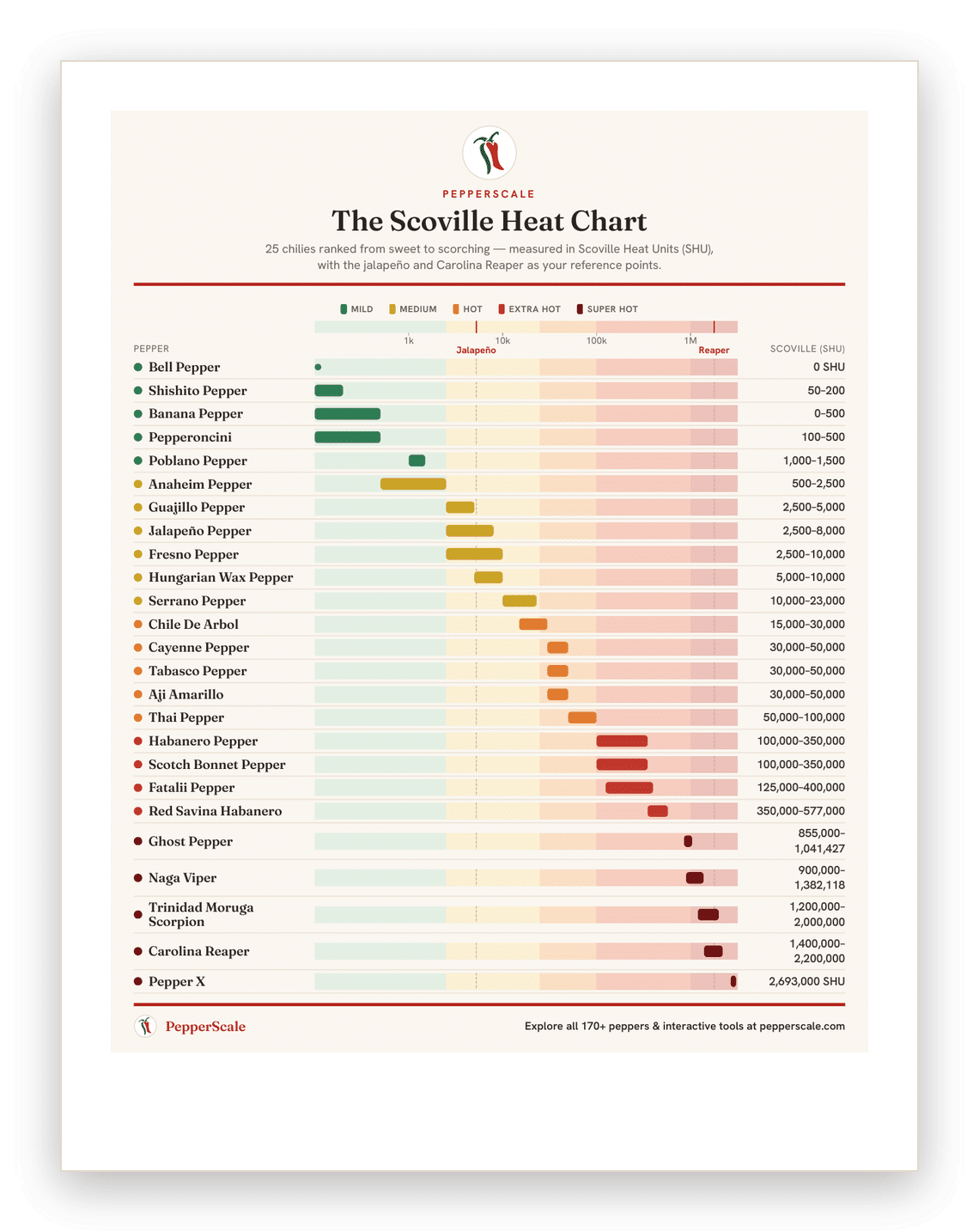
The PepperScale Scoville Heat Chart
Free printable

Get the free PepperScale Scoville Heat Chart

A printable, at-a-glance ranking of 25 chilies from sweet to scorching — with the jalapeño and Carolina Reaper as your reference points. Join the newsletter and we’ll send it straight to your inbox.

No spam — just Wicked Wednesday recipes and occasional extra dashes of chili pepper inspiration. Unsubscribe anytime.

Related reading

Subscribe
Notify of
guest

0 Comments