Ask anyone where to find the spiciest food in America and you’ll start an argument. Most people name their own town, or the last place that made them sweat through a shirt. So we asked a different question. If you want a city where chili peppers are part of the local identity, where should you go? We mean a pepper the town claims as its own, a tradition with real years behind it, and locals who still care enough to search for it.
By that measure, New Mexico runs away with it. The Hatch Valley and the Albuquerque and Santa Fe area have the deepest chili culture in the country, right down to an official state question about it. Close behind come Louisiana’s hot sauce country, St. Augustine and its datil, Pueblo, Tucson and San Antonio. Then there are the cities that built their fame on one hot dish, like Nashville and Buffalo. Below is how we sorted all twelve, and the history you should know behind each one.
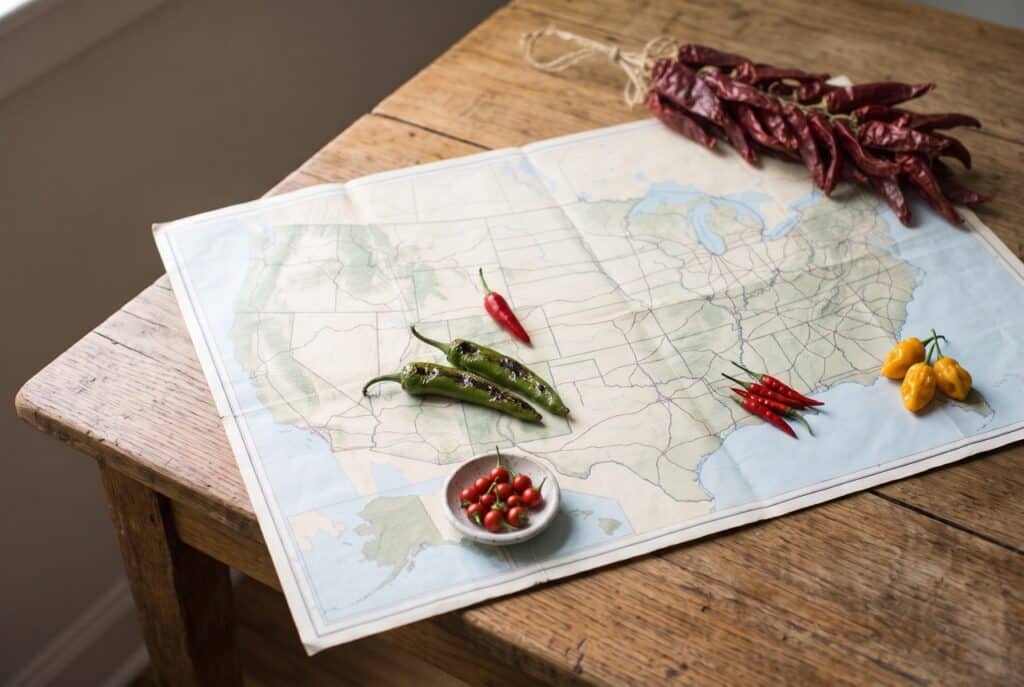
How did we pick the best cities for spicy food?
Is there a way to measure which city eats the most chili? Not directly. Nobody tracks it at the city level, so any single “spiciest city” score would be made up. Instead, we checked each city for six things anyone can look up:
- A signature hot dish or condiment that started there or is known for it.
- A local pepper, ideally one that carries the place’s name.
- How far back the tradition goes, using the earliest date we could find on record.
- Official recognition, like a state symbol or a UNESCO City of Gastronomy title.
- A festival that’s still running, and for how long.
- Whether the city owns its search. We looked up each city’s signature pepper or dish in Google Trends for the five years up to November 2026, by metro area. If locals care about something, you’ll usually see their metro lead the country in searching for it.
Then we grouped the cities into tiers instead of adding up the checks. Tier one is for the chili capitals, where the claim rests on chilies themselves, backed by a long history or official recognition. Tier two is for cities built around one famous dish or sauce. Los Angeles gets a tier of its own, for reasons you will see.
One more note on spelling. You will see “chile” in names like the Hatch Chile Festival, because that is how New Mexicans spell it. We use “chili” everywhere else, and our look at chili vs. chile explains the difference.
The scorecard
Here is how the twelve cities stack up, so you can compare them at a glance. A check means the city meets that marker, and you’ll find the dates and sources in each city’s section. Don’t read the checks as a score, though. Pueblo has the most, but New Mexico’s chili culture is far bigger, and the tiers reflect that.
| City | Tier | Local pepper | On record before 1950 | Official recognition | Festival | Search rank |
|---|---|---|---|---|---|---|
| Hatch and Las Cruces, NM | 1 | ✓ | ✓ | ✓ | ✓ | 2nd |
| Albuquerque and Santa Fe, NM | 1 | ✓ | ✓ | ✓ | 1st | |
| Avery Island, New Iberia and Lafayette, LA | 1 | ✓ | ✓ | 1st | ||
| St. Augustine, FL | 1 | ✓ | ✓ | ✓ | 1st | |
| Pueblo, CO | 1 | ✓ | ✓ | ✓ | ✓ | 1st |
| Tucson, AZ | 1 | ✓ | ✓ | 1st | ||
| San Antonio, TX | 1 | ✓ | ✓ | 3rd | ||
| Nashville, TN | 2 | ✓ | ✓ | 1st | ||
| Buffalo, NY | 2 | ✓ | Not top 5 | |||
| New Orleans, LA | 2 | ✓ | 1st | |||
| Honolulu, HI | 2 | ✓ | 1st | |||
| Los Angeles, CA | 3 | Not top 5 |
Tier one: America’s chili capitals
Hatch and Las Cruces, New Mexico
Hatch is a farming village of about 1,600 people in southern New Mexico, and it calls itself the Chile Capital of the World. Its name has become shorthand for the long green Hatch chilies grown up and down the valley.
The science behind those chilies came from just down the road in Las Cruces. In 1913, horticulturist Fabián García of what is now New Mexico State University released New Mexico No. 9, according to NMSU. Later releases you may know, from the Sandia (1956) to the Big Jim (1975), came out of the same program. NMSU still runs the Chile Pepper Institute, founded in 1992.
The Hatch Chile Festival has been held on Labor Day weekend since the early 1970s, with sources splitting between 1971 and 1972 for the first one. If you doubt the reputation, the searches back it up. The El Paso metro, which takes in Las Cruces and Hatch, ranks second nationally for “hatch chile,” just behind Albuquerque and Santa Fe.
Albuquerque and Santa Fe, New Mexico
If Hatch grows the chilies, the Albuquerque and Santa Fe area eats them like nowhere else. Order enchiladas here and you will be asked “Red or green?” meaning red or green chili sauce. The answer “Christmas” gets you both. In 1996, the legislature passed a memorial asking the state to make “Red or green?” New Mexico’s official state question. No other state has one.
Chili and pinto beans have been New Mexico’s official state vegetables since 1965, and the aroma of roasting green chili is now the official state aroma, too. Yes, you read that right. Northern New Mexico also has its own heirloom: the Chimayó pepper, a small, curled landrace from the hills around Chimayó, north of Santa Fe, at 4,000 to 6,000 SHU.
Nobody can say exactly when chilies arrived here, and accounts differ on whether Pueblo farmers or Spanish colonists grew them first. What isn’t in doubt is how much locals care. Albuquerque and Santa Fe lead the nation in searches for both “green chile” and “hatch chile.”
Avery Island, New Iberia and Lafayette, Louisiana
Some of Louisiana’s oldest hot sauce brands come from one small corner of Cajun country. On Avery Island, Edmund McIlhenny grew his first commercial crop of tabasco peppers in 1868, by the company’s own history. He sent out 658 bottles of sauce the next year and patented it in 1870. Is that the full story? Not quite, and some of the official version is disputed. A New Orleans planter named Maunsel White was reportedly making a tabasco pepper sauce two decades earlier.
Nearby New Iberia became a hot sauce town in its own right. Trappey’s started there in 1898, and Bruce Foods began selling The Original Louisiana Hot Sauce in 1928. There is no festival or state title to point to, but the searches tell you where the bottles come from. The Lafayette metro covers Avery Island and New Iberia, and it leads the country in searches for “Tabasco.” If you have never tried the original red sauce, it is aged pepper mash, vinegar and salt, and not much else.
St. Augustine, Florida
St. Augustine’s pepper is the datil, a small yellow-orange Capsicum chinense pepper with habanero-level heat, around 100,000 to 300,000 SHU. Commercial growing is mostly confined to the St. Augustine and Jacksonville area, and you’ll find it in Minorcan clam chowder, a spicy tomato-based soup, and in a pile of local sauces, relishes and jellies.
Where did it come from? The story told most often is that Minorcan settlers brought it. They arrived in Florida in 1768 to work Andrew Turnbull’s New Smyrna colony and moved up to St. Augustine after it collapsed. But a 2015 Southern Cultures article calls that account “widely accepted folklore.” A 1937 article in the local paper told a different story, crediting a jelly maker named S.B. Valls with bringing seeds from Cuba around 1880. Neither story is proven. What you can safely say is that St. Augustine has grown datils since at least the 1930s, and very likely much longer.
Either way, the pepper has outlasted the argument. St. Johns County declared the first Saturday in October Datil Pepper Day in 2013, and the Jacksonville metro, which includes St. Augustine, leads the country in searches for “datil pepper” by a wide margin. If you want a taste without the trip, we have reviewed a few local bottles, including Minorcan Mike’s datil pepper sauce.
Pueblo, Colorado
If you’ve only tried Hatch chilies, Pueblo is the one to know next. The Colorado city is New Mexico’s friendly rival. Its pepper is the Mirasol, Spanish for “looks at the sun,” because the pods grow pointing up instead of hanging down. Farmers around Pueblo have grown chilies “since at least the late 1800s,” according to History Colorado. An improved strain released in 2005, the Mosco, is named for farmer Harry Mosco, who left his family the seed.
Growers organized in 2015 as the Pueblo Chile Growers Association, and in 2018 the state approved a license plate with a Mirasol plant on it. The Chile & Frijoles Festival has run since the mid-1990s and marked its 25th year in 2019. Pueblo is still small next to New Mexico, though. Colorado Public Radio put Colorado at about 333 acres of chilies against about 8,100 in New Mexico, using 2012 farm census numbers.
Heat? Pueblo’s boosters call its chili hotter and meatier than Hatch, but we don’t have a lab heat range to back that up. What we can say is that the Colorado Springs and Pueblo metro owns the search for “pueblo chile” outright.
Tucson, Arizona
Why does Tucson make the top tier? Its claim rests on a wild pepper. The chiltepin, a tiny round chili at 50,000 to 100,000 SHU, still grows wild in the mountains south of the city. In 1999, the Coronado National Forest set aside a 2,500-acre Wild Chile Reserve around Rock Corral Canyon in the Tumacácori Mountains, home to the largest wild chili population in Arizona.
Then, in December 2015, Tucson became the first UNESCO City of Gastronomy in the United States. The designation rests on the region’s food heritage in general, which local groups say includes the chiltepin, not on chilies alone. Still, Tucson leads the nation in searches for “chiltepin,” and, oddly enough, for “chili con carne” too.
San Antonio, Texas
Where did chili first become street food in America? San Antonio is a good answer. From about 1870 to 1930, the city’s “chili queens” served chili, tamales and enchiladas from open-air stands on Military Plaza and other downtown squares, Texas Public Radio reports. Health rules and complaints from restaurant owners eventually pushed them out.
Texas has since made it official, several times over. Chili became the state dish in 1977, the jalapeño the state pepper in 1995, and the chiltepin the state native pepper in 1997. Want proof that Texas takes this seriously? The chiltepin resolution even notes that the mockingbird, the state bird, eats the peppers almost exclusively when they are in season. UNESCO named San Antonio a City of Gastronomy in 2017, and the San Antonio metro ranks third in the country for “chili con carne” searches.
Tier two: cities built on one hot dish
Nashville, Tennessee
Hot chicken is Nashville’s dish, and its origin story is almost too good. The Prince family says Thornton Prince’s girlfriend loaded his fried chicken with extra pepper to get back at him for cheating, and he loved it. By the mid-1930s, he and his brothers had opened a chicken shack, and his great-niece, André Prince Jeffries, has run Prince’s Hot Chicken Shack since 1980. The cayenne paste that defines the dish today may only date to the 1970s.
The Music City Hot Chicken Festival has been held on the Fourth of July since 2007, based on NewsChannel 5’s count. You can see the city’s claim in search, too. Nashville leads the country in searches for “hot chicken.”
Buffalo, New York
Buffalo wings, as the usual story goes, started at the Anchor Bar in 1964, when Teressa Bellissimo tossed fried wings in hot sauce. So who made the first one? That is disputed. John Young, a local restaurant owner, said he was serving uncut wings in his own “mumbo sauce” by the early 1960s.
The sauce you probably know is a cayenne sauce like Frank’s RedHot, though it probably wasn’t the one used in 1964. Frank’s has a Louisiana connection, too: it started in Cincinnati, but its first peppers came from a Louisiana farm. The National Buffalo Wing Festival has run since 2002.
Here’s the twist. Buffalo doesn’t make the top five for “buffalo wings” searches. Our guess is that locals just call them wings, but that’s only a guess. Search data can’t tell you why.
New Orleans, Louisiana
New Orleans has its own table sauce: Crystal, a simple aged cayenne sauce made by Baumer Foods since 1923. If Maunsel White’s sauce did come first, the city’s hot sauce history goes back further still. New Orleans leads the country in searches for “crystal hot sauce.” We’ve given it a full review, and if you’d like to make your own, start with our homemade Louisiana hot sauce.
Honolulu, Hawaii
Hawaii’s everyday hot sauce is barely a sauce at all. Chili pepper water, wai nīoi in Hawaiian, starts with just red chilies, salt and water. Traditionally it’s made with the small Hawaiian chili pepper, called nīoi.
Want proof that locals care? This is the clearest search result on this list. Honolulu’s interest in “chili pepper water” is more than 30 times that of any other metro. You can make it at home, too, with our Hawaiian chili pepper water recipe. Any small red chili works if you can’t find Hawaiian ones.
Tier three: Los Angeles, where everyone’s heat lands
Los Angeles doesn’t fit the other tiers, and we didn’t want to force it. It doesn’t have one local pepper or one hot dish that everyone ties to it. What you get instead is everyone else’s heat: Mexican, Thai, Korean, Sichuan and more.
It does have one modern claim. David Tran started Huy Fong Foods in LA’s Chinatown in 1980, and its sriracha became one of the best-known hot sauces in the country. We’ve reviewed Huy Fong’s sriracha if you want to know how it stacks up. In 1999, the city named Thai Town in East Hollywood, the first neighborhood in the US with that name.
So where does that leave LA? It doesn’t own its sauce in search. Sacramento leads the nation in searches for “sriracha,” and Los Angeles isn’t in the top five. That is the melting-pot problem in one number. When a sauce belongs to everyone, it stops belonging to one city.
What can search data tell you about spicy food?
Google Trends turned out to be useful in one way and useless in another. When you search for a city’s own pepper or dish, the home metro wins almost every time. Datil, Pueblo chili, chiltepin, chili pepper water and hot chicken all have clear home towns.
Generic searches are a different story. The top metro for “hot sauce” is Cheyenne, Wyoming, followed by Parkersburg, West Virginia, Elmira, New York, and Clarksburg, West Virginia. That probably says more about who is searching than about who eats the spiciest food. Trends measures each metro’s share of searches, not how much anyone eats, and small metros can swing hard. So why use search data at all? Because for a city’s own pepper, it lines up with everything else you read here. We used it as one check, not as a ranking.
Which peppers are named for places that never became chili capitals?
Some American peppers carry a place name without the place ever becoming a chili capital.
- Anaheim pepper: The seed came from New Mexico. Emilio Ortega is usually credited with bringing it back to California in the 1890s, and it took its name from the Anaheim area, where it was widely grown.
- Fresno pepper: Clarence Brown Hamlin first grew it in 1952, and it’s named for Fresno County, California.
- Fish pepper: A 19th-century heirloom tied to African American cooks in the oyster and crab houses of Baltimore and Philadelphia. It nearly disappeared, and today the top metro for “fish pepper” searches is Albany, Georgia, not Baltimore.
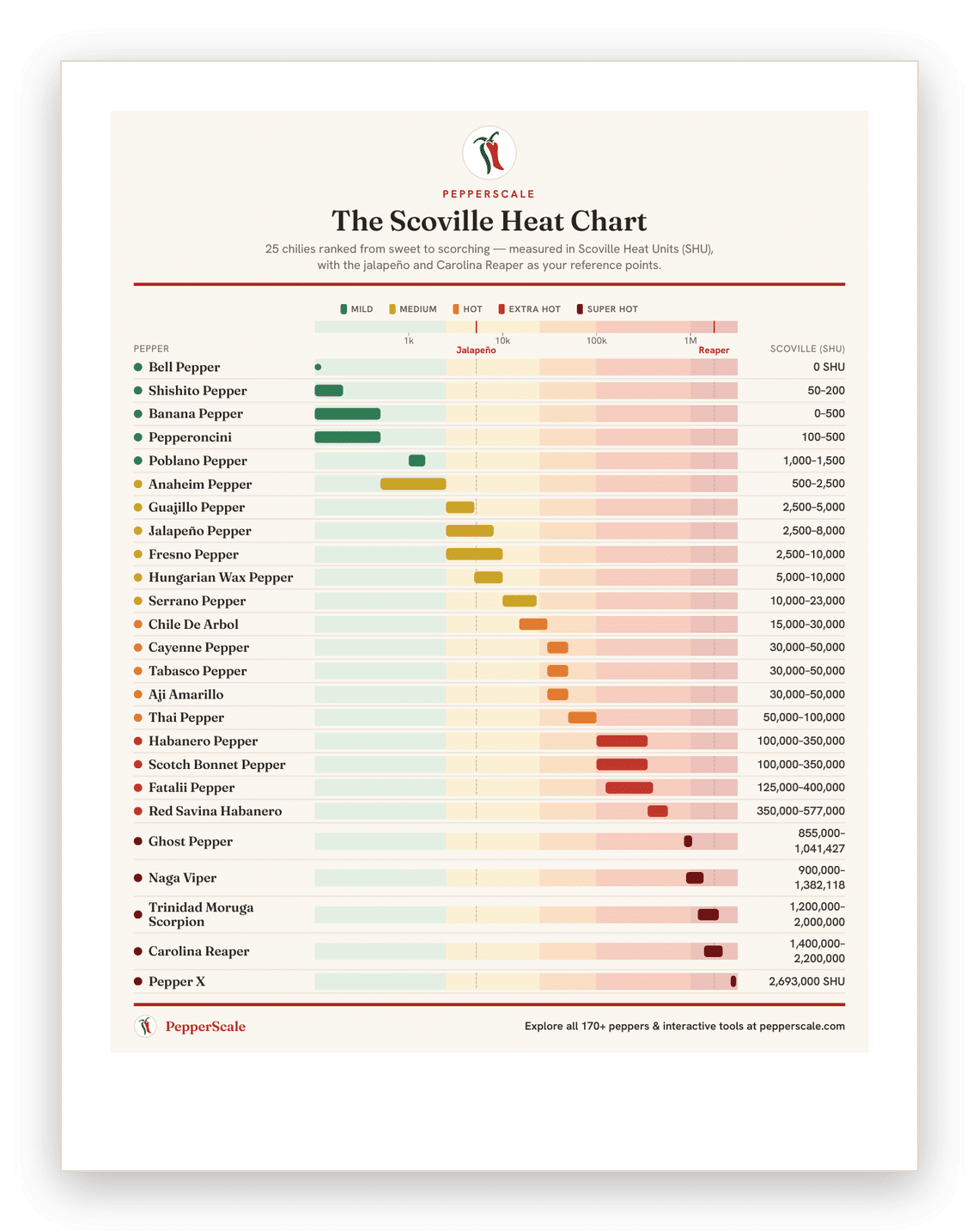
Get the free PepperScale Scoville Heat Chart
A printable, at-a-glance ranking of 25 chilies from sweet to scorching — with the jalapeño and Carolina Reaper as your reference points. Join the newsletter and we’ll send it straight to your inbox.
No spam — just Wicked Wednesday recipes and occasional extra dashes of chili pepper inspiration. Unsubscribe anytime.
Related reading
- Which Countries Have The Spiciest Food?: The same question at the country level, with a scorecard built on chili consumption and recipe data.
- Chili Pepper History: Where Do Peppers Come From?: How chilies spread from the Americas to the rest of the world.
- 10 Of The Spiciest Foods In The World You Should Know: Dishes worth traveling for, from every corner of the globe.