The scorpion pepper (here, the Trinidad Moruga Scorpion, or just the Moruga Scorpion) and the Carolina Reaper have been listed among the world’s hottest peppers for more than a decade. They share a species, Capsicum chinense, a sweet, fruity flavor under the fire, and a claim to the hottest-pepper title. So which one is hotter? How do they differ, and which is easier to find? Here’s how the two compare, head to head.

Last update on 2026-11-12. We earn a commission if you make a purchase, at no additional cost to you.
| Trinidad Moruga Scorpion | Carolina Reaper | |
|---|---|---|
| Scoville range | 1,200,000–2,000,000 | 1,400,000–2,200,000 |
| Median SHU | 1,600,000 | 1,800,000 |
| Vs. jalapeño | 305× a jalapeño | 343× a jalapeño |
| Aroma family | Fruity & Tropical | Fruity & Tropical |
| Origin | Trinidad | United States |
| Uses | Culinary | Culinary |
| Loudest notes | Fruity, Sweet | Fruity, Sweet |
Which is hotter, the scorpion pepper or the Carolina Reaper?
The Carolina Reaper, but by less than its fame suggests. The Moruga Scorpion runs from 1.2 million to 2 million Scoville heat units (SHU). The Reaper’s range is 200,000 higher at both ends, 1.4 million to 2.2 million. Compare the midpoints, 1.6 million against 1.8 million, and the Reaper comes out only about an eighth hotter.
The ranges overlap from 1.4 million to 2 million SHU, so the pod in your hand could go either way. A hot Moruga runs about 40% past a mild Reaper. Flip it, and the hottest Reaper is nearly twice as hot as the mildest Moruga.
Lab averages point the same way. Moruga Scorpions averaged 1,207,764 SHU in a 2011 New Mexico State University field trial, and Guinness World Records now gives the Reaper’s average as about 1.64 million. Those come from different tests, so treat the gap as rough. Against a jalapeño, it hardly matters: at the median, a Moruga is about 300 times hotter and a Reaper about 340.
In either case, these are heat levels that most people shouldn’t seek out. This is spiciness left to extreme eaters, and handling either of these super-hot peppers should be done with great care.
Was the scorpion pepper ever the hottest in the world?
Yes and no, and it depends on which scorpion you mean. “Scorpion” covers a family of Trinidad super-hots, named for the stinger-like tail many of them grow. The one Guinness World Records recognized was the Trinidad Scorpion “Butch T”, listed in 2011 at 1,463,700 SHU.
The Moruga Scorpion’s claim came from science instead. It’s a landrace from Moruga, a village on Trinidad’s south coast. Researchers at NMSU’s Chile Pepper Institute raised it from seed a San Diego grower, Jim Duffy, had sent them. In February 2012, they announced that it beat the other four super-hots in their trial on average heat. Two of its plants topped 2 million SHU, the first chilies ever reported past that mark.
Guinness gave its title to the Carolina Reaper in November 2013, measured at 1,569,300 SHU on average, enough to unseat the Butch T. It’s a bred pepper, not a landrace. Ed Currie of PuckerButt Pepper Company in South Carolina spent about ten years on it, and Guinness’s announcement called it a sweet habanero crossed with a Naga Viper. Currie has kept breeding super-hots since, and his Pepper X took the record from the Reaper in 2023.
How does each taste?
Very much alike. In our flavor groups, both are Fruity & Tropical, alongside the ghost pepper and the habanero. Our ratings for the two are identical: fruit first, sweetness close behind, and a faint floral note. So the difference between them is degree, not character.
Scorpion peppers have a fruity quality similar to the flavor of scotch bonnet peppers, but with considerably more heat. And the Moruga’s heat doesn’t hit right away. It builds over several seconds, so you might be tempted to keep eating, only to have it escalate to panic-inducing levels. As Paul Bosland, who led the NMSU study, told the Associated Press: “It doesn’t seem so bad, and then it builds and it builds and it builds.”
Similarly, Carolina Reapers have a mild fruity flavor that is usually quickly overpowered by the pepper’s intense heat. When Guinness announced the record, it noted hints of cinnamon and chocolate alongside the fruit.


What does each look like?
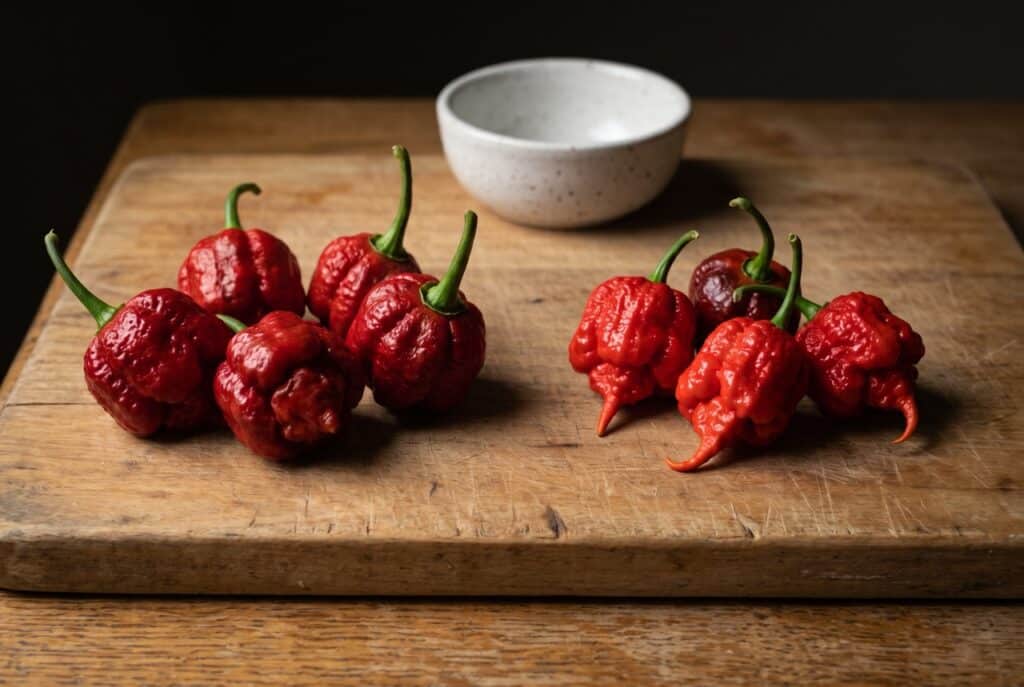
Can you tell which is which by eye? Not always. Both are bulbous, wrinkled and pockmarked, and both ripen from green to red. The Moruga Scorpion grows 2 to 2½ inches long, about golf ball size, and it only sometimes tapers to a short tail.
The tail is the tell. If you see a long, pointed stinger on one of these two, you’re most likely looking at a Reaper. It can run a little smaller, about 1½ to 2½ inches, and PuckerButt describes it as bright red with a long stinger. Red is the classic for both, though seed sellers offer other colors, including yellow and chocolate Reapers.
Which is easier to find?
As fresh produce, neither is easy to find. The hottest super-hot peppers have limited appeal to most shoppers, so you won’t see them in many mainstream grocery stores. You might occasionally spot super-hots as a novelty item at a farmer’s market or independent grocer.
Dried pods, powders and seeds of both are easy to buy online. Want fresh pods? You’ll likely have to grow them, and our Moruga Scorpion and Carolina Reaper planting guides cover it, from seed to harvest.
Bottled, the Reaper wins easily. It’s the bigger name, and Reaper products run from hot sauces, salsas and powders to flavored nuts and chips. We’ve reviewed Torchbearer Garlic Reaper and Time’s Up Reaper, among others. The Moruga turns up in fewer products, often in blends: Elijah’s Xtreme Regret pairs it with the Reaper; Devilfish Kitchen Pirate Panic blends it with habanero, ghost and scotch bonnet.
Which is more useful in the kitchen?
Neither is an everyday cooking pepper. Both are at their best in hot sauces and salsas, where their fruit comes through and a tiny amount flavors a big batch. In soups and stews, a sliver of either is plenty for your pot. Since the flavors are so close, choose by the heat you’re after and what you can get.
Treat both with the same caution. It’s best to wear kitchen gloves, goggles and even a mask. When NMSU researchers picked Moruga Scorpions for their study, capsaicin soaked through the pickers’ latex gloves, and they went through about four pairs. Brush up on treating chili burn first, and don’t relax with dried pods, which are just as dangerous to handle.
Can you substitute one for the other?
Yes, and few super-hots swap more cleanly. The fruit and sweetness carry over, so the dish tastes much the same. At the median, the Reaper is only about 12% hotter, so you can trade them roughly one for one. Putting a Reaper in place of a Moruga? Use a little less at first, then adjust to taste.
Need a bigger jump, like from a habanero? Plug the two peppers into our pepper conversion tool, and it works out the amounts for you.
Overall: near twins, with the Reaper a step hotter
The Moruga Scorpion and the Carolina Reaper are about as close as two super-hots get: one species, one sweet and fruity flavor profile, and heat ranges that mostly overlap. The Reaper averages a bit hotter and is far easier to find in a bottle. The Moruga is the landrace that first tested past 2 million SHU. Pick whichever you can get, and respect both.
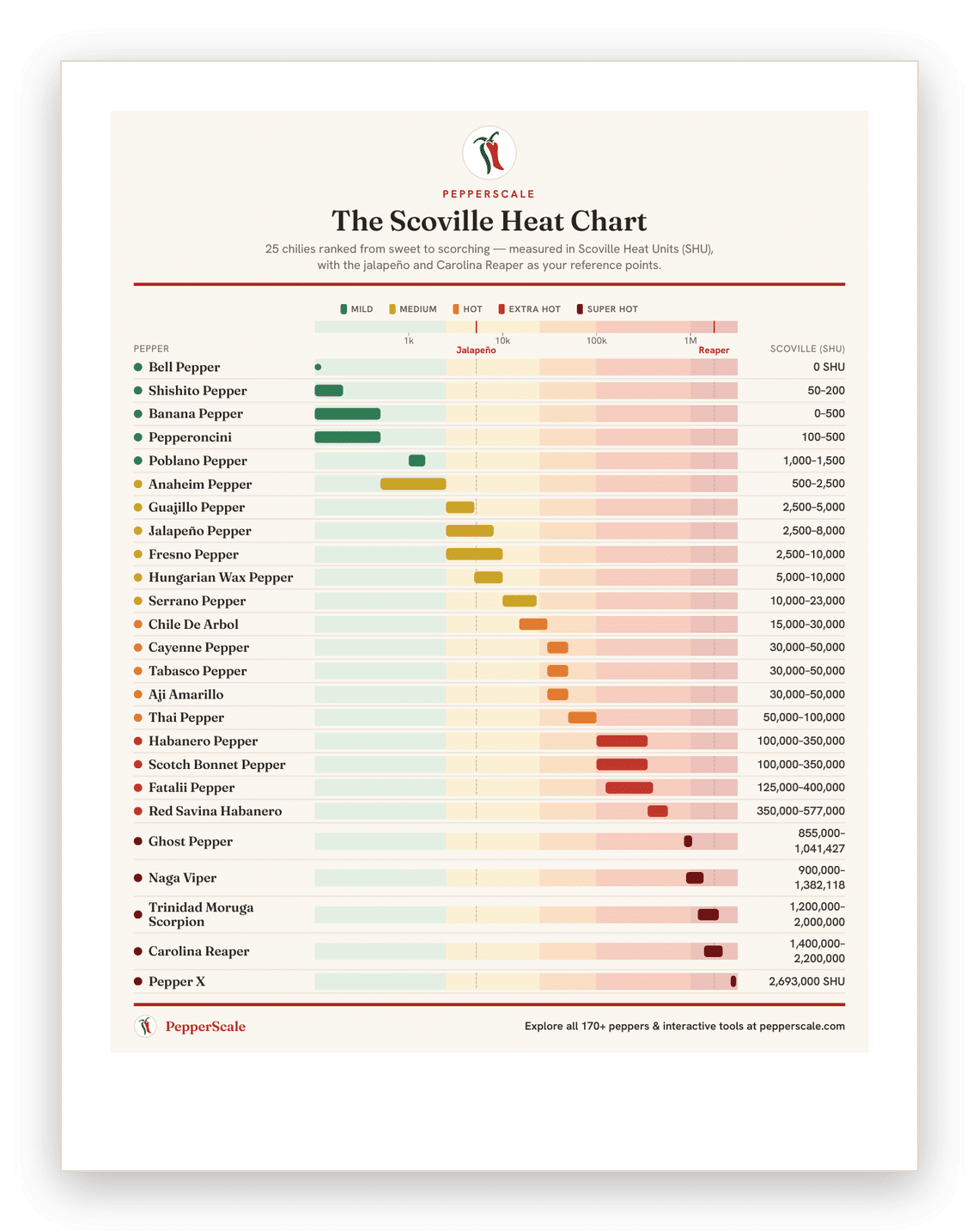
Get the free PepperScale Scoville Heat Chart
A printable, at-a-glance ranking of 25 chilies from sweet to scorching — with the jalapeño and Carolina Reaper as your reference points. Join the newsletter and we’ll send it straight to your inbox.
No spam — just Wicked Wednesday recipes and occasional extra dashes of chili pepper inspiration. Unsubscribe anytime.
Related reading
- Pepper X Vs. Carolina Reaper: The current record holder against the pepper it replaced.
- Moruga Scorpion Vs. Ghost Pepper: How the Moruga measures up against the ghost, an earlier record holder.
- The Hot Pepper List: Compare both against more than 175 other chilies, by heat, flavor or use.