An heirloom pepper is a variety old enough to have been handed down, which usually means at least 50 years old. Experts don’t all agree on where exactly to draw that line, and some go by a fixed date instead, but 50 years is the figure you’ll see most often.
Heirloom seeds are handed down over generations in a particular location. Breeders select them for a particular trait. They are all wind- or insect-pollinated and have stable characteristics that remain from year to year.
Most heirloom peppers are created in nature, not in a laboratory. However, some may have been created in universities or back when commercial breeding was still new.
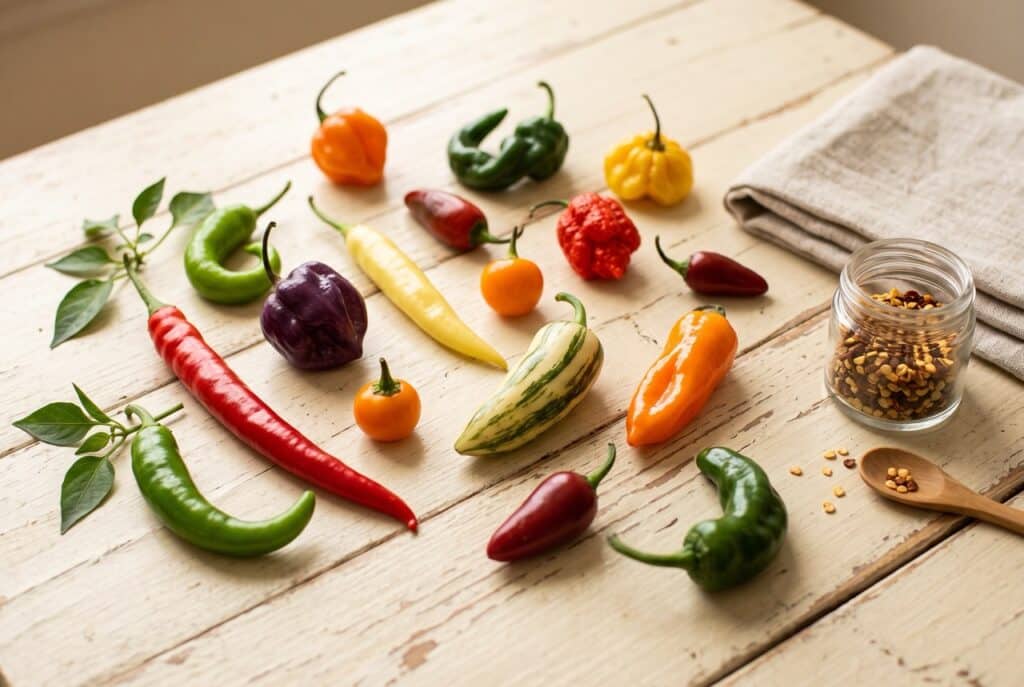
Can a jalapeño be an heirloom?
Yes, and it’s where the word trips most people up. Heirloom describes a variety. Jalapeño is a kind of pepper, and a kind covers dozens of varieties. Early Jalapeño is open-pollinated and has been grown for about a century. Jalafuego is a modern F1 hybrid. They’re both jalapeños, and only one of them is an heirloom. That’s why our own piece on jalapeños that turn out mild tells growers they’ll want heirloom seed.
Bell peppers work the same way. California Wonder came out in 1928 and it’s the standard heirloom bell, while most of the bells stacked up in a supermarket came off hybrid plants bred for uniform size and shipping. So there’s no master list of heirloom peppers to memorize. Nearly every pepper you can name has both kinds behind it, and the seed packet is what tells them apart.
Four heirlooms and how they got here
There are hundreds of them, and none of these is the only heirloom of its kind. They’re just four with an unusually clear line of people behind them, and they’ve all got guides here.
- Fish pepper: Grown by Black communities around the Chesapeake and a fixture in Baltimore crab houses by the 1870s. Its immature pods are creamy white, so a cook could season a cream of crab soup without tinting it. It nearly disappeared, then came back in 1995 from seeds found in a family freezer.
- Jimmy Nardello: The Nardello family carried these seeds from Basilicata to Naugatuck, Connecticut in 1887. Jimmy grew them until he died in 1983 and left them to the Seed Savers Exchange. Sweet, thin-skinned and grown for frying.
- Hinkelhatz: Pennsylvania Dutch, and grown in Amish country for more than 150 years. It mostly gets pickled or turned into pepper vinegar.
- Rooster spur: A Southern US heirloom that shows up around the world under other names, including takanotsume in Japan.
Are heirloom peppers and heirloom seeds more expensive?
Heirloom peppers and seeds do tend to be more expensive for a number of reasons. The first reason is that fewer of them are produced when compared to commercial hybrid seeds. Because there are fewer of these seeds, you can expect to pay more for them. Keep in mind that these seeds contain decades of careful selection within them.
How do heirloom peppers differ from hybrids?
Hybrid plants typically bear fruit that all looks the same. Along with having a uniform appearance, they all come in at about the same time. In other words, they are predictable. Hybrid pepper plants also tend to provide larger yields than heirloom plants.
Heirloom plants vary in size and color. In addition, your harvests from heirloom plants may be unpredictable. Because heirlooms are usually local, they tend to be the best variety for the region in which they were bred. They have built up resistance to local pests and diseases.
Heirloom seeds have another advantage over hybrids in that they’re true to type. That doesn’t mean every plant is a clone of the last one, which is why you’ll still see sizes and colors wander a bit. It means the seed grows up as the same variety, so if you keep selecting from your best plants each season, the line holds.
Heirloom, open-pollinated, hybrid, GMO: what’s the difference?
These four get thrown around as though they’re interchangeable. Open-pollinated means the plant is pollinated by wind or insects and its seeds grow up resembling the parent. Heirloom means an open-pollinated variety that’s been around long enough to be handed down, which is where that 50-year mark comes in. So every heirloom is open-pollinated, while plenty of open-pollinated varieties are simply too new to count as heirlooms. Hybrids are a separate thing again, and we go through them in what is a hybrid plant.
GMO doesn’t belong in this conversation at all. There’s no genetically modified pepper seed sold to home gardeners, so a packet stamped non-GMO is telling you something that was already true of every other packet on the rack.
Are heirloom peppers more nutritious than other peppers?
Nutrient density isn’t one of the criteria used to select hybrid pepper plants. Breeders are picking for yield, uniformity and how well the fruit travels, so nutrition lands wherever it lands.
There’s research behind this, though it’s narrower than it sounds. A 2004 study of 43 garden crops compared USDA nutrition data from 1950 with 1999 and found six nutrients had fallen by 6 to 38 percent. The authors put that down to the varieties themselves changing over those fifty years: the higher the yield a variety is bred for, the lower its mineral density tends to run. There’s a name for that trade-off, the genetic dilution effect. It stops short of being a clean heirloom-versus-hybrid result, though that’s mostly where heirlooms sit anyway.
Do heirloom peppers taste better?
Characteristics like flavor are not high priorities for commercial breeders. Instead, they focus on factors like shelf life and how well a pepper variety travels. Commercial peppers are selected for characteristics like disease resistance and high yield rather than for how good they taste. The flavor is often not a primary factor.
In comparison, many heirloom pepper varieties are bred specifically for their flavor. A farmer would simply plant the seeds from last season’s best-tasting peppers and, over time, develop a highly flavorful pepper. If you’re looking for the tastiest possible pepper, go with an heirloom.
Can you save seeds from heirloom peppers?
You can, and for a lot of gardeners that’s why they bother. Save seed off a hybrid and next season is a lottery, because you’ll get some scrambled mix of the grandparents. Save seed off an heirloom and you get the same pepper again. That’s what true to type is describing.
There’s one catch, and it’s a big one if you grow more than one variety. Peppers cross-pollinate readily once bees are involved, so seed saved from an heirloom growing beside three other kinds won’t necessarily come true either. Space the varieties out, bag a few flowers, or save from a plant that’s on its own. We cover the how-to in saving pepper seeds.
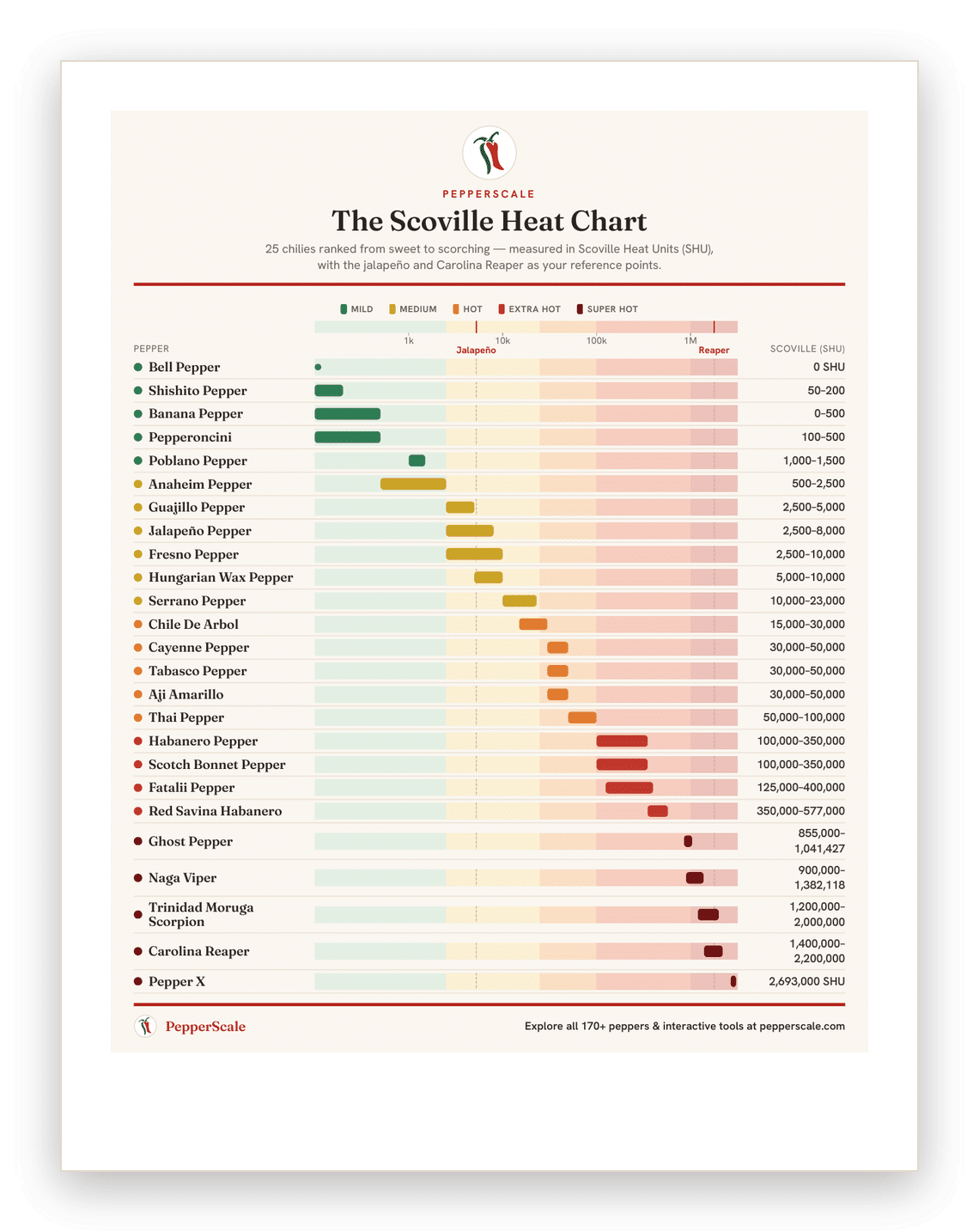
Get the free PepperScale Scoville Heat Chart
A printable, at-a-glance ranking of 25 chilies from sweet to scorching — with the jalapeño and Carolina Reaper as your reference points. Join the newsletter and we’ll send it straight to your inbox.
No spam — just Wicked Wednesday recipes and occasional extra dashes of chili pepper inspiration. Unsubscribe anytime.
Related reading
- What Is A Hybrid Plant? Learn all about them.
- Cultivar Vs. Variety Vs. Hybrid: What are the differences between them?
- Genus Capsicum: Learn about the scientific classification of chili peppers.