Ghost peppers are low in calories, and gram for gram, they’ve got about as much vitamin C as a jalapeño. But at 855,000 to 1,041,427 Scoville heat units, you’ll only ever eat a little at a time, so those vitamins don’t add up to much. Most of the health claims you’ll see are about capsaicin, the compound behind the heat, and the research on it comes with big limits and a couple of real risks. Here’s what’s in a ghost pepper, how much of it you’ll get, and what the science does and doesn’t show.
One quick note before we start: we know chili peppers inside and out, but we’re not doctors. If you’re thinking about ghost peppers or capsaicin for a health reason, talk to your doctor first. The same goes if you’ve got a heart condition, reflux or a touchy stomach and you’re eyeing a chili challenge. They know your health, and we know peppers.

What nutrients are in a ghost pepper?
USDA doesn’t publish nutrition data for ghost peppers, so the numbers below come from Indian lab work on green king chilli, one of the ghost pepper’s names in northeast India. Next to them, you’ll find USDA’s figures for a raw jalapeño.
| Per 100 g | Ghost pepper (green) | Jalapeño |
|---|---|---|
| Calories | 43 | 29 |
| Protein | 1.5 g | 0.9 g |
| Carbohydrates | 6.9 g | 6.5 g |
| Fiber | 1.7 g | 2.8 g |
| Fat | 0.1 g | 0.4 g |
| Vitamin C | 118 mg | 119 mg |
One lab’s numbers aren’t the last word, especially for vitamin C. When researchers tested 16 king chilli lines from across northeast India, vitamin C ran from about 92 to 301 mg per 100 g, with an average of 177. So depending on the plant, a ghost pepper can have a bit less vitamin C than a jalapeño or more than twice as much.
You’ll also find ghost pepper nutrition labels online listing 29 calories, 0.91 g of protein and 0.37 g of fat per 100 g. Those match USDA’s figures for a raw jalapeño exactly, so they don’t tell you anything about ghost peppers.
How much nutrition do you get from a ghost pepper?
Very little, because you can’t eat much. Five grams of green ghost pepper, less than one pod, works out to about 2 calories and 6 mg of vitamin C. That’s roughly 7% of the 90 mg Daily Value. And most recipes spread one pepper across a full batch. Our ghost pepper salsa uses one or two for eight servings, so you’d get a small fraction of a pepper in each one.
A jalapeño’s the opposite case. It’s mild enough to eat a few at a time, and one 14-gram pepper gives you around 17 mg of vitamin C. So even though the two are close gram for gram, you’ll get more nutrition from the jalapeños you eat than from a ghost pepper.
What makes a ghost pepper so hot?
Also known as bhut jolokia, ghost peppers rose to fame in the early 2000s and still carry a significant amount of notoriety. It’s a Capsicum chinense pepper from northeast India, especially Assam. New Mexico State University researchers also found genetic markers from Capsicum frutescens in it, which suggests it’s a natural cross between the two species.
Its heat comes from capsaicin, the compound that makes chili peppers hot. Ghost peppers run 855,000 to 1,041,427 Scoville heat units, or about 180 times hotter than a jalapeño if you compare the middle of each range. Guinness World Records named it the world’s hottest pepper in 2007. It’s since been passed by the Carolina Reaper, the Trinidad Moruga Scorpion and others, but it’s still a superhot by any measure.
Can ghost peppers fight cancer?
Not in any way that’s been shown in people. The study behind most of these claims is a 2006 Cedars-Sinai and UCLA study published in Cancer Research. Capsaicin slowed the growth of human prostate cancer cells in the lab, and tumors in treated mice ended up about one-fifth the size of untreated ones. But the lead researcher compared the mice’s dose to 400 mg of capsaicin three times a week for a 200-pound man, or roughly three to eight fresh habaneros by his estimate. Nobody’s tested that in people.
Research on people who eat a lot of chilies doesn’t support the idea either. Some studies have linked heavy chili eating to stomach and esophageal cancer. But most of them rely on people remembering what they’d eaten, and they’re often at odds with each other. We go through them in our look at whether chili peppers cause cancer.
Do ghost peppers lower blood sugar or cholesterol?
There’s a little evidence, but nothing you’d build a diet around. In a small 2003 study from Thailand, 10 women had a glucose drink with or without 5 grams of fresh chili. With the chili, their blood sugar rose about 20% less at the 30-minute mark. That’s one short test of a single drink, and it used a different, milder chili.
Most of the cholesterol research doesn’t use peppers at all. A 2022 review of seven small trials found capsaicin lowered total and LDL cholesterol in people with metabolic syndrome or excess weight, with no clear effect on HDL or triglycerides. Those trials mostly gave capsaicin in capsules, and the authors said there weren’t enough trials, or big enough ones, to settle it.
Do people who eat chili peppers live longer?
People who eat chili peppers do seem to, but nobody’s sure why, or whether it’s the peppers. A 2020 analysis presented to the American Heart Association pooled four studies of more than 570,000 people in the U.S., Italy, China and Iran. Those who ate chili pepper had about a 25% lower risk of dying from any cause during the studies than people who rarely or never did.
The senior author was clear about the limits. He said it’s impossible to conclusively say that eating more chili pepper can prolong life. The studies also didn’t track how much people ate or which peppers, so it doesn’t tell you anything about superhots in particular.
Are ghost peppers dangerous to eat?
In normal cooking amounts, a ghost pepper’s a lot of heat but not a health risk for most people. The trouble’s with eating contests and challenges. In one 2016 case report, a 47-year-old man ate a ghost pepper purée on a burger during a contest, then vomited and retched so hard that he tore his esophagus. He needed surgery and spent 23 days in the hospital afterward. The pepper didn’t burn a hole in him, though. The doctor who wrote up the case said the violent vomiting caused the tear.
In 2023, a 14-year-old in Massachusetts died after eating the Paqui One Chip Challenge chip, which was made with Carolina Reaper and Naga Viper peppers. The autopsy found cardiopulmonary arrest after eating a food with a high concentration of capsaicin, and it found that he had an enlarged heart and a congenital heart defect. Paqui pulled the chip from stores.
Handling them takes care, too. Wear gloves when you cut ghost peppers, keep your hands away from your eyes, and know how to treat chili burn before you start. Our guide to cooking with ghost peppers covers the rest.
Ghost pepper health claims: fact or fiction?
- “Ghost peppers are low in calories.” Fact. A green ghost pepper has about 43 calories per 100 g, and you’ll usually eat just a few grams.
- “Ghost peppers are packed with vitamins.” Half true. Gram for gram, they’ve got about as much vitamin C as a jalapeño, but you can’t eat enough to get much of it.
- “Ghost peppers can treat cancer.” Fiction. The best-known study used cancer cells and mice, and nothing has shown that eating ghost peppers treats cancer in people.
- “Ghost peppers lower your blood sugar.” Not proven. One small study found a smaller rise after a glucose drink with 5 grams of chili, which is a long way from a treatment.
- “A ghost pepper can burn a hole in your esophagus.” Fiction. In the case that made headlines, violent vomiting after a contest tore the man’s esophagus, and the pepper didn’t burn through it.
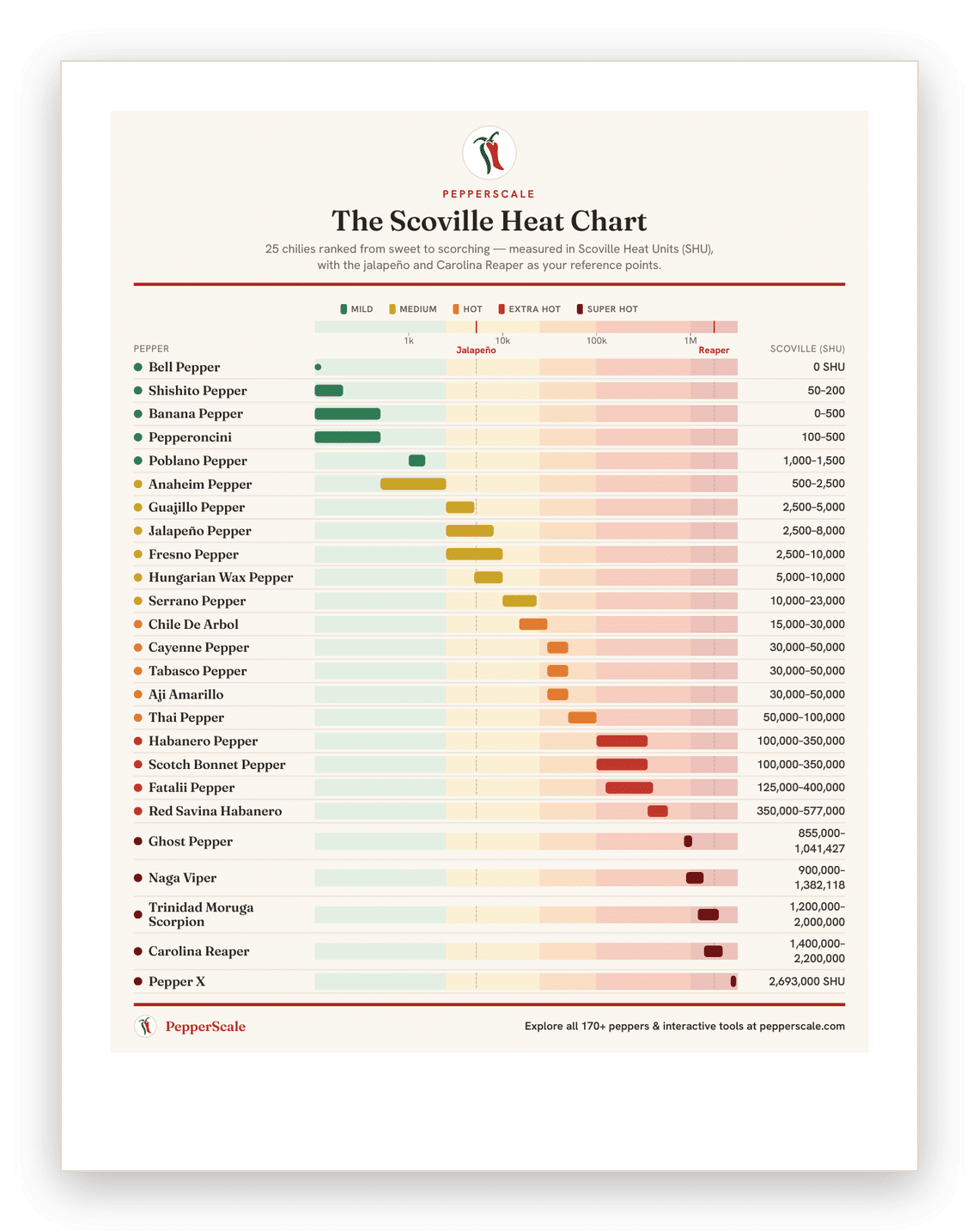
Get the free PepperScale Scoville Heat Chart
A printable, at-a-glance ranking of 25 chilies from sweet to scorching — with the jalapeño and Carolina Reaper as your reference points. Join the newsletter and we’ll send it straight to your inbox.
No spam — just Wicked Wednesday recipes and occasional extra dashes of chili pepper inspiration. Unsubscribe anytime.
Related reading
- Jalapeño Nutrition: How Healthy Are They?: The pepper you can eat whole, and what it brings besides heat.
- Habanero Nutrition: How Healthy Are They?: A step down from the ghost pepper in heat, and easier to eat in amounts that count.
- Vitamin C In Peppers: Which Have The Most, And What’s Fiction: How much vitamin C each pepper has, and how they compare to oranges.
Just cooked a sauce &…. Too much ghost chillies..A burner in eyes & mouth,unintentionally,, but knew milks soothing qualities..Tissued milk into eye & immediately chillies burn stopped,& 2 gulps of milk mouth burn went away…