Spicy food won’t cure a cold. Nothing will. But it can make you feel better for a while, and the interesting part is working out which bits of the folklore hold up. Some of it does. Some turns out to run on a different mechanism than people think. And one popular claim about it backfiring on you has nothing behind it at all.

A quick word before you go on. I write about peppers, not medicine. Everything above comes from published research and the sources are linked so you can read them yourself, but I’m not a doctor and none of this is medical advice. If a cold drags on, a fever climbs, breathing gets hard, or anything about how you feel worries you, that’s a conversation for an actual doctor.
Does spicy food actually help a cold?
It can make some symptoms feel better while you’re eating, and it does nothing at all to the cold itself. A cold is a virus that runs its course in about a week to ten days, and no food shortens that.
What spicy food changes is how you experience the next twenty minutes. That’s a much smaller promise than the folklore makes. It’s also a real one, and when you feel awful, twenty minutes counts.
| The claim | What holds up |
|---|---|
| It clears a blocked nose | You feel clearer. Measured airflow may not change at all. |
| It loosens phlegm | It triggers thin, watery secretion in the nose. Evidence for the chest is thin. |
| The vitamin C shortens your cold | Peppers really are high in vitamin C. Starting it once you are already sick doesn’t shorten anything. |
| It relieves pain | Capsaicin does deplete substance P, but that finding comes from repeated topical use, not from dinner. |
| It leaves you more congested later | No evidence. Rebound congestion comes from decongestant sprays. |
What spicy food really does to a blocked nose
Capsaicin sets off a nerve reflex that tells the glands in your nose to secrete, and that reflex is why your nose runs when you eat spicy food. The fluid it produces is thin and watery, and that’s a real, immediate, physical change you can feel happen.
Whether it opens the airway is a separate question. One study gave thirty people with colds either a hot drink or the same drink at room temperature. The hot drink produced no significant change in measured nasal airflow. It did produce an immediate improvement in how clear their noses felt, and that feeling held for the next half hour.
And there’s a reason those two come apart. When researchers checked whether the sensation of a clear nose tracks actual airflow, they found no significant correlation between them. What the sensation tracks is cooling of the nasal lining. Your nose grades itself on feel.
Does the vitamin C in chili peppers help?
Peppers really are loaded with it. A cup of chopped red bell pepper carries around 190 mg of vitamin C and a cup of jalapeños about 107 mg, against a daily requirement near 90 mg. We put numbers on the rest of them in vitamin C in peppers.
The problem is the step after that. A Cochrane review covering 29 trial comparisons and 11,306 people found that regular vitamin C supplements had no effect on how often people caught colds. Taken regularly it did shorten them a little, by about 8% in adults and 14% in children. But trials where people started high doses after symptoms appeared showed no consistent effect on either duration or severity.
That last line is the key point, because reaching for chili when you already feel rough is exactly the case those trials tested. Eat peppers all winter and you might shave a few hours off a cold. Eat them on day two of one and the vitamin C isn’t the reason you feel better.
Will spicy food make your congestion worse afterward?
Nothing in the research says it will. The idea gets repeated a lot, so it’s worth taking apart properly.
Rebound congestion is real and it has a name, rhinitis medicamentosa. It comes from topical decongestant sprays that work by squeezing nasal blood vessels shut: oxymetazoline, xylometazoline, naphazoline, phenylephrine and ephedrine. Use one past roughly five to seven days and the vessels stop responding, and you end up more blocked than you were at the start. That’s why the box tells you to stop at three days.
Capsaicin works nothing like those drugs, and no food appears on that list. If anything the evidence on repeat exposure runs the other way. A Cochrane review of four trials covering 302 people with non-allergic rhinitis found that capsaicin nasal spray improved nasal symptoms, with benefit still measurable up to 36 weeks, by turning TRPV1 down on the sensory fibers. Low to moderate quality evidence, so let’s call it promising and unsettled. But it’s not a rebound.
One thing to keep straight, though. That research is a supervised treatment course for a chronic condition. It’s not a bowl of chili on a Tuesday when you feel rotten.
Does it help a cough or a sore throat?
Here the true answer moves away from the pepper. Two of the most common spicy cold remedies are cayenne with honey and black pepper with honey, and honey is the ingredient carrying the better evidence.
Another Cochrane review found that honey probably reduces cough frequency better than no treatment or placebo, performs about as well as dextromethorphan, and may beat diphenhydramine. The placebo comparison is moderate certainty, the rest lower. The benefit showed up across about three days and flattened after that.
Never give honey to a baby under twelve months. The risk is infant botulism, and that’s the one rule here with no exceptions.
A raw sore throat is a different matter, because capsaicin is an irritant landing on tissue that already hurts. Some people find the distraction helps and others find it plainly worse, and no research will tell you in advance which one you are.
When to skip it
- Your stomach is in it too. Colds and flu often bring gut symptoms along, and spicy food can make those worse. Blander food is the better call until that settles.
- Your throat hurts more than your nose does. The heat lands on the sore part and does nothing for the blocked part.
- You’re feeding it to a small child. Heat tolerance aside, the honey rule above applies under twelve months.
- It’s making you miserable. There’s no prize for toughing out a bowl of something painful while ill.
Which spicy remedies do people actually use?
- Cayenne pepper is the one people reach for most, usually stirred into honey and sometimes turmeric. The heat does what heat does, and the honey is the part with trial evidence behind it.
- Horseradish and wasabi get their bite from allyl isothiocyanate instead of capsaicin, working on TRPA1, a sibling of the channel capsaicin uses. That compound is volatile, so it lifts off the food and goes straight up into your nose, and that is why it feels more like a sinus treatment than a mouth one. We compare the two kinds of heat in pepper heat versus horseradish heat.
- Black pepper shows up mixed with honey, and in some versions with vodka. Piperine is a different compound again, and the same logic applies: it’s a sensation, not a cure, and the honey is doing the measurable work.
So what does help a cold?
Rest and time do the real work, and a cold ends when it ends. Honey has decent evidence for cough, and paracetamol or ibuprofen handle aches and fever. A hot drink makes you feel better for half an hour, and the research backs that up even where it can’t find a change in airflow.
Spicy food belongs in that last group. It works on how you feel instead of on the virus, and there’s nothing wrong with that when the alternative is lying there feeling terrible.
The bottom line
Fiction: that spicy food fights a cold, shortens it, or clears your sinuses in any way a machine could measure. Also fiction: that it leaves you worse off once it wears off.
Fact: it makes you feel less blocked for a while, the vitamin C in peppers is real even though the cold benefit isn’t, and if your stomach is unhappy you should leave it alone. So if a bowl of something hot is what you want when you’re sick, eat it. Just eat it because it’s a comfort, and not because it’s medicine.
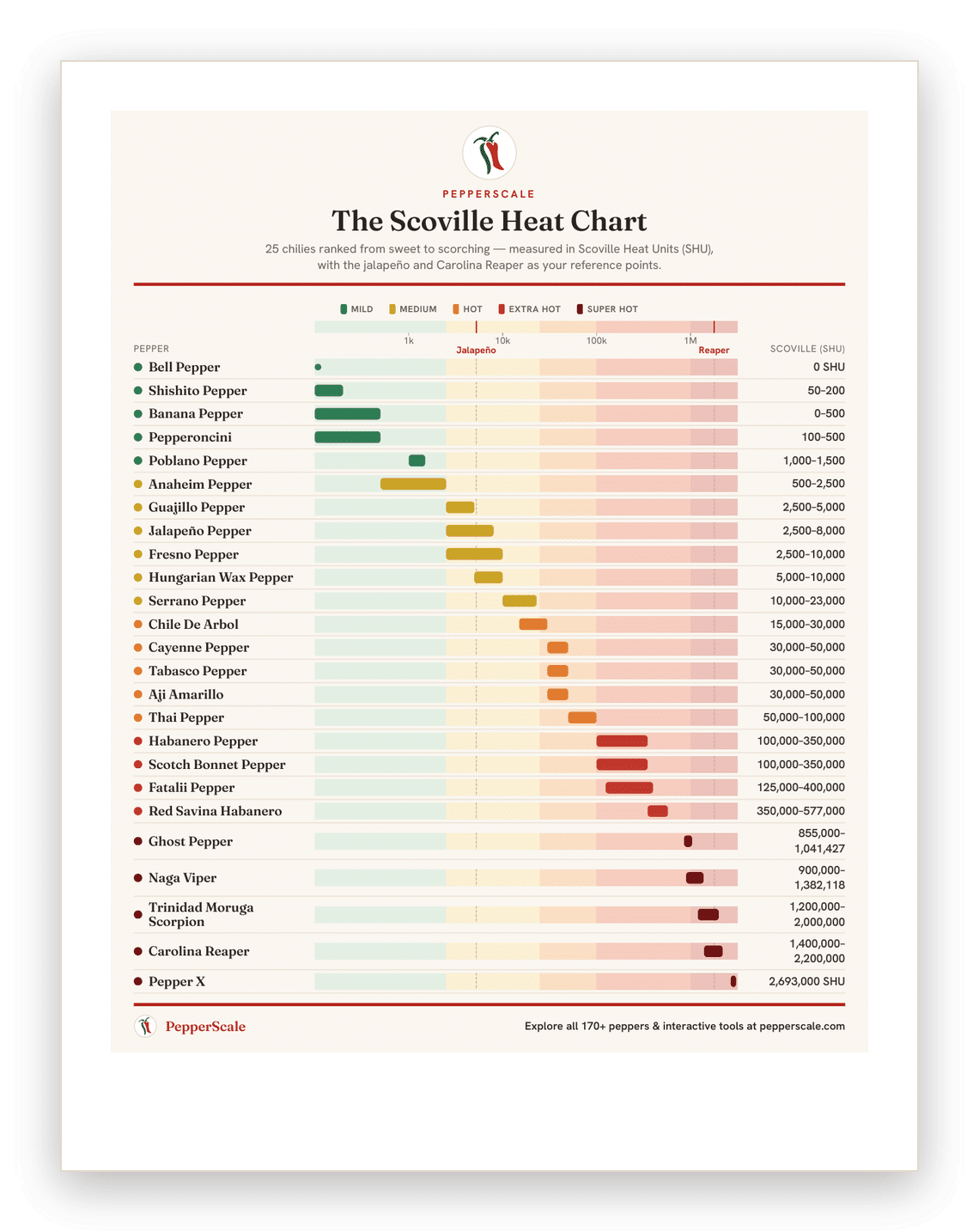
Get the free PepperScale Scoville Heat Chart
A printable, at-a-glance ranking of 25 chilies from sweet to scorching — with the jalapeño and Carolina Reaper as your reference points. Join the newsletter and we’ll send it straight to your inbox.
No spam — just Wicked Wednesday recipes and occasional extra dashes of chili pepper inspiration. Unsubscribe anytime.
Related reading
- Cayenne Pepper Tea With Ginger: The cold-remedy drink itself, if all this talk of cayenne and honey has you wanting to make one.
- Cayenne Pepper Nutrition: How Healthy Are They?: What is actually in a cayenne beyond the heat, vitamin C included.
- Do Chili Peppers Cause Cancer?: The other big what-is-this-doing-to-me question, weighed against the real studies.
I’ve used crushed red pepper to help fight a cold. I just mix that in some spicy rice and it does wonders for congestion and sore throat symptoms and the soft rice texture is easy on the throat when its sore as well. I think somehow its like inducing an artifical fever that helps fight off infections. Felt great after a cup or two of the stuff.