Crushed red pepper won’t do much for your nutrition, and that is fine. A shake or two on a slice of pizza is a fraction of a gram, so the vitamins in it barely register. Most of the health claims about it are borrowed from cayenne powder or from capsaicin research, and they are figured on far more than anyone shakes on. Here is what’s in it, what the research says, and where the numbers you’ve seen came from.
One quick note first: we know chili peppers and the spices made from them, but we’re not doctors. If you’re thinking about chili flakes, or a capsaicin supplement, for your weight, your stomach or anything else health-related, talk it over with your doctor. They know your health, and we know peppers.

What is crushed red pepper made from?
Crushed red pepper, also sold as red pepper flakes, is dried red chilies crushed into flakes, seeds and all. Most store brands are a blend, usually built on cayenne and cut with milder chilies, so the mix runs about 15,000 to 30,000 Scoville heat units, around half as hot as straight cayenne. Our guide to what crushed red pepper is covers what goes into the blend.
What’s in a shake of crushed red pepper?
USDA does not keep a nutrition record for crushed red pepper. The closest match is its record for ground red pepper and cayenne, so that is what we used here. Since crushed red pepper is a blend that includes the seeds, treat these as ballpark figures.
Several store brands list a serving as a quarter teaspoon, about half a gram. Here’s what USDA’s FoodData Central shows for that and for a full teaspoon, with the percent of the daily values used on today’s nutrition labels.
| Nutrient | ¼ teaspoon | % DV | 1 teaspoon | % DV |
|---|---|---|---|---|
| Calories | 1.6 | 5.7 | ||
| Vitamin A | 10 mcg | 1% | 37 mcg | 4% |
| Vitamin E | 0.15 mg | 1% | 0.5 mg | 4% |
| Vitamin B6 | 0.01 mg | 1% | 0.04 mg | 3% |
| Fiber | 0.14 g | under 1% | 0.5 g | 2% |
| Vitamin C | 0.4 mg | under 1% | 1.4 mg | 2% |
| Manganese | 0.01 mg | under 1% | 0.04 mg | 2% |
| Iron | 0.04 mg | under 1% | 0.14 mg | 1% |
| Potassium | 10 mg | under 1% | 36 mg | 1% |
| Sodium | 0.2 mg | under 1% | 0.5 mg | under 1% |
So a quarter teaspoon comes to about 1 percent of your daily vitamin A and E, and less of everything else. Look at the nutrition panel on a jar of flakes and you’ll see mostly zeros. It also has almost no sodium, so it’s an easy way to add flavor to food without adding salt.
Is crushed red pepper a good source of vitamin A?
Not at the amounts most people use. Like other red chilies, it gets its vitamin A from carotenoids such as beta-carotene, which your body turns into vitamin A. A teaspoon gives you about 4 percent of the daily value.
You may have read that a tablespoon gives you more than 2,000 IU of vitamin A, almost half of what you need. That was true on older nutrition labels, which counted vitamin A in international units against a daily value of 5,000. Today’s labels use a unit that credits plant carotenoids with much less vitamin A, and on those a tablespoon is about 12 percent. And when did you last put a tablespoon of flakes on anything?
What about vitamin C, vitamin E and fiber?
They are in there, but in small amounts. A full teaspoon has about 2 percent of your daily vitamin C, 4 percent of your vitamin E and half a gram of fiber, and the minerals come in at 2 percent or less. If you want the per-teaspoon numbers for the straight powder, our look at cayenne pepper nutrition has them.
Fiber is good for you, but you’d want to get it from beans, grains and vegetables. A tablespoon of crushed red pepper has about 1.4 grams, and you won’t eat that much in one sitting.
Does the capsaicin in crushed red pepper do anything?
Capsaicin is the compound behind the heat, and it’s where most of the health claims come from. When you read that it kills prostate cancer cells, that comes from a 2006 study on cells in a dish and on mice, at a dose the researchers compared to several habaneros’ worth of capsaicin three times a week. Our look at chili peppers and cancer covers what’s known in people.
Can it help with weight loss? A little, maybe. Studies on capsaicin have found it can nudge up the calories you burn and take the edge off your appetite, but the effect is small, and our guide to capsaicin and weight loss goes through the trials. Capsaicin creams and patches are used for some kinds of pain, too, but they go on the skin, and a shake of flakes on your pizza isn’t the same thing.
Is crushed red pepper bad for ulcers?
It doesn’t cause them. According to the National Institute of Diabetes and Digestive and Kidney Diseases, most peptic ulcers come from H. pylori infection or from pain relievers like aspirin and ibuprofen, and researchers haven’t found that diet plays an important role in causing them.
You may also read that capsaicin eases ulcer symptoms. That idea comes mostly from lab and animal studies, so don’t treat an ulcer with chili flakes. And if spicy food leaves your stomach sore, ease off.
How much crushed red pepper is too much?
Your mouth usually tells you first. A heavy hand with the shaker can bring on sweating, a runny nose and an upset stomach. If you’ve overdone it, our guide to chili burn has ways to cool it down.
Want the heat without the guesswork? Making your own lets you pick the chilies, and our homemade crushed red pepper recipe walks you through it.
Crushed red pepper health claims: fact or fiction?
- “A tablespoon gives you almost half your vitamin A.” Outdated. That came from old label math, and today a tablespoon is about 12 percent.
- “Crushed red pepper is very nutritious.” Fiction at the amounts you’ll use. A quarter teaspoon has about 1 percent of the daily value for vitamin A and E, and less for everything else.
- “It’s a good way to get more fiber.” Fiction. A full tablespoon has about 1.4 grams.
- “Capsaicin kills cancer cells.” In a dish and in mice. It hasn’t been shown to treat cancer in people.
- “It helps you lose weight.” Capsaicin has a small effect in studies, and a shake of flakes is a small dose.
- “Spicy food causes ulcers.” Fiction. Most ulcers come from H. pylori or pain relievers.
- “It’s a salt-free way to add flavor.” Fact. A teaspoon has about half a milligram of sodium.
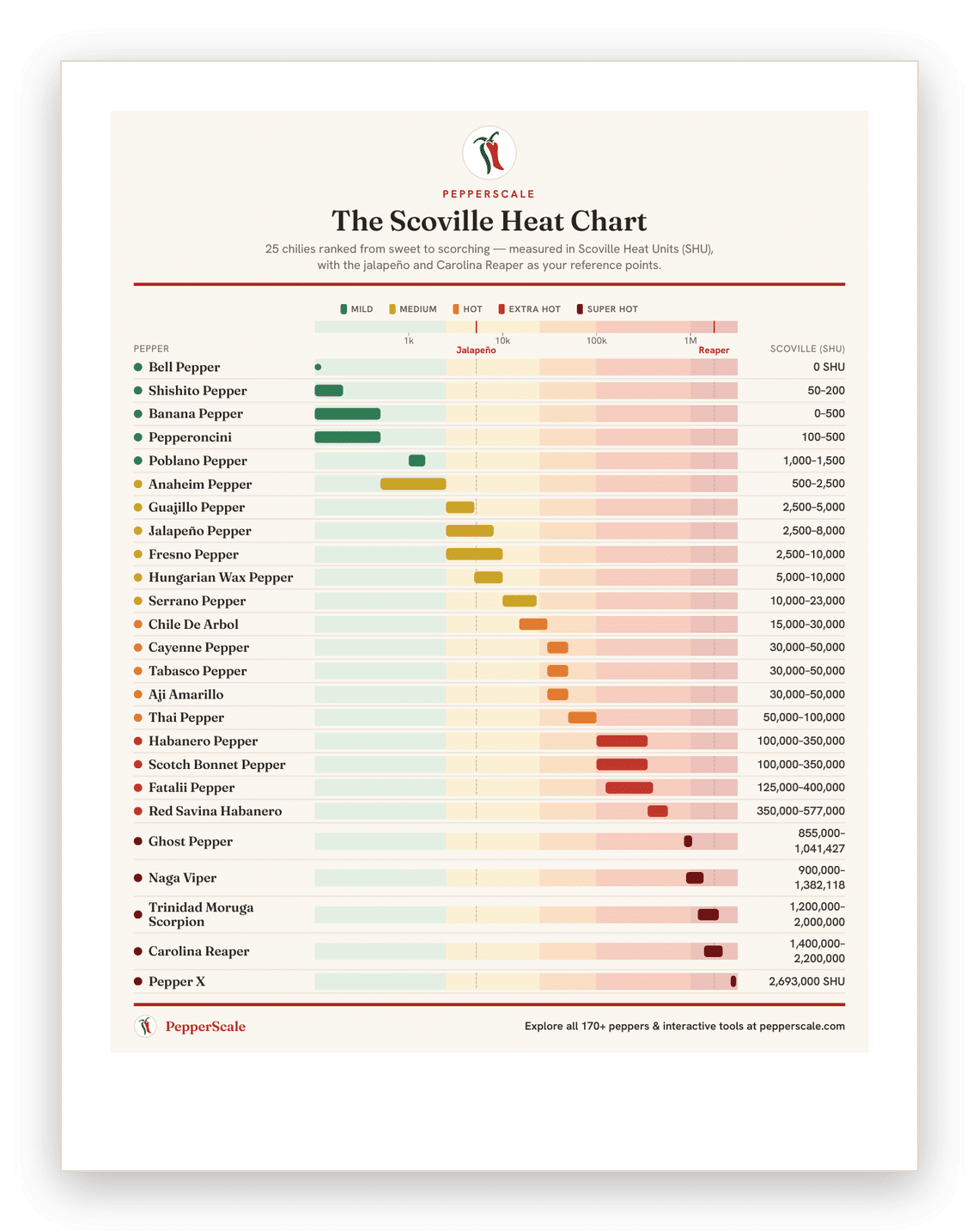
Get the free PepperScale Scoville Heat Chart
A printable, at-a-glance ranking of 25 chilies from sweet to scorching — with the jalapeño and Carolina Reaper as your reference points. Join the newsletter and we’ll send it straight to your inbox.
No spam — just Wicked Wednesday recipes and occasional extra dashes of chili pepper inspiration. Unsubscribe anytime.
Related reading
- Paprika Nutrition: How Healthy Is It?: The milder red pepper spice, by the teaspoon.
- Ghost Pepper Nutrition: How Healthy Are They?: What a superhot offers, and how little of it anyone eats.
- Is Hot Sauce Good For You?: What a few dashes do and don’t give you.