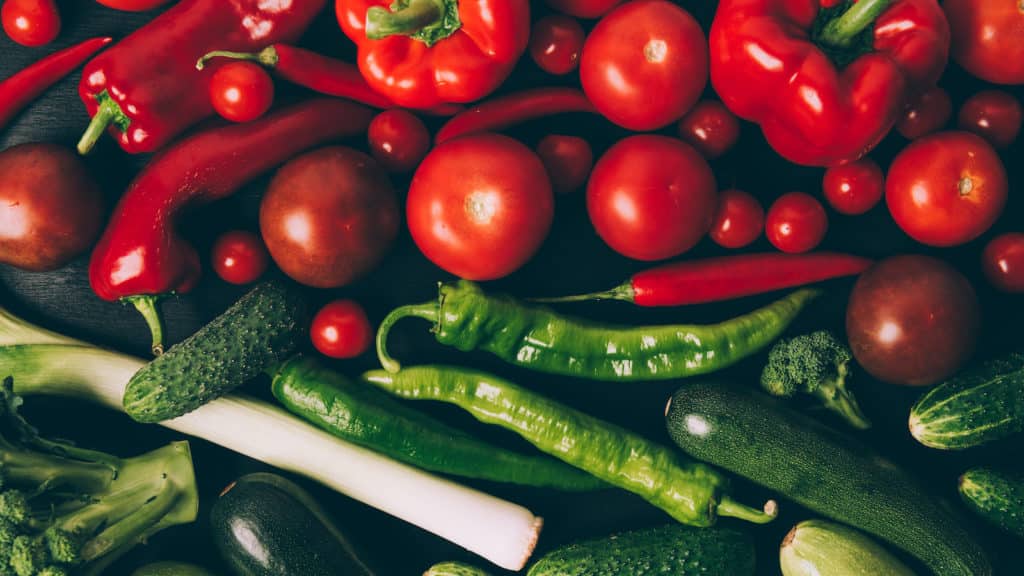
When you think of fruit, apples, peaches, and pears come to mind. But how about chili peppers? They should. A chili pepper is the fruit of a Capsicum plant, and to a botanist it’s a berry, even though we cook it like a vegetable.
What is a chili pepper?
A chili pepper is the fruit of a plant in the genus Capsicum, which belongs to the nightshade family along with tomatoes, potatoes and eggplants. The genus holds dozens of wild species, and people domesticated five of them. Every pepper you’ll find at the store, from a sweet bell to a Carolina Reaper, comes from one of those five.
Chilies get their heat from capsaicin, a compound the plant makes in the pale pith inside the pod. Bell peppers are the exception. They’re the same species as the jalapeño, but they carry a broken copy of the gene that makes capsaicin, so they rate a zero on the Scoville scale.
The name’s a bit of a mix-up. “Chili” comes from chīlli, the word in Nahuatl, the language of the Aztecs. “Pepper” came from Christopher Columbus and his crew, who called the fruits pimientos because they were pungent like black pepper (Wikipedia). The two aren’t related. Black pepper is the dried fruit of a flowering vine called Piper nigrum.
You’ll see it spelled chili, chile or chilli depending on where you are, and our chili vs. chile breakdown sorts out which is which.
Is a chili pepper a fruit or a vegetable?
That’s right: chili peppers are technically a fruit. That may seem to defy logic; chili peppers, after all, are really not that sweet. Sorry habanero, datil, and scotch bonnets: you may be sweeter than other chilies, but your sweetness is nothing compared to the peaches and apples of the world.
Plus, you typically find hot peppers among other vegetables like onions and leafy greens when you hit the produce section of your local grocer. So what gives?
Oh, those nightshades
They are one of the infamous “fruits that look like a vegetable” class of produce which includes the likes of the tomato and the eggplant. What do these two and the chili pepper have in common? They are the fruits of flowering plants from the nightshade family. Vegetables, on the other hand, are parts of plants like leaves and roots. Another clue: vegetables typically don’t have seeds, while fruits, like chili peppers and tomatoes as well as pears and apples, do.
It comes to life more when you consider ornamental chilies like the Black Pearl pepper. These chilies are shaped more like a berry and the plant itself blooms beautiful purple flowers. It has a more consistent fruit-like appearance than other types of hot peppers.
The kitchen view has a court ruling behind it, too. In 1893, the US Supreme Court decided in Nix v. Hedden that tomatoes count as vegetables for tariff purposes, because they’re served with dinner and not as dessert, while agreeing that botanically they’re a fruit. Chili peppers are in the same boat: a fruit to a botanist and a vegetable to a cook.
So don’t be fooled by the taste and produce aisle placement: the answer to “Are chili peppers a fruit?” is a resounding yes. Yes, it’s a fruit most often eaten like a vegetable, but a fruit nonetheless. It really does make you consider the sly sweetness that pops up with some of the peppers on the Scoville scale. That touch of fruitiness definitely hints at the hidden truth.
Is a chili pepper a berry?
Yes. To a botanist, a berry is a fleshy fruit that grows from a single flower with one ovary, and a chili fits that description. So do tomatoes, eggplants, cucumbers, grapes and bananas. Strawberries and raspberries don’t, despite their names.
So the next time someone calls a habanero a berry, they’re right. It’s just a berry you’ll want to handle with gloves.
Where do chili peppers come from?
The genus got its start in South America. A 2016 study in Annals of Botany places its origin along the Andes, in the west and northwest of the continent. People then domesticated five species separately, in different places. The most widely grown, Capsicum annuum, was domesticated in central-east Mexico more than 6,000 years ago, according to research published in PNAS that combined genetics, archaeology, linguistics and ecology.
Chilies didn’t leave the Americas until Columbus. After his voyages they reached Spain, and by the mid-1500s they were a common garden plant there. Portuguese traders carried them on to Africa, Arabia and their trading posts in Asia, including Goa in India. Today China grows about 39% of the world’s green chilies and peppers, and India another 12%, going by 2024 figures cited on Wikipedia.
What are the different types of chili peppers?
Those five domesticated species cover every chili you’ll cook with. Here’s how the 176 peppers we’ve profiled to date break down:
| Species | Peppers you’ll know | Peppers we’ve profiled |
|---|---|---|
| Capsicum annuum | Bell pepper, jalapeño, cayenne, poblano, Black Pearl | 109 |
| Capsicum chinense | Habanero, scotch bonnet, datil, ghost pepper, Carolina Reaper, Pepper X | 49 |
| Capsicum baccatum | Aji amarillo, aji panca, lemon drop | 12 |
| Capsicum frutescens | Tabasco, malagueta, peri-peri | 4 |
| Capsicum pubescens | Rocoto, manzano | 2 |
Annuum’s the everyday species, and it covers most of what’s in a supermarket produce aisle. Chinense is where you’ll find the extreme heat. The ghost pepper, the Carolina Reaper and Pepper X all belong to it.
How hot are chili peppers?
Anywhere from zero to painful. A bell pepper rates 0 Scoville heat units, a jalapeño runs 2,500 to 8,000, a habanero 100,000 to 350,000, and Pepper X, the hottest on record, hits 2,693,000. Our guide to the Scoville scale explains how that heat gets measured.
Knowing where the heat is helps in the kitchen. Most of it’s in the pith that holds the seeds, so knowing your way around a pepper is how you control it. Cut out the pith and you’ll take out most of the fire.
Are chili peppers good for you?
A quick note first: we know chili peppers, but we’re not doctors, so run anything health-related by yours.
With that said, chilies don’t bring many calories, about 40 per 100 grams, and they’re a rich source of vitamin C and vitamin B6 (Wikipedia). Our look at vitamin C in peppers has more on that one. For the capsaicin side of the story, including which health claims hold up and which don’t, see our capsaicin guide.
How do you use chili peppers?
Just about every way you can think of. Fresh chilies go into salsas, stir-fries and pickles. Dried ones get rehydrated for sauces or ground into powders and flakes. Smoke-dry a jalapeño and you’ve got a chipotle. And plenty of them end up in hot sauce.
If you’re shopping, our guide to common peppers at the supermarket is a good place to start. If you’ve grown more than you can use, here’s how to go about preserving chili peppers.
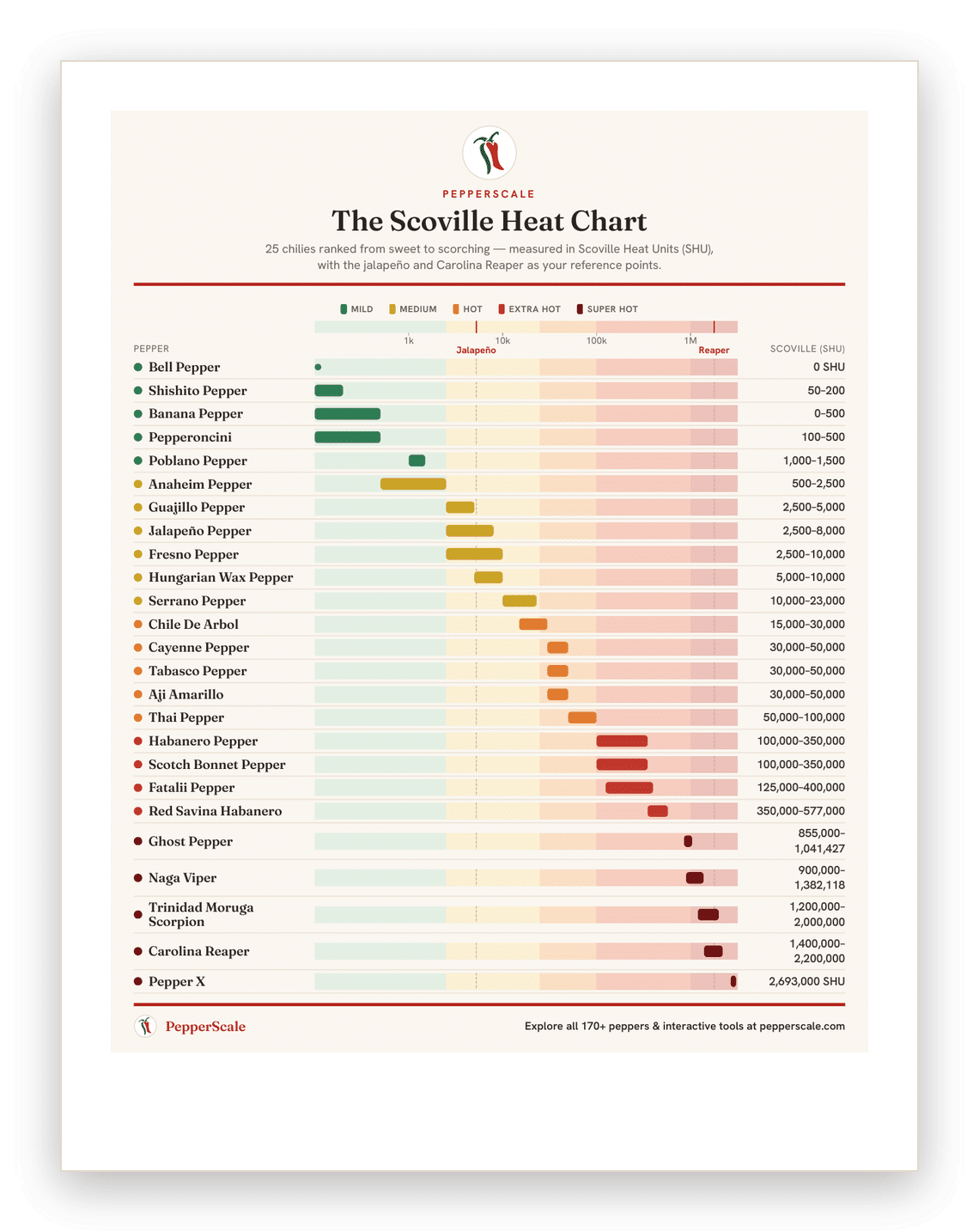
Get the free PepperScale Scoville Heat Chart
A printable, at-a-glance ranking of 25 chilies from sweet to scorching — with the jalapeño and Carolina Reaper as your reference points. Join the newsletter and we’ll send it straight to your inbox.
No spam — just Wicked Wednesday recipes and occasional extra dashes of chili pepper inspiration. Unsubscribe anytime.
Related reading
- The Hot Pepper List: More than 150 chilies you can sort by heat, flavor and how you’d use them.
- Why Are Bell Peppers Different Colors?: Green is usually just an unripe red, and here’s how color changes the flavor.
- What Are Heirloom Peppers?: What makes a pepper an heirloom, and why it means you can save the seeds.