Every city that is famous for spicy food has a story about how the heat got there. Outside the Americas, that story cannot be older than about 500 years, because chilies only crossed the oceans after Columbus. In that time, some places took a pepper so completely to heart that it now carries their name, their legal protection and their biggest party of the year.
So which cities make the cut, and where should you go if you love heat? We used the same scorecard as our look at America’s chili capitals, adjusted for a bigger map. Chengdu and Nabeul tick the most boxes, with Espelette, Mérida, Hungary’s paprika towns and Jamaica’s jerk country close behind, and New Mexico’s Hatch Valley flies the flag for the US. Then come the cities built on one fiery dish, from Chongqing’s hot pot to Puebla’s mole, and two villages that gave the world a superhot.
How did we choose these cities?
Is there a world ranking of how much chili each city eats? There isn’t, so we built this list from things you can check for yourself. Every city was looked at for five markers:
- A local pepper or chili product, like a named pepper, paste or seasoning tied to the place.
- A protected name, meaning a geographical indication or designation of origin that only producers from that area can use.
- A tradition on record before 1900, going by the oldest date you can trace in the records.
- Heritage recognition, like a UNESCO listing or a national heritage title.
- A festival that’s still running.
For the US version, we also checked search data. That doesn’t work worldwide: Google is blocked in mainland China, and people search in dozens of languages. So you will not find a search column here.
How do the tiers work? Tier one holds the chili capitals, places you would know by their pepper or chili paste. Tier two holds the cities known for one famous dish or event. Tier three holds two villages that gave the world a superhot. We never totaled the checks.
The scorecard
Below are all nineteen cities side by side. Each check marks a box the city fills, and each city’s section has the dates and sources if you want to dig in. Should you treat the checks as a score? No. Chongqing has none, and few cities are more famous for heat.
| City | Tier | Local pepper or chili product | Protected name | On record before 1900 | Heritage recognition | Festival |
|---|---|---|---|---|---|---|
| Chengdu, China | 1 | ✓ | ✓ | ✓ | ✓ | |
| Nabeul, Tunisia | 1 | ✓ | ✓ | ✓ | ✓ | |
| Espelette, France | 1 | ✓ | ✓ | ✓ | ||
| Mérida, Mexico | 1 | ✓ | ✓ | ✓ | ||
| Kalocsa and Szeged, Hungary | 1 | ✓ | ✓ | ✓ | ||
| Herbón and Padrón, Spain | 1 | ✓ | ✓ | ✓ | ||
| Şanlıurfa, Turkey | 1 | ✓ | ✓ | |||
| Guntur, India | 1 | ✓ | ✓ | |||
| Arequipa, Peru | 1 | ✓ | ✓ | |||
| Sunchang, South Korea | 1 | ✓ | ✓ | |||
| Hatch and Las Cruces, United States | 1 | ✓ | ✓ | |||
| Chongqing, China | 2 | |||||
| Changsha, China | 2 | ✓ | ||||
| Puebla, Mexico | 2 | ✓ | ✓ | |||
| Padang, Indonesia | 2 | |||||
| Boston Bay, Jamaica | 2 | ✓ | ✓ | ✓ | ||
| Diamante, Italy | 2 | ✓ | ✓ | |||
| Moruga, Trinidad and Tobago | 3 | ✓ | ||||
| Kohima, India | 3 | ✓ | ✓ |
Tier one: the world’s chili capitals
Chengdu, China
Why does Chengdu top the list? The capital of Sichuan province was the first city in Asia named a UNESCO City of Gastronomy, in February 2010, according to Beijing Review. If you’ve eaten Sichuan food, you know its signature: ma la, the numbing tingle of Sichuan peppercorns paired with the heat of chilies like the facing heaven pepper.
Chengdu also gave the world mapo tofu, usually traced to a restaurant run by a woman nicknamed Chen Mapo in the 1860s or 1870s. And its suburb of Pixian, now the Pidu district, makes the most famous version of doubanjiang, a fermented chili bean paste protected as a geographical indication in China. Chilies probably reached Sichuan from India or Macau in the late 1600s or early 1700s, so Sichuan’s chili tradition is younger than you might guess.
Nabeul, Tunisia
Nabeul, on Tunisia’s Cap Bon peninsula, is the main center for harissa, the chili paste at the heart of Tunisian cooking. In 2022, UNESCO added harissa and the practices around it to its list of the intangible cultural heritage of humanity.
How long has Nabeul been making it, you might ask? Most accounts point to the 16th century, tied either to the Spanish occupation of the coast or to Andalusian settlers, and they differ on the details. The city still celebrates it every year with the Nabeul Harissa Festival. Want to make it at home? Try our homemade harissa.
Espelette, France
Espelette is a small village in the French Basque Country, and its pepper is a quiet one. How hot is the Espelette pepper? Only about 500 to 4,000 SHU, so you get warmth more than fire. But few peppers are better protected. Piment d’Espelette got French AOC status in 2000 and European PDO status in 2002.
Each October since 1968, the village has thrown a pepper festival on the last weekend of the month. Chilies reached France in the 16th century, but we could not find a date for when Espelette’s own story starts on record, so the scorecard leaves that box blank.
Mérida, Mexico
Mérida is the capital of Yucatán, and the Yucatán Peninsula is the world’s biggest producer of the habanero. In 2010, Mexico gave the peninsula’s habanero its own denomination of origin. In Mérida, you’ll find habaneros with most dishes, served on the side or puréed, and local hot sauces lean on regional chilies like the xcatik and the habanero.
Mexican cooking in general has UNESCO recognition, too. Traditional Mexican cuisine joined the list in 2010, and its listing describes a food system built on corn, beans and chili.
Kalocsa and Szeged, Hungary
Kalocsa and Szeged are Hungary’s two paprika towns, and each has its own European protected name for ground paprika: Szeged since 2010 and Kalocsa since 2012. Kalocsa even has a paprika museum. Our guide to Hungarian paprika covers the grades, from sweet to the hot grade, erős.
Is it spicy food, though? It used to be. Central European paprika was hot until the 1920s, when a Szeged breeder found a plant with sweet fruit. Either way, the tradition goes back a long way. Kalocsa’s PDO specification says paprika has been grown there since the early 1700s.
Herbón and Padrón, Spain
The Padrón pepper comes from Herbón, a parish in the municipality of Padrón in Galicia. Local history says the peppers were first planted at Herbón’s Franciscan convent, though we could not find a date we trust for that. The EU has protected the name Pemento de Herbón since 2010.
These are mild peppers, around 500 to 2,500 SHU, but they come with a famous gamble. The Galician saying goes “Os pementos de Padrón, uns pican e outros non”: some are hot, and some are not. You never know which one you’re about to bite. Herbón has held its pepper festival on the first Saturday of August every year since 1978.
Şanlıurfa, Turkey
Şanlıurfa, in southeastern Turkey, makes isot, which you’ll usually see sold abroad as Urfa biber. The peppers are sun-dried by day and wrapped tightly at night, a step called sweating, for about a week. Urfa isot is a protected geographical indication in Turkey.
Its better-known neighbor has had a rougher time. Aleppo pepper takes its name from the Syrian city, and the Syrian civil war sent its exports into a steep drop.
Guntur, India
What does a chili town look like? Guntur, in the Indian state of Andhra Pradesh, is a good answer, because it is a market town built on chilies. Its chili market yard is described as the largest in Asia, with yearly sales passing ₹10,000 crore in 2023. The local Guntur Sannam chili was registered as a geographical indication in 2010 to 2011, and if you want a taste of the region’s cooking, try our Andhra chicken curry.
If Guntur is about heat, Byadgi in Karnataka is about color. The Byadgi chili got its own geographical indication in 2011 and is prized for its deep red color.
Arequipa, Peru
Arequipa, in southern Peru, is rocoto country. Its picanterías, traditional restaurants serving spicy local food, were declared part of Peru’s national cultural heritage in April 2014. Order rocoto relleno there and you will get a stuffed rocoto, a thick-walled pepper at 30,000 to 100,000 SHU.
Sunchang, South Korea
Sunchang, a county town in southwestern South Korea, is famous for gochujang, the fermented chili paste. Sunchang traditional gochujang is a protected geographical indication, and the UK has recognized the name since 2020 under its trade deal with Korea. The county even built a gochujang village, which opened in 1997.
There is a famous legend, too: Korea’s first Joseon king is said to have eaten gochujang in Sunchang in the 14th century. But the earliest Korean mention of chilies we found dates to 1614, and gochujang made with chili shows up in 18th-century books. So whatever the king ate, it wasn’t today’s gochujang. Our guide to what gochujang is covers the rest.
Hatch and Las Cruces, United States
The US gets one spot in tier one, and it goes to New Mexico. If you have ever bought roasted green chilies in the Southwest, you have probably heard of Hatch. The village, home to about 1,600 people, calls itself the Chile Capital of the World, and its long green Hatch chilies run about 1,000 to 8,000 SHU. Down the road in Las Cruces, New Mexico State University released the chili variety New Mexico No. 9 in 1913, and Hatch has held a chili festival on Labor Day weekend since the early 1970s.
So why only two checks? New Mexico law does stop sellers from calling chilies New Mexican unless they were grown there or say otherwise, but that is a state labeling rule, not a protected origin like Espelette’s. And 1913 just misses our 1900 cutoff, even if chilies were grown in the region long before anyone wrote it down.
Tier two: one dish, one obsession
Chongqing and Changsha, China
Chongqing doesn’t tick a single box, and yet you can hardly talk about spicy food without it. Its numbing, chili-red hot pot is usually traced to dock workers and riverside peddlers along the Yangtze in the early 20th century, though the exact story varies. Chongqing shows why we didn’t add up the checks: a scorecard can only count what has been written down and protected.
Changsha, the capital of Hunan, makes the other half of China’s hot food. Hunan cooking is known as gan la, or dry and spicy, and it is often hotter by pure chili content than Sichuan’s. Chilies show up in Hunan’s local records as early as 1684, and one of the province’s signature dishes is a steamed fish head buried in chopped chilies.
Puebla, Mexico
The poblano pepper comes from around Puebla, and its name means someone or something from the city. It is mild, at 1,000 to 1,500 SHU, but Puebla’s most famous dishes are built on chilies. Mole poblano is said to have been invented in one of the city’s convents, though historians say there isn’t enough evidence to know which, or when. Chiles en nogada is said to have been created for the future emperor Agustín de Iturbide, but that is a story, too. Want to try a shortcut version? Here is our easy mole sauce.
Padang, Indonesia
Padang, on Sumatra, lends its name to a cuisine. Padang food is famous across Indonesia for coconut milk and lots of chili, and Minang cooking rests on three things: curry, chili and rice. There is no protected name or festival you could point to, but how many cities have a national cuisine named for them? If you have eaten rendang, you have eaten Padang’s cooking.
Boston Bay, Jamaica
Jamaica’s jerk has deep roots. The technique came from the island’s Indigenous Taíno people and was adopted by Maroons in the 17th century. Boston Bay, in Portland Parish, has long been called jerk’s capital. Caribbean Beat traced the first commercial jerk pork stand there to the 1930s.
Its heat comes from the Scotch bonnet, at 100,000 to 350,000 SHU. Jamaica registered Jamaica Jerk as a geographical indication in 2015. You can get close at home with our homemade jerk seasoning.
Diamante, Italy
Diamante, on Calabria’s coast, is Italy’s chili town. Its Peperoncino Festival started in the early 1990s, founded by Enzo Monaco of the Accademia Italiana del Peperoncino, and it runs for a week in early September, by one account. The star is the Calabrian chili, at 25,000 to 40,000 SHU.
Tier three: birthplaces of the superhots
Moruga, Trinidad and Tobago
How hot can a village’s pepper get? Moruga is a village in southern Trinidad, and it is the home of the Trinidad Moruga Scorpion. In 2012, New Mexico State University’s Chile Pepper Institute named it the hottest pepper at the time, with an average of about 1.2 million SHU. Our data puts it at 1.2 to 2 million.
Kohima, India
Kohima is the capital of Nagaland, in India’s far northeast, and the state’s own superhot is the Naga mircha, better known as the ghost pepper. Nagaland registered Naga mircha as a geographical indication in 2008 to 2009. Guinness named the ghost pepper the world’s hottest in 2007, and it has been passed several times since. You can see how far it has fallen on our hottest peppers list.
What about other American cities?
Several other US cities would earn a check or two on this scorecard. Tucson and San Antonio hold the same UNESCO City of Gastronomy title as Chengdu, from 2015 and 2017. On Avery Island in Louisiana, Tabasco’s first commercial pepper crop dates to 1868, though the name is a trademark rather than a protected origin.
Then there’s St. Augustine and its datil, Pueblo and its Mirasol, and Nashville’s hot chicken. Want to see how they all stack up? Our list of America’s chili capitals runs the full US scorecard.
Why aren’t Bangkok, Seoul or Mexico City on the list?
Some of the spiciest food in the world does not belong to one city. Bangkok, Seoul, Mexico City and Addis Ababa all serve serious heat, but it is national heat, not a local pepper or a local dish. Korea’s kimchi tradition is on UNESCO’s list as kimjang, for example, and that listing covers all of Korea.
Bhutan is the clearest case. Ema datshi, chilies stewed with cheese, is often called the national dish, and chilies are a staple of Thimphu’s markets. But it is the country’s dish, not the capital’s. If you want the country-level picture, our look at which countries have the spiciest food compares them using consumption and recipe data.
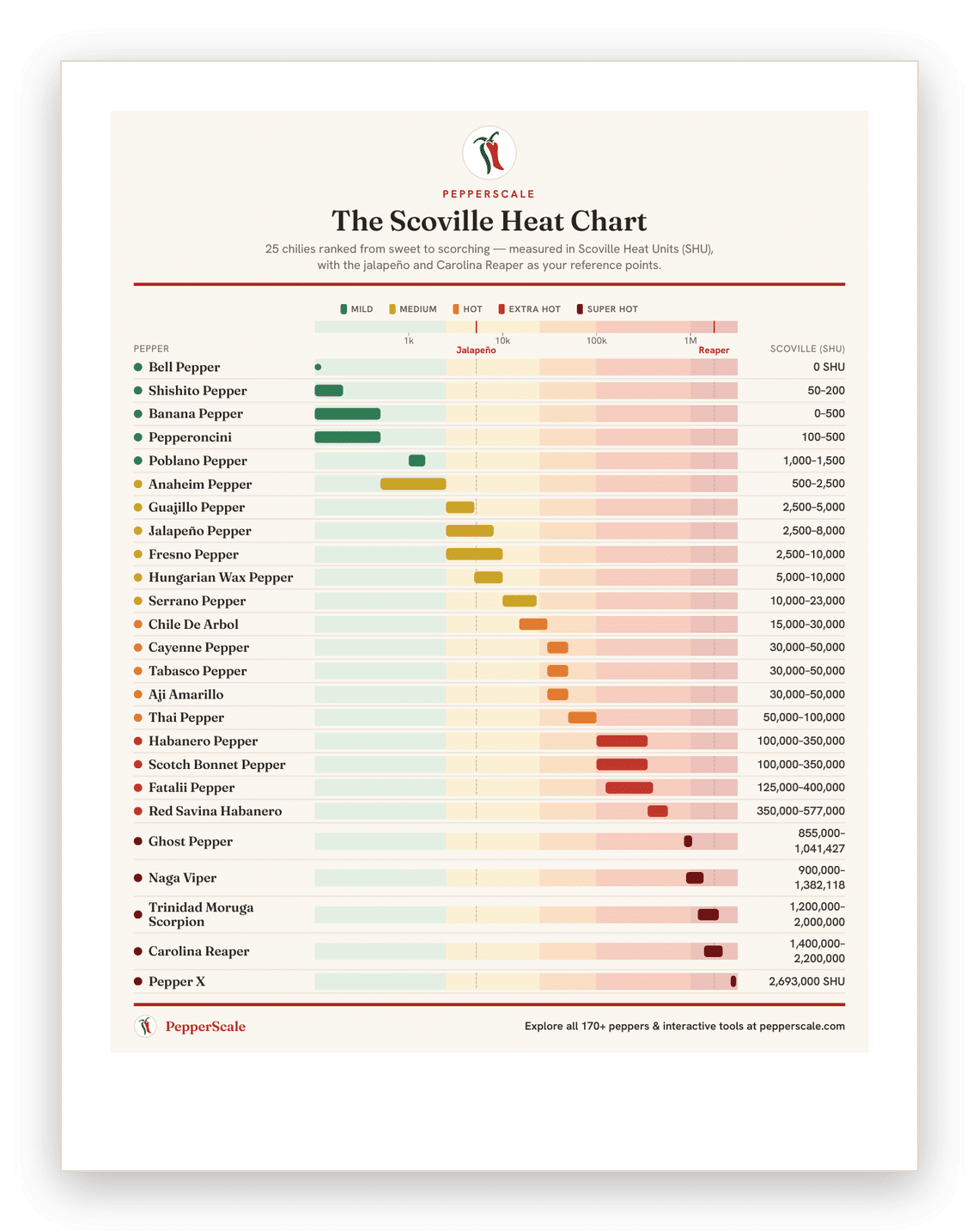
Get the free PepperScale Scoville Heat Chart
A printable, at-a-glance ranking of 25 chilies from sweet to scorching — with the jalapeño and Carolina Reaper as your reference points. Join the newsletter and we’ll send it straight to your inbox.
No spam — just Wicked Wednesday recipes and occasional extra dashes of chili pepper inspiration. Unsubscribe anytime.
Related reading
- Chili Pepper History: Where Do Peppers Come From?: How chilies spread from the Americas to every city on this list.
- 10 Of The Spiciest Foods In The World You Should Know: The dishes worth traveling for.
- Why Do People Like Spicy Food? Behind The Love Of Heat: What keeps whole cities coming back for more.